
Three Bats Who Need To Step Up for the Reds To Remain in First
The Reds need to score more runs if they're going to keep winning, and that means getting more out of these three bats.
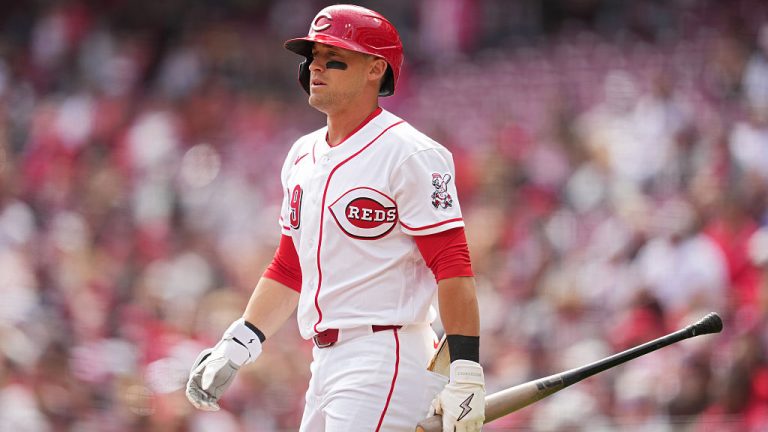
The Cincinnati Reds have jumped out to their best start in modern history, sitting atop the NL Central with an 18-10 record. They are beating tough teams, winning on the road, collecting walk-offs, you name it.
The emergence of Sal Stewart not only as one of the best rookies, but as one of the best players in baseball, paired with Elly De La Cruz, has made for a lethal three-four in the Reds lineup. Add in a bullpen that has been lights out, and you can see the semblance of a playoff team.
Wins are wins, no matter how you get them. I would be lying if I said there were no concerns with this team. Sure, timely hitting and clutch pitching deserve some credit, but I think we can all agree Cincinnati’s offense has not been up to par with most first-place teams.
As a team, the Reds currently rank 23rd in runs scored and 25th in wRC+ (88) and last in both categories amongst NL Central teams. Pitching carried them last season and could do so again in 2026, but the offense has to be better for the Reds to sustain their winning ways.
Like every team and every season, players are going to get hot and cold. We would all love for each player to be playing at their top level, but that is not a reasonable expectation. So, today I am going to highlight three players who must step up in order for the Reds to correct their offensive woes.
Stats updated prior to games on April 28.
TJ Friedl, Center Field
2026 Stats: .188/.278/.260, 1 HR, 52 wRC+
When this team is at its best, TJ Friedl is setting the table from the leadoff spot. Last season, Friedl was an important piece of the offense, posting a 109 wRC+ with a .365 OBP while adding 14 home runs.
A reliable bat that makes contact and puts the ball in play is something manager Terry Francona values in the leadoff spot, and Friedl has not been able to replicate that skill in 2026.
Friedl has always been near the bottom of the league in all of the different batted ball metrics. Hard-hit rate, barrel rate, and so on. His game is not impact, but contact. These types of profiles typically have a small margin of error due to a high reliance on one skill.
The good news? Friedl is still making elite contact. So far, he has posted a 94% zone contact rate, a career best and 12% above league average. The problem is that his contact has not translated into much success. Soft groundballs or lazy fly outs are not going to produce many runs.
When Frield is at his best (2023, 2025), he’s shooting line drives and leaning into a heavy pull approach that sneaks enough balls over the first baseman’s head or into the first two rows of Great American Ball Park’s seats.
Every year of his career, Friedl has posted a pull air percentage of 20% or higher. That’s essentially how often he pulls the ball in the air. This season, he is sitting at 9.3%. However, we are seeing some signs of improvement.
Over the weekend, we saw Friedl hit his first home run, pulling a mistake pitch down the middle into the fourth row at Great American Ball Park – a Friedl special. It might only be one swing and a bad pitch, but we have not seen many Friedl swings look that fluid all season.
Over the past week, Friedl has slashed .385/.385/.769 with two doubles and a home run. Possibly a sign of turning it around? Time will tell.
Cincinnati needs a consistent leadoff hitter to get on in front of De La Cruz and Stewart, and Friedl is the best option. Him figuring out his early-season flaws is crucial to getting the offense back on track.
Tyler Stephenson, Catcher

2026 Stats: .156/.286/.266, 2 HR, 57 wRC+
A streaky hitter who has had plenty of up and down moments as a Red but has been more productive than many may realize, Tyler Stephenson has 2,056 career PA with 65 HR and a .756 OPS.
For reference, De La Cruz has 1,948 at-bats with 69 home runs and a .782 OPS. Obviously, more goes into value here, and Elly’s a better player, but Stephenson’s bat is better than you may realize – not only in his career, but in 2026.
When you see a .156/.286/.266 slash with two home runs and a 57 wRC+, you probably don’t want to hear me talk about the positives. Too bad, because that’s where I’ll start.
Stephenson has excelled at making hard contact to start the year. A 95.2 mph average exit velocity is in the 98th percentile, and he is lifting the ball at a rate that should lead to success. By now, we all know Stephenson is not going to be a power hitter, and even reaching 20 home runs is unlikely. Where he excels is hard line drives to all areas of the field. So far, those hits aren’t landing.
The past three seasons, Stephenson has had a batting average on balls in play (BABIP) between .307 and .322, which is rather consistent. This season, he is currently at .205, which is the type of extreme outlier that should send an alert.
Regression to the mean will help Stephenson’s overall numbers and give the lineup depth, which they have lacked all season. The Reds do not need Stepheson to be a driver of offense, but instead what he has mostly been throughout his career, which is around league average.
Unlike at a few other positions, the Reds have no offensive hope outside of Stephenson. Jose Trevino and a slew of AAAA catchers offer little to nothing at the plate. Stephenson is the only option and hope for any type of production from the catcher’s spot, and that’s why it’s crucial he starts trending back to his career norms.
JJ Bleday, Outfield
2026 Stats: (1 G) 1-for-1, HR, BB
The first two names I discussed are struggling veterans not meeting expectations, but that’s not the only reason why a player needs to step up. If it’s not performance, it is opportunity, and JJ Bleday is staring at a golden one.
The Reds’ outfield issues are a topic that has been alive for years. By now, you know the gist: fourth outfield profiles with limited ceilings and defensive questions.
Cincinnati elected to have a competition in the corners this year, which resulted in Will Benson making the team and JJ Bleday landing in Triple-A Louisville. Now, Bleday is with the big club and should have an opportunity to cement himself as a regular.
The struggles of Benson are well-documented, and I think his time on the team could be short. Bleday is too similar a roster fit, and having both can be a bit wonky once Eugenio Suárez comes back. Bleday has proven himself at the major league level before and destroyed Triple-A pitching across 24 games to start this season.
A need for a lefty bat and outfielder gives Bleday an opportunity. Although it was only two plate appearances in one game, the patience at the plate was notable, as was the power he showed in his home run swing.
Does he need to be a middle-of-the-order answer? No. Any level of consistency and league-average performance would be a lift to this offense and the back third of the lineup. He already has the tools, and now he has the opportunity to show everyone he can be a starter at this level.
Final Thoughts
We are still working with relatively small samples that can be telling us lies. I know the Reds will not end the season with four starters under an 80 wRC+. I also don’t think the Reds can count on Stewart, De La Cruz, and, to a smaller extent, Nathaniel Lowe to continue at this elite pace.
Water finds its level. If the hot bats normalize, even to a 120-130 wRC+, others will need to step up in order for the Reds to not lose steam. To me, these three players are the key to the Reds achieving a more formidable offense and staying alive in the NL Central.
Become a Member of Just Baseball
Subscribe and upgrade to go ad-free!
* Save 25% by subscribing annually.

Written by