
How Has Michael Soroka Magically Rediscovered Himself?
It’s been a winding path to get here, but Soroka is finally trending toward a season he's long been waiting for.
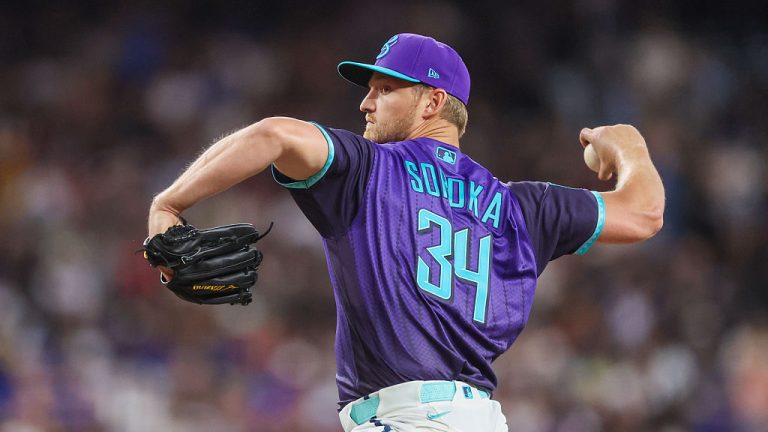
Michael Soroka was selected 28th overall in 2015 as a prep right-hander out of Canada. Now, in his age-28 season, he appears to be in the midst of a career year.
On the surface, that makes sense — former top prospect, peaking in his prime. But the path Soroka took to get here has been far more winding than that description suggests.
Soroka debuted in 2018 with the Atlanta Braves, the organization that drafted him. He burst onto the national scene in 2019 at just 21 years old, logging 174.2 innings with a 2.68 ERA and 3.45 FIP. He earned an All-Star selection, finished second in NL Rookie of the Year voting, and posted a 6.0 bWAR season—by every measure, a rising star.
In the shortened-2020 season, he looked poised to build on that breakout before tearing his Achilles. What followed was a brutal stretch.
An exploratory surgery in May 2021 revealed his body had rejected the sutures from the initial procedure. Then, in June 2021, he tore that same Achilles again — simply walking into the clubhouse. Three surgeries on the same Achilles in less than a year, all before he could rent a car.
Soroka missed his age-23 and age-24 seasons entirely. He returned to the majors in 2023 at 25, but the version of Soroka that once dominated never fully reappeared.
He bounced from Atlanta to the south side of Chicago, then to Washington, and eventually to the north side of Chicago. However, he never quite resembled the pitcher he had been at 21.
And yet, here we are. In 2026, a 28-year-old Soroka is once again one of the better pitchers in baseball through the first month of the season.
How does that happen?
Let’s find out.
Breaking Down Soroka’s Terriffic Start
During his dominant 2019 season, Soroka was a sinker-heavy pitcher, throwing it roughly 45% of the time, with his slider serving as his primary secondary. He mixed in a four-seamer up in the zone to change eye level and featured a changeup that often lived in the dead zone.
The formula was simple: generate ground balls at a high clip and work efficiently through lineups without relying on strikeouts.
Fast forward to 2026, and the arsenal looks entirely different — and so do the results.
His primary fastball is now the four-seamer (34% usage), closely paired with a breaking ball that Baseball Savant classifies as a “slurve” (33%). The pitch plays like a deeper version of his previous slider, and his ability to command it against both right- and left-handed hitters has turned it into a true weapon.
The changeup has also taken a step forward. It now features significantly more arm-side movement — nearly 17 inches of horizontal break with minimal vertical drop — and is deployed almost exclusively against left-handed hitters.
Against righties, Soroka leans heavily on the slurve and four-seamer combination, while mixing in sinkers on the inner half and a bridge cutter away to keep hitters from sitting on either primary offering.
The result is a fundamentally different pitcher. This reworked arsenal is driving the best whiff and strikeout rates of Soroka’s career — albeit in a small sample.
One of the primary issues for Soroka following his return from injury was command. He posted walk rates of eight percent in 2023 and 12.7% in 2024 — clear indicators that something in the delivery wasn’t syncing.
When Soroka returned in 2023, his arm angle sat around 41 degrees, closely mirroring the over-the-top slot he used during his 2019 breakout. But in each season since, that slot has steadily dropped — 37 degrees in 2024, 33 in 2025, and now down to 28 degrees in 2026.
So why move away from what once made him an All-Star?
A New Version of Soroka
Looking back at amateur footage from his time in Canada, the answer becomes clearer. As a prospect, Soroka worked from a noticeably lower slot with a slight crossfire delivery. While his current arm angle may not recreate the exact pitch shapes he featured in 2019, it appears to have unlocked something just as valuable: command.
The results support it. Soroka is posting his lowest walk rate since returning (6.5%) while simultaneously generating the highest strikeout rates of his career — 11.1 K/9 and a 30.1% strikeout rate, a mark that is well above his previous high of 25.1%.
That combination — more strikeouts and fewer walks — isn’t supposed to happen without a meaningful underlying change.
He’s also generating career-best chase and CSW rates (32.1% and 29.2%, respectively), further pointing to improved execution. It’s difficult to separate those gains from the adjustments to his delivery.
In many ways, Soroka appears to have tapped back into an earlier version of himself — the one that made him a coveted prep arm out of Canada. This time, with a more refined understanding of how to weaponize it.
Nothing is everything, but these mechanical and arsenal changes represent meaningful signal for Soroka.
Is he going to maintain a sub-3.00 ERA with a 4.67 K/BB ratio? Probably not. His fastball has been hit hard (average exit velocity around 98 mph), so some level of batted-ball regression is likely. But the underlying indicators are encouraging — his 3.00 FIP aligns closely with a 3.06 xFIP, suggesting this isn’t purely smoke and mirrors.
For context, Soroka posted a 3.85 xFIP during his 2019 breakout. This version of Soroka may not be the frontline arm he flashed at 21, but at 28, he may be settling into the prime of a sustainable mid-rotation starter.
For the Arizona Diamondbacks, that’s a lifeline. As they await the return of Corbin Burnes, Soroka’s emergence alongside Zac Gallen, Merrill Kelly, and Eduardo Rodríguez gives Arizona the framework for one of the deeper rotations in baseball once fully healthy.
More broadly, if Soroka sustains anything close to this level of performance, he’s positioned to cash in as a free agent entering his age-29 season.
It’s been a winding path to get here, but Michael Soroka finally appears to be trending toward something resembling the career he once envisioned as a teenager in Canada.
Become a Member of Just Baseball
Subscribe and upgrade to go ad-free!
* Save 25% by subscribing annually.

Written by