
Could Trevor Rogers Be a Nine-Figure Free Agent?
Rogers could be one of the more sought-after arms in a top-heavy free agent pitching class.
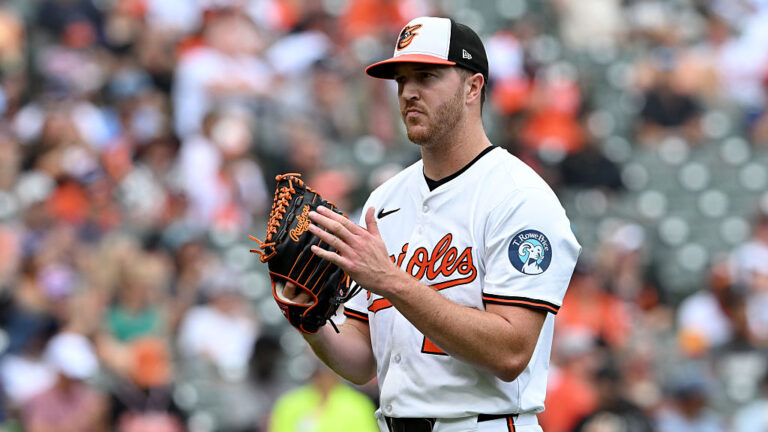
Not many players hit the free-agent market having already experienced the extreme peaks and valleys that Trevor Rogers has in his career. He is acquainted with navigating the challenges of overcoming failure and reaching lofty expectations.
When Rogers began his career, he looked like an ascending young ace. In his first full season, at age 23, the left-hander tossed 133 innings with a 2.64 ERA and earned an All-Star nomination. His season was cut short by back spasms, but it was thought he’d be a big piece for the Marlins moving forward.
Unfortunately for Rogers, the injuries didn’t stop there. Additional back spasms cost him time in 2022, and his season ended prematurely due to a lat strain in September of that season. In 2023, Rogers threw just 18 innings. He strained his left bicep in April, then partially tore his lat while rehabbing the bicep injury.
The 2024 season was not a success in the scorebook, though Rogers threw 124.1 innings. He was dealt to the Orioles at the trade deadline, and Baltimore offered him a change of scenery after a litany of previous injuries in his career.
That transition didn’t go so well at first. Rogers offered no help to the O’s down the stretch, throwing 18 innings with a 7.11 ERA. He didn’t make the club’s Opening Day roster in 2025 and owned a 5.51 ERA in Triple-A Norfolk by June.
At this point, Kyle Stowers, part of Miami’s return for Rogers, was starting to perform like an All-Star. This trade was looking like a heist for the Marlins.
But when Rogers returned to the big leagues that season, the results were nothing short of shocking. The southpaw was brilliant, tossing 109.2 innings with a 1.81 ERA, earning 3.3 fWAR. He was one of the best starters in that span and stabilized a subpar Orioles rotation in dire need of impact arms.
So far in 2026, that success has continued. Rogers owns a 3.04 ERA in 23.2 innings, with a 2.49 xERA and 20 strikeouts. (This piece was written prior to Rogers’ start on April 19.) He was given the Opening Day nod by the O’s and has functioned as the team’s ace to this point.
With Rogers due to hit free agency this winter in a top-heavy pitching class, it’s not unreasonable to say that he could be one of the most sought-after arms.
Why Should Teams Believe in Rogers?
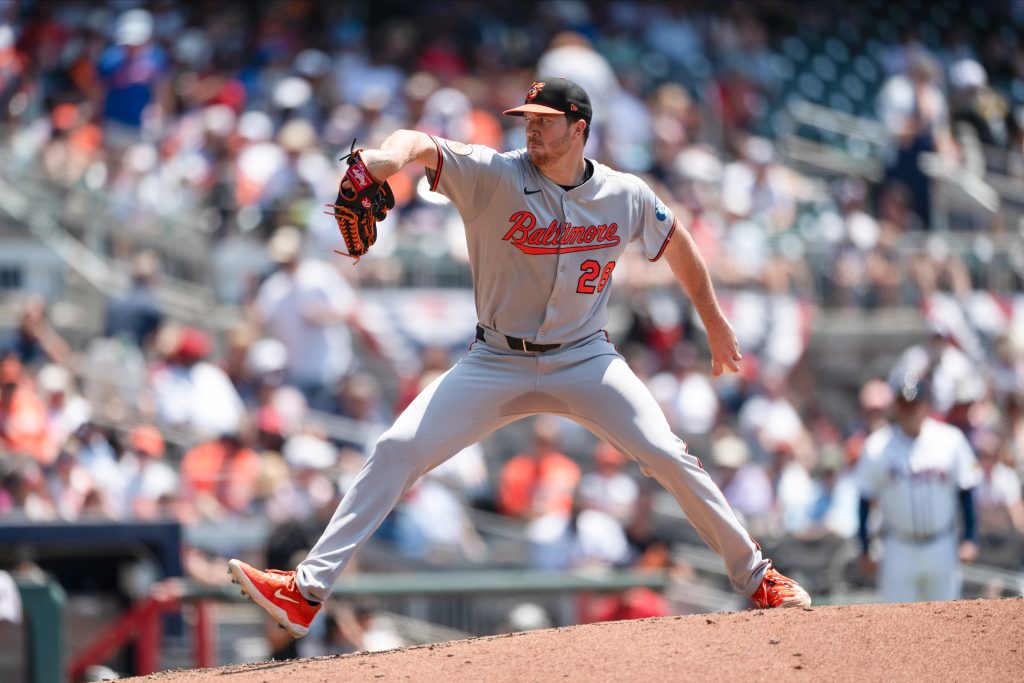
The main reason that big league clubs could talk themselves into giving Rogers a large multi-year deal in free agency is his effectiveness since his re-emergence. We now have a 133.1-inning sample between the end of 2025 and the start of 2026 (prior to games on April 19), in which Rogers has managed a 2.03 ERA with just less than a strikeout per inning.
His biggest strength is his above-average command, which he leverages to ensure hitters aren’t able to do too much damage.
Last season, among pitchers who threw at least 100 innings, Rogers ranked 19th in the league in xwOBA against (.288), ahead of household names like Joe Ryan, Freddy Peralta, and Logan Webb. This year, Rogers is currently ninth in xwOBA against (.254), albeit in a small sample.
So far this season, Rogers’ barrel rate (2.8%) and hard-hit rate (28.2%) against are in the bottom-12th percentile in baseball, meaning he is limiting hard contact. The hard-hit rate is a great deal better than what we saw last season, as Rogers’ 48.8% hard-hit rate against was among the worst in the league for pitchers in 2025.
Another reason to believe that Rogers can continue to be effective is that he’s been able to get swings and misses at pitches in the zone. Last year, among pitchers with at least 100 innings, Rogers was 14th in baseball in in-zone whiff rate (20.2%), ahead of Bryan Woo and Jacob deGrom. This season, his 16.9% mark for that category is a bit of a drop-off, but it’s still a small sample.
Overall, to believe in Rogers is to believe in the results. He doesn’t have the stuff of a prototypical ace, but at what point is it no longer a fluke? Rogers is clearly a valuable big-league arm right now.
Why Should Teams Doubt Rogers?
Barring an utter collapse, there figures to be little doubt that Rogers can at least contribute like a mid-rotation starter down the road. I would imagine, however, that front offices will doubt whether he is worth a nine-figure deal.
Last season, in Rogers’ miracle 1.81 ERA campaign, he had luck on his side. A clear indicator of this was his incredibly low .226 BABIP, uncommon for even for the best pitchers in the game. Tarik Skubal, back-to-back AL Cy Young Award winner, saw his opposition hit .273 on balls in play in each of those seasons.
Another reason why Rogers’ .226 BABIP was so unusual was that he allowed hard-hit batted balls 48.8% of the time. What are the odds that so many hard-hit balls become outs? That was a super unusual, and ultimately, very beneficial outcome for Rogers. Simply put, more balls in play are going to be hits against Rogers this year. That will likely lead to more earned runs.
I could also imagine teams having a hard time viewing Rogers as a top-of-the-line starter because he doesn’t have some of the most common traits of an ace: throwing hard and getting a lot of strikeouts.
Rogers’ average fastball velocity stands at 92.6 mph this year, which is in the bottom 24% of qualified starters. His strikeout rate last year was a solid 24.3%, but it is down to 20.4% in 2026, which is in the bottom 32% of starters.
Strikeout rate minus walk rate (K-BB%) is one of the best predictors of future success for starting pitchers. Even in Rogers’ amazing season last year, his 17.5% K-BB% mark was 30th in baseball among pitchers who threw at least 100 innings. Certainly nothing to scoff at, though not necessarily elite.
There are real reasons to believe that regression is coming for Rogers this season and that he will not be an ace moving forward.
Early Free Agency Outlook
This offseason’s free-agent pitching class has some exciting names at the top, but not much depth. The cream of the crop is Skubal, who will be seeking a record-setting contract for any starting pitcher.
Once he’s off the board, Peralta is likely to be the next most desired option. After Peralta, Ryan (who has a $13 million mutual option he’s likely to decline) and Rogers should garner the most interest. Other pitchers like Michael King ($25 million opt-out) and Sonny Gray ($30 million mutual option) could join the class, but that depends on their performance this season.
Last offseason, only three pitchers received contracts worth upwards of $100 million in total value. Skubal, Peralta, and Ryan should be in that position this offseason, with Rogers aiming to prove himself worthy of earning that kind of sum.
The ideal outcome for Rogers would be to have another outstanding season, similar to Ranger Suárez when he entered free agency last year. He’s also a soft-tossing lefty with a low strikeout rate, but Suárez has been more durable.
While Rogers is unlikely to get the same five-year, $130 million deal as Suárez, that could be an upper-end negotiating point for his agent with another great campaign from Rogers.
Perhaps a more realistic outcome for Rogers would be signing a similar contract to Sean Manaea. In the 2024-25 offseason, Manaea received a three-year, $75 million deal from the New York Mets. He followed a similar path to Rogers in his career: breaking out early, struggling and being relegated to a bullpen role, then re-emerging as a solid starter before hitting free agency.
Baseball Savant’s player similarity map reveals that no left-handed pitcher was more similar to Rogers by velocity and movement than Manaea in 2025. Perhaps where there’s smoke, there’s fire, and Rogers ends up getting a three-to-four-year deal worth around $25 million AAV like Manaea.
To get that fourth year to push him over $100 million in total value, Rogers must fill up the zone, limit hard contact, and increase his strikeout rate in 2026. I’d bet against Rogers earning a nine-figure payday without these marked improvements.
Become a Member of Just Baseball
Subscribe and upgrade to go ad-free!
* Save 25% by subscribing annually.

Written by
Daniel Rotter follows the game of baseball with passion. He was the youngest participant in the inaugural year of The Great Fantasy Baseball Invitational, at 17…