
Three Things the Brewers Need To Improve
After a strong start to the season, the Brewers have hit a snag in recent weeks. Here's what they need to improve to get back to their winning ways.
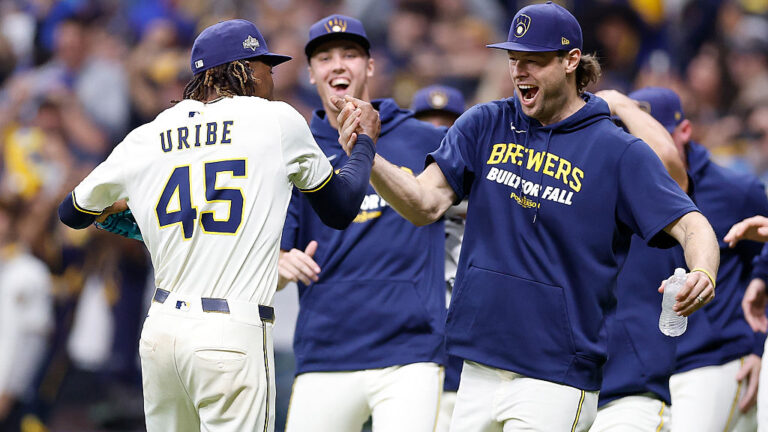
It’s already been a rather interesting season for the Milwaukee Brewers thus far. After getting off to a sensational start, the injuries are starting to pile up, and the team has hit a bit of a snag in recent weeks.
Starting the season 8-2, the Brewers then went on a six-game losing streak before winning their two most recent games against the Toronto Blue Jays. While it’s not all bad in Milwaukee, there are areas that need to be improved if they want to get back to their winning ways.
From figuring out who will be closing out games moving forward to getting more production from several key members of the lineup, here are three areas the Brewers need to improve to get back toward the top of the National League standings.
Stats were taken prior to play on April 17.
Bullpen Play
Simply put, the Brewers’ bullpen needs to be better moving forward. While the team’s bullpen ERA of 4.00 (15th in MLB) might not suggest that the sky is falling, this unit has been struggling as of late, and Pat Murphy’s “trust tree” is thinning out rather quickly.
Trevor Megill and his early-season struggles has been the storyline of the season so far for Milwaukee. Currently sporting an ERA of 12.00 in six innings of work, Megill’s implosion against the Nationals on April 10 coupled with another disastrous blown save in his following outing against the Blue Jays sounded the alarms.
Most notably, his four-seamer has lost two ticks when compared to last year. His inability to generate whiff with the heater, specifically in his two aforementioned blowup outings, has led to a plummeting strikeout rate. That, coupled with his inability to locate either of his two pitches, has been a recipe for disaster.
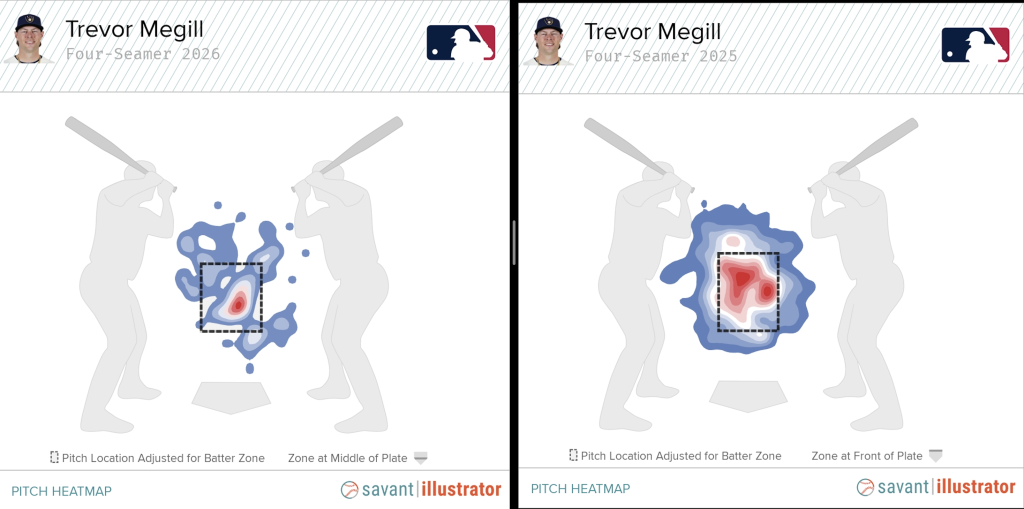
When Megill’s fastball is living at the top of the zone, it’s nearly impossible for hitters to catch up to. When he’s leaving it low and over the heart of the plate, on top of his diminished velocity, he’s a much less effective pitcher.
That is exactly what’s happening through his first few outings, which is highlighted in the images above. His four-seam is catching far too much of the zone, and hitters have teed off against it to the tune of a .429 batting average and .571 slugging percentage.
Murphy did not formally announce a closer change, but it is noteworthy that in each of the Brewers’ last two games, it was Abner Uribe and Angel Zerpa whom Murphy turned to in the save situations. Megill did come into the eighth inning in Thurdsay’s game, though, and looked sharp. At this point, anything to get his confidence back will go a long way.
Megill has a longer leash than some fans might think, but he will undeniably need to get his fastball back to its 2025 form in order for him to repeat his All-Star success.
This does beg the question: if not Megill, then who?
Well, there aren’t a whole lot of trustworthy names in Milwaukee’s bullpen at the moment that would warrant a sudden change at closer.
Uribe would be the next man up, but he hasn’t looked particularly flawless himself through his first eight appearances. Still, he’s earned the benefit of the doubt given the 2025 campaign he put together, and he looked quite sharp in getting the save in Wednesdays’ matchup. There’s a chance he gets more looks in the ninth rather than the eighth moving forward.
Zerpa, whom the Brewers acquired from Kansas City this offseason, has been solid outside of a blowup outing against the Nationals on April 12. With Jared Koenig on the shelf, Zerpa has claimed the seventh inning role and has already notched two saves on the young season.
He doesn’t strike out the world, but he is a ground-ball maestro, and the Brewers see great value in that. He’s been the go-to closer option in games where Megill and Uribe are unavailable, and fans could see more of that in the coming weeks.
Aaron Ashby has been a bona fide workhorse for this bullpen, already appearing in 10 games and racking up an MLB-leading five wins on the year. But as fans saw with Nick Mears last season, is that type of workload sustainable for a guy who has a lengthy history of injuries?
Perhaps, but it also means that guys like DL Hall and Grant Anderson need to deliver in the moments they’re called upon to provide some length out of the bullpen.
Point being, Milwaukee’s bullpen play has been a pillar of this team’s success over the years, and when it’s not firing on all cylinders, it creates a challenging ripple effect elsewhere.
Starters working deeper into games would go a long way in preserving this bullpen, and fans saw that this week with Chad Patrick and Brandon Sproat each going 6.2 innings in victories for Milwaukee. If the rotation can keep that up, it will have a positive impact on the rest of the pitching staff.
Production From the Back Half of the Order
This is where the injuries are starting to have a massive impact for Milwaukee, as the absences of Jackson Chourio, Christian Yelich, and Andrew Vaughn are forcing players who were supposed to be bench bats into starting roles.
That being said, those injured players are not expected back for at least another month, so the Brewers need to figure something out at the tail end of the order in the meantime. If they don’t, this offense will continue to struggle mightily.
Production from the back of the order was a key contributing factor to Milwaukee’s hot start. Recently, however, that production has taken a nosedive.
Since April 7, the day the Brewers started their six-game skid, hitters six through nine combined are dead last in MLB in batting average (.143), slugging percentage (.152), OPS (.383), wOBA (.188), and wRC+ (15). That’s nearly half of the batting order that is producing bottom-tier results, and it’s greatly hurting this offense.
Just for reference, from Opening Day through April 6 when the Brewers were 8-2 and sporting one of the best offenses in baseball, that same part of the order was 17th in OPS (.658), 13th in wRC+ (97), and 12th in wOBA (.314). Not otherworldly results, but a drop-off that dramatic has caused a major ripple effect on the consistency of this offense.
For the time being, Joey Ortiz is the team’s starting shortstop and simply needs to be better. Consistently hitting near the back of the order, he’s slashing just .204/.250/.204 for a .454 OPS and 32 wRC+.
Third base has been filled by Luis Rengifo, who is batting .125 with a -2 wRC+, and David Hamilton, who has a .586 OPS, and neither have taken advantage of the opportunity to carve out an everyday role to this point.
Perhaps the answer to this problem is more small ball, which is something that was on display in the Brewers’ two most recent games. In fact, it’s what sparked them to victory in both outings.
In Wednesday’s game, the offense was dormant until the eighth inning when Hamilton reached on an infield single and Sal Frelick reached on a swinging bunt. Both players ended up scoring on RBI singles and an RBI groundout to give Milwaukee the 2-1 win.
It was a similar story on Thursday, when the Brewers strung together a walk and three straight bunts to take the 2-1 lead in the seventh. It’s certainly not flashy, and it’s not a play style that is popular among all baseball fans, but it’s an offensive philosophy that the Brewers have mastered over the years and one that they have embraced.
With the margin for error being as small as it is with all the injuries the Brewers are dealing with, this is one way they can manufacture offensive production until the regulars return to the lineup.
If it works, it works, and the Brewers are in dire need of finding something that works with the back half of the lineup at the moment.
Situational Hitting
Situational hitting is something that is very fluid, and it can often dictate how well a team is performing over a certain stretch of time.
To start the year, the Brewers were coming through in the clutch time and time again. More recently, however, they’ve been prone to stranding baserunners in key situations.
The table below highlights the Brewers’ performance with runners in scoring position from Opening Day through April 6, when the team went 8-2, and from April 7 to April 17, a stretch in which the team is 2-6 and lost six straight games.
| Metric | March 26 – April 6 | April 7 – April 17 |
| BA | .339 (2nd) | .170 (26th) |
| OBP | .441 (1st) | .286 (25th) |
| SLG | .574 (3rd) | .358 (19th) |
| OPS | 1.015 (3rd) | .644 (22nd) |
| wOBA | .441 (3rd) | .267 (27th) |
| wRC+ | 178 (3rd) | 67 (27th) |
| K% | 18.8% (7th) | 29.2% (30th) |
The most noteworthy thing that stands out in the table above is the leap in strikeout rate when hitting with runners in scoring position. Putting the ball in play is the name of the game for the Brewers’ offense, and when they aren’t doing that — especially in crucial situations — it greatly limits what this offense is capable of.
For a lineup that struggles to slug, they need to put the ball in play in the right moments. Lately, they haven’t been doing that.
Understanding that we are only a few weeks into the season and that the sample sizes are inevitably small, this is still an important item to call out when assessing what has changed between Milwaukee’s strong start and their recent skid. Hitting with RISP is one of the key factors in the offense’s drop-off in production.
Similarly, if you watched the Brewers during their 8-2 start, you noticed that they always seemed to come through with two outs. They were pesky and relentless with each at-bat, and a lot of their production came with one out remaining in the inning.
However, the same cannot be said in recent weeks.
| Metric | March 26 – April 6 | April 7 – April 17 |
| BA | .307 (2nd) | .193 (23rd) |
| OBP | .423 (1st) | .302 (19th) |
| SLG | .579 ( 2nd) | .361 (14th) |
| OPS | 1.002 (2nd) | .664 (16th) |
| wOBA | .432 (2nd) | .288 (18th) |
| wRC+ | 173 (2nd) | 82 (18th) |
| K% | 21.9% (9th) | 25.0% (23rd) |
It’s been over a 100-point drop in batting average, on-base percentage, and slugging percentage when hitting with two outs, and nearly a 100-point difference in wRC+ from their hot start.
A lot of the conversation surrounding this offense is connected — the struggles in the back half of the order bleed into the lack of situational hitting. Not having the same length that they were getting early in the year is starting to take its toll.
While getting healthy will certainly help the offense, the Brewers will need to further lean into their identity to manufacture runs for the foreseeable future as they look to get back to their early-season form.
Become a Member of Just Baseball
Subscribe and upgrade to go ad-free!
* Save 25% by subscribing annually.

Written by
Joey Peterson is a graduate of the University of Wisconsin-Madison and an editor for Just Baseball. He covers the Milwaukee Brewers, along with general MLB topics…