
Connor Phillips Is Facing a Make-or-Break Year for the Reds
Phillips has the ability to become a very effective bullpen arm for the Reds, but will he realize that potential in 2026?
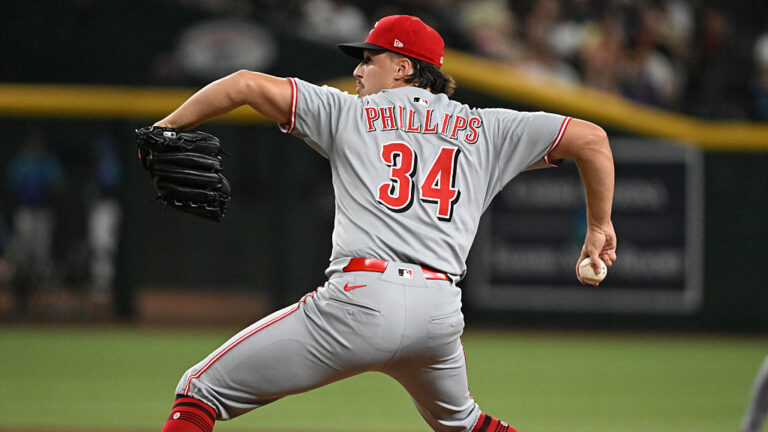
When Connor Phillips joined the Cincinnati Reds as part of the Jesse Winker and Eugenio Suárez trade with Seattle, he came with plenty of intrigue. A second-round pick with wicked stuff and high strikeout potential, Phillips quickly climbed prospect rankings before falling off most radars entirely.
Once Phillips hit Triple-A, he could no longer make up for his mistakes the same way he did in the lower minors. His command was completely lost. Every start came with a number of uncompetitive pitches and a higher reliance on his fastball, which snowballed quickly into an 8.01 ERA across 19 starts in 2024.
In some ways, Phillips looked like someone who needed time away. A chance to focus on getting his composure and confidence back to a level that would allow him to find a success.
After being a starter through his career, Phillips made the transition to the bullpen in 2025. A simplified role that allowed him to focus on one inning instead of five or six and an opportunity to let his stuff truly play up in shorter outings.
Although the results were a mixed bag, Phillips joined the Reds’ bullpen late in the 2025 season and flashed the potential that made him a highly-regarded prospect. Across 25 innings, he racked up 32 strikeouts, posted a 2.88 ERA, 3.82 FIP, and put himself on the radar for 2026.
The Good
If you have watched any amount of Connor Phillips in your life, then you know what gives him a high ceiling: his stuff. He features a three-pitch mix made up of a four-seamer, sweeper, and curveball that all tend to catch your eye at any given moment.
Moving from the rotation to the bullpen has allowed Phillips to fall more into a two-pitch mix, pairing his fastball with his sweeper. They’re two pitches that are good enough to find success in shorter outings and give him a chance at carving out a role in the Reds bullpen.
Let’s start with the sweeper, which is the pitch I think gives him the best chance to become a plus reliever.
Albeit a small sample, Phillips’ sweeper last season saw a 53.2% whiff rate and held batter to a .053 average allowing only two hits in 41 plate appearances. The numbers are tough to extrapolate over a 162-game season, but the changes we saw from years prior give me hope that the success can stick.

In 2025, Phillips dropped him arm angle from 48 degrees down to 40. The different slot allowed for the ball to come out of his hand closer to a three-quarters slot and caused his sweeper three inches more of lateral movement.
Considering he uses the pitch heavily against righties, the pitch was thrown toward the outside of the zone, and its late break missed bats or forced weak contact.
But the sweeper also has enough movement to fool lefties. I think the feel he has for the sweeper is better than his fastball, resulting in better command. However, the fastball has to be there in order for the sweeper to be effective.
Moving to the bullpen usually results in an increase of velocity, and that stayed true for Phillips as he saw a two-tick jump to 98.2 mph on the four-seamer. Phillips is able to work his velocity throughout the zone and allow the 13-mph difference in velocity from his sweeper to keep hitters off balance.
Any time you can sit 98 mph, you have a chance. An above-average induced vertical break (IVB) and improved horizontal movement give the pitch enough of a profile to truly be a weapon. If you have your doubts, just go back and watch.
I went back and watched all of the batters Phillips faced in 2025. All you need to do is watch the batters to understand how good his stuff is. He generates uncomfortable swings and freezes hitters because they thought a breaking ball was coming but instead had 98 blown past them.
There’s no doubt the ability is there. A 37.4% whiff rate is more than 10% better than league average, and that doesn’t happen by chance. Although the highlights pop, there’s more to the Connor Phillips story. Of course, something has caused him to spend so much time in the minors.
The Bad
Just as the 98-mph fastball and darting sweeper catch your eye, so does the lack of command. Unfortunately, this has been Phillips’ kryptonite throughout his entire career. No matter the level or league, Phillips has posted an alarmingly high walk rate at each stop.
Walking too many batters is what ultimately forced the move to the bullpen. I don’t need to run through all the reasons why walking 12-15% of batters is bad. I think that one is obvious. But, his command issues causes problems in other areas of his game.
Not every pitch needs to be a strike, but most pitches at least need to appear to look like a strike at some point. Getting batters to chase pitches is important, and the only way to do so is if the batter thinks a pitch is a strike at some point.
The video above highlights my greatest frustration with Phillips and the main reason why outings can get away from him. The amount of pitches he throws that are obviously missing the zone from the second it leaves his hand is concerning and makes everything else harder on him.
Giving a batter easy pitches to lay off will only get Phillips in more hitters counts and make landing the next pitch that much more crucial. All of the pitches in that video are ball four. Easy takes and a runner on base without enough of a challenge.
Command issues not only come into play with walking batters but also with missing your pitch locations. I don’t expect many pitchers to be perfect, but the margin of error is slim and Phillips will learn that the hard way.
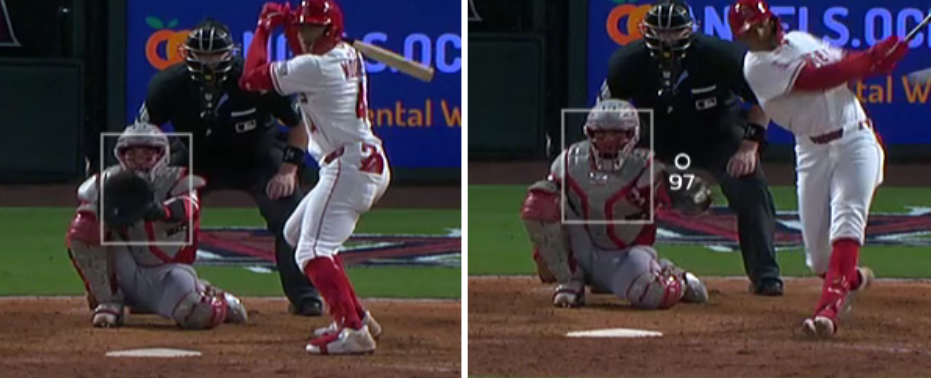
The picture above is one of numerous examples where Phillips was not in the same zip code as the called location. Trevino sets up for an outside pitch against Christian Moore only for the pitch to land a few inches inside, which would have been a ball, but Moore turned it into a single.
For certain pitchers, allowing contact is not too bad. We all know the crafty arms who produce a high ground-ball rate and generate soft contact to find success. Well, that’s not exactly how Phillips wins.
Last season, Phillips allowed an average exit velocity of 92.6 mph, which would rank near the bottom of the league.
The recipe for a bad Phillips outing is simple: If his stuff is not located well, it can catch too much of the pate and lead to hard contact. Combine that with a likely walk, and you have runs on the board quickly.
In order to find success, he’s going to need to induce ground balls at a higher rate and/or cut down on walks. I’d lean toward ground balls being the more likely of the two.
Running Out of Opportunity
Cincinnati made adding to the bullpen a priority this offseason. Pierce Johnson, Brock Burke, and Caleb Ferguson were all added to be fixtures in the bullpen proving that manager Terry Francona wanted proven veterans he could trust.
Last season, we saw Francona lean into Tony Santillan and Emilio Pagan in a big way down the stretch. Earning Tito’s trust, especially in big moments, will not be easy for Phillips.
How long will the leash be if Phillips is not throwing strikes? Does Francona see the upside and give him an opportunity to work through struggles, or does he pull the plug quickly?
Phillips does have one minor-league option left. If he is sent to the minors this season, he would have to pass through waivers in future seasons if he’s not on the active roster. The 40-man roster becomes crowded quickly, and Phillips will need to prove himself in order to stick.
Final Thoughts
You could tell me Connor Phillips finishes the year as one of the four most productive arms out of the Reds’ bullpen and I could believe you. You could also say he’s off the roster in the next couple of months and my belief would be the same.
Every team has a relief pitcher that flashes plus stuff and cannot command it. The harsh reality is there’s a threshold of throwing strikes a pitcher has to meet in order to stick in the league, and Phillips will need to prove he can get to that point.
Become a Member of Just Baseball
Subscribe and upgrade to go ad-free!
* Save 25% by subscribing annually.

Written by