
A Mathematical Case For a Top Prospect to Break Camp
At what point is it worth it for a team to roll the dice on a prospect, and when are they better off taking a more traditional approach to promotions?
As spring training gets underway, fans across Major League Baseball are tuning in to watch their favorite teams prepare for the upcoming season.
A major storyline every year is which top prospects will push the envelope and begin the season on their club’s Opening Day roster.
Unlike in years past, the most recent collective bargaining agreement incentivizes franchises to start their MLB-ready premium prospects in the big leagues, with the potential of receiving an additional top draft pick the following year. These selections are known as Prospect Promotion Incentive picks, or PPI picks.
Young stars Julio Rodríguez, Gunnar Henderson, Corbin Carroll, Bobby Witt Jr., Drake Baldwin, and Hunter Brown have each netted their teams such a selection. However, since the program was introduced in 2022, 40 total players have been eligible to yield their teams a pick, translating to a conversion rate of just 15%.
Given such a low success rate, the question is: At what point is it worth rolling the dice with a young prospect, as opposed to taking a more traditional stance on prospect promotion?
PPI Primer
According to MLB.com, the Prospect Promotion Incentive (PPI) is a rule designed to end “service time manipulation” by rewarding teams that carry their best prospects on the Opening Day roster. If these top prospects perform well enough to win or place for major awards, their team earns an additional high-value draft pick.
PPI picks occur at the end of the first round, with a player needing to fulfill the following requirements to earn his team a selection:
- A prospect must be ranked on at least two of the three major top 100 lists, which include the lists from MLB Pipeline, ESPN, and Baseball America.
- A prospect must accrue a full season of MLB service time, or 172 days on the active roster as a rookie.
- A prospect must either win his league’s Rookie of the Year Award or finish top three for MVP or Cy Young at any point through his first three years of team control.
Along with the above requirements, there are several caveats and restrictions:
- A team can only earn one PPI pick per year, even if multiple rookies meet the criteria.
- A single player can only earn a PPI pick for his team once in his career.
- A player is disqualified if they have already accrued more than 60 days of MLB service before the season begins, even if they still have “rookie” status.
- Any player who signs a multi-year contract extension before making his MLB debut is ineligible to earn a PPI pick for his team. However, the team could put the prospect on the Opening Day roster, sign them after the season begins, and still be in line for a pick.
- Older international stars (ex. Yoshinobu Yamamoto) classified as “foreign professionals” are ineligible. However, younger international amateurs subject to bonus pool restrictions (ex. Roki Sasaki) remain eligible.
Framework
With such a low hit rate on PPI selections, it may not always benefit a franchise to abide by the new status quo, especially if they are located in a smaller, lower-revenue market.
While other considerations aid teams in making these decisions, here are two inequalities that help make a mathematical argument.
Case for Prospect making the Opening Day roster
(Prospect’s projected WAR in ~7th season of team control) ≤ (Probability of prospect winning Rookie of the Year OR finishing in the top three in Cy Young/MVP voting before arbitration)*(9 WAR)
Case for Prospect NOT making the Opening Day roster
(Prospect’s projected WAR in ~7th season of team control) ≥ (Probability of prospect winning Rookie of the Year OR finishing in the top three in Cy Young/ MVP voting before arbitration)*(9 WAR)
- Prospect’s projected WAR in ~ 7th season of team control: What a team projects their top prospect’s WAR output to be in their final year of team control should his service time be manipulated. This value would be determined using a team’s internal projection model for the player, which, in this case, would produce the player’s anticipated WAR output in their final year of team control.
Note: This is technically still considered his sixth year of team control. If a player were to be held out until mid-April, he essentially accrues 6.95 years of service time before reaching free agency. For simplicity’s sake, we’re calling this his seventh year. - Probability of prospect winning Rookie of the Year OR finishing in the top three in MVP/Cy Young voting before arbitration: The necessary condition, either/or, for a team to receive a PPI pick. The probability of the prospect reaching either of the above milestones is paramount, as it serves as the coefficient for the potential PPI pick’s eventual WAR output when compared to the prospect’s WAR output in his final year of team control.
Let “A” represent the probability of a prospect winning ROY, and let “B” represent the probability of a prospect finishing in the top three in Cy Young/MVP voting before arbitration.
P(A B)= P(A)+P(B)-P(A B)
P(A B)= The probability of either event happening
P(A B)= The probability of both events happening
These two probabilities are the most difficult to determine. For a seven-year WAR projection, teams use historical data, recent player performances, and statistical methods like linear regressions, machine learning, and Bayesian methods to forecast future outcomes.
Additionally, when it comes to winning Rookie of the Year or finishing in the top three in Cy Young/MVP voting, there is no clear way to define a threshold; the player with the most WAR doesn’t necessarily win the award or finish in the top three in voting.
The best way to describe this would be to set a high enough WAR threshold that the club feels would give the player a competitive chance to achieve either accomplishment, and to determine the probability of that player actually accruing that output. - 9 WAR: This is the projected six-year 50th percentile WAR output of a 45 FV prospect, which is the typical rating of a draftee selected in the late-20s/early 30s of a draft, where PPI selections have traditionally fallen.
So, what does this mean? If the team believes that the prospect’s manipulated service-time year will yield more WAR than the potential PPI pick over their first six years of team control, he is assigned to the minors to begin the season.
Conversely, if the team believes that the prospect’s manipulated service time year will yield less WAR than the potential PPI pick through their first six years of team control, he likely makes the team’s Opening Day roster.
Case Study: JJ Wetherholt
Case for Wetherholt making the Opening Day roster
(Wetherholt’s projected WAR in ~7th season of team control) ≤ (Probability of Wetherholt winning Rookie of the Year OR finishing in the top three in MVP voting before arbitration)*(9 WAR)
Case for Wetherholt NOT making the Opening Day roster
(Wetherholt’s projected WAR in ~7th season of team control) ≥ (Probability of Wetherholt winning Rookie of the Year OR finishing in the top three in MVP voting before arbitration)*(9 WAR)
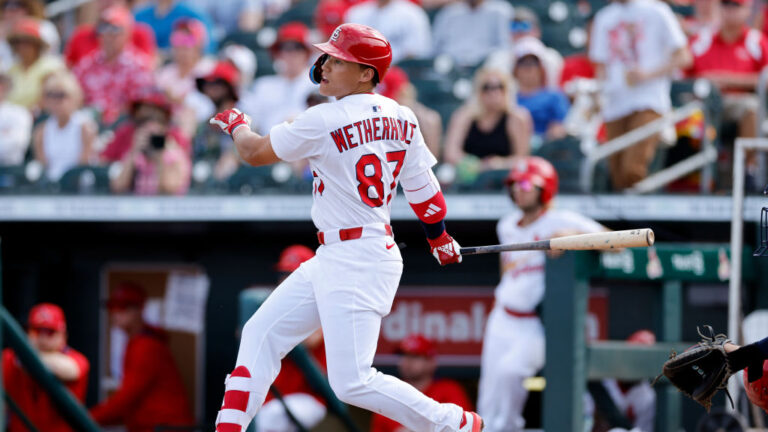
Now that we’ve introduced the mathematical framework, let’s think about how it applies to a prospect in the situation himself: St. Louis Cardinals second baseman JJ Wetherholt.
It should be noted that Wetherholt will have every opportunity to make the big leagues out of camp and is all but guaranteed to make the Opening Day roster. For the sake of the exercise, let’s break this down anyway.
Prospect’s projected WAR in ~ 7th season of team control: What the Cardinals project Wetherholt’s WAR output to be in 2032, his final year of team control, assuming service time manipulation occurs.
Probability of Wetherholt winning ROY OR finishing in the top three in MVP voting before arbitration: The coefficient for the potential PPI pick’s eventual WAR output when compared to Wetherholt’s WAR output in his final year of team control.
9 WAR: See above.
If the Cardinals believe that Wetherholt’s manipulated service-time year will yield more WAR than the potential PPI pick over their first six years of team control, he is assigned to Memphis to begin 2026.
However, if the Cardinals believe that Wetherholt’s manipulated service time year will yield less WAR than the potential PPI pick through their first six years of team control, Wetherholt is the team’s 2026 Opening Day second baseman.
I won’t be solving these inequalities in this article, as we don’t have publicly available seven-year projections for players or a clear procedure for determining Wetherholt’s chances of converting on a PPI pick for the Cardinals, given the above criteria.
Still, the logic is sound and is an interesting way to think about what goes into a team’s decision when determining whether to promote their young stars.
Caveats to this Framework
While these equations give a mathematical argument for why a player should or should not make his team’s Opening Day roster, they are by far from the only factor that teams weigh.
Most importantly, this framework assumes a front office wishes to maximize surplus value at all costs. While this may be a higher priority for franchises with less financial resources, wealthier teams may not consider it as heavily.
A team’s organizational strategy and an executive’s history also affect the direction a franchise decides to take.
For example, in the case of the St. Louis Cardinals, the franchise has recently embarked on a full-scale rebuild. Chaim Bloom and his staff have a peppered history of maximizing surplus value, so in a vacuum, it may make sense to hold off on promoting Wetherholt if they feel he doesn’t have a strong enough chance to win Rookie of the Year or finish in the top three in MVP voting before he becomes arbitration-eligible.
Conversely, the Los Angeles Dodgers are in win-now mode; any prospect in their farm that they feel could contribute immediately in 2026 will likely receive strong consideration for making their Opening Day roster.
As a concept, service time manipulation is also not as widely practiced as it once was. As explained earlier, teams are now encouraged by the most recent CBA to start a prospect’s clock as soon as they are ready from a talent perspective. The framework does not account for the human element behind a decision like this one.
If a star prospect is held out, front offices risk upsetting them and their representation, which could have negative ramifications if/when they attempt to extend that player or sign them as a free agent after their team control expires.
The level of patience displayed by an ownership group is also a critical factor. Depending on the promised timeline of a rebuild by the baseball operations staff, perpetually maximizing the surplus value of a farm system may not always be in their best interest.
Ownership may become disgruntled at the lack of success, and it could behoove the front office to make haste with their star prospects in an attempt to win sooner. They risk termination if they don’t.
Final Thoughts
These equations serve as a mathematical representation for how a front office may go about deciding whether or not an MLB-ready prospect should be on the Opening Day roster. It only represents one contention of an overall discussion, with the others being the aforementioned caveats.
Still, this is an interesting glimpse into how front offices can use game theory and decision tree modeling to help make complex decisions.
Become a Member of Just Baseball
Subscribe and upgrade to go ad-free!
* Save 25% by subscribing annually.

Written by
Adam Akbani is a writer and analyst from St. Louis, MO. He attended Washington University in St. Louis, double majoring in Economics & Strategy and Political…