
Top 3 Los Angeles Dodgers Spring Training Storylines to Watch
With a bevy of prospect battles, workload management question, and a World Baseball Classic twist, here are the top three Dodgers storylines to follow at Camelback Ranch.
The defending champion Los Angeles Dodgers don’t enter many springs with uncertainty. That’s the luxury of a roster built around stars like Shohei Ohtani, Mookie Betts, and Freddie Freeman, supplemented by aggressive offseason additions such as Kyle Tucker and Edwin Diaz.
But even for a team chasing a rare three-peat, spring training at Camelback Ranch offers real intrigue.
In my recent piece: Top Dodgers Prospects Who Could Contribute in 2026, I broke down the next wave of talent pushing toward Los Angeles. This spring, many of those same names will be in big-league camp, and thanks to some unique timing, they’ll get real opportunity.
Here are the three biggest storylines shaping camp in Arizona.
1. The WBC Opens Up A Prospect Parade
Who will pop in the desert?
The Dodgers invited 32 non-roster players to camp, and the prospect contingent is loaded.
Outfielders Josue De Paula, Zyhir Hope, James Tibbs III, and Zach Ehrhard are all in camp, along with left-handed hurler Jackson Ferris, right-hander Nick Frasso, former first-round selection and outfield speedster Kendall George, and versatile defender/switch-hitting infielder Alex Freeland, who already logged MLB time in 2025.
For those who read my recent prospect deep dive, this is the first extended look at how that group stacks up against big-league pitching in a shared environment.
Hope’s raw power is among the loudest in the minors, while De Paula might have the most MLB-ready bat in the system, walking nearly as often as he struck out across High-A and Double-A last season. Then there’s Tibbs, who rediscovered his swing after two trades in 2025 and posted a .900 OPS in Double-A Tulsa once he landed in L.A.’s system.
None of these players are expected to break camp with the big club. Most are 22 or younger and firmly part of the long-term plan. Still, Cactus League at-bats against frontline arms and innings against major-league hitters are invaluable checkpoints, and a scorching March from any of them could accelerate internal conversations.
And then comes the wrinkle.
From March 5 to March 17, the World Baseball Classic takes center stage, and several Dodgers will be away from camp.
Diaz (Puerto Rico), Hyeseong Kim (Korea), Ohtani and Yoshinobu Yamamoto (Japan), and Will Smith (USA) are among the notables competing internationally.
The Dodgers will have already played 12 Cactus League games before the WBC begins, but the absence of key veterans will open up extended reps for some of the prospects mentioned above, as well as bench candidates looking to cement a role.
For young players on the bubble, the WBC is an opportunity generator in Arizona.
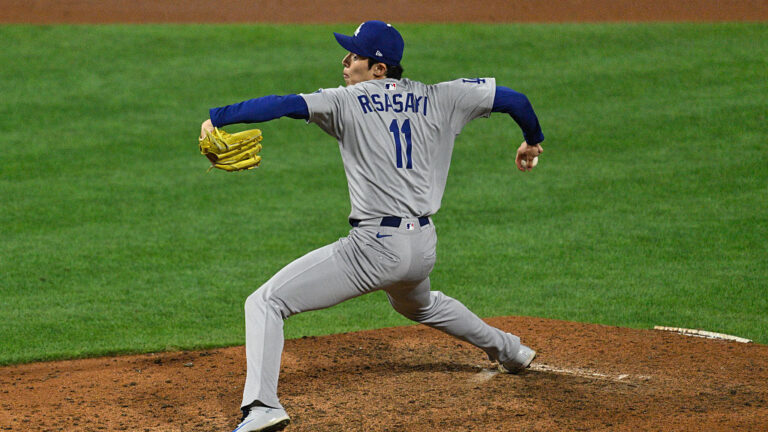
2. Roki Sasaki Needs to Show Mechanical and Pitch Mix Development
Few players in all of MLB carry more intrigue than Roki Sasaki this spring.
In his rookie season, the Japanese right-hander and coveted rookie phenom struggled with durability and posted a 4.72 ERA as a starter before landing on the injured list for an extended period of time. But when October arrived, Sasaki thrived in a high-leverage bullpen role, pitching to a microscopic 0.84 ERA and recording key outs time and again in the postseason.
Sasaki now enters camp with the stated goal of returning to a starting role. The Dodgers have emphasized that in order to achieve sustained success in the rotation, Sasaki will need to make strides with mechanical consistency, as well as develop a convincing third offering, aside from his elite four-seam fastball + splitter combo.
Sasaki has reportedly been working on a cutter and two-seamer. Notably, the Dodgers declined to let Sasaki pitch in the WBC so he could focus entirely on his 2026 preparation.
With Yamamoto, Ohtani, Blake Snell and Tyler Glasnow headlining the rotation, there’s no need to force anything. But if Sasaki shows improved command, a repeatable delivery, and a viable third pitch this spring, the Dodgers could have yet another ace on their hands in the rotation.
3. Managing a Veteran Core While Competing for a Three-Peat
Freeman is entering his age-37 season. Miguel Rojas is 36 and entering his final season. Max Muncy is 35 and has dealt with injuries the last couple of seasons. Betts is coming off a demanding year adjusting to everyday shortstop. Ohtani is expected to resume full two-way duties. Yamamoto logged a heavy October workload. Blake Snell and Tyler Glasnow both dealt with injuries last season.
Then there’s the state of the Dodgers’ beloved utility players.
Tommy Edman’s recovery timeline (rehabbing his ankle) clouds Opening Day availability. Kiké Hernández has officially re-signed but will be on the shelf the first half of the season after undergoing surgery on his left elbow.
It’s an aging core, and one that deals with a second consecutive shortened offseason after capturing another World Series. Obviously, that’s a good problem to have, but it does impact timelines and readiness for the start of the regular season.
This breeds position and bench battles that will play out throughout spring.
Freeland and Hyeseong Kim are both competing for meaningful roles. Freeland’s switch-hitting profile and defensive flexibility make him an ideal depth piece. Kim brings speed, glove work and bat-to-ball skills, despite a tale-of-two-halves rookie campaign.
The Dodgers treat March as a time to calculate and calibrate. It’s not so much about finding answers as it is reinforcing the infrastructure that makes sustained dominance possible.

Written by