
Five Position Battles To Keep a Close Eye on This Spring
They say the games don't matter in spring training, but for these players embroiled in position battles, the stakes couldn't be higher.
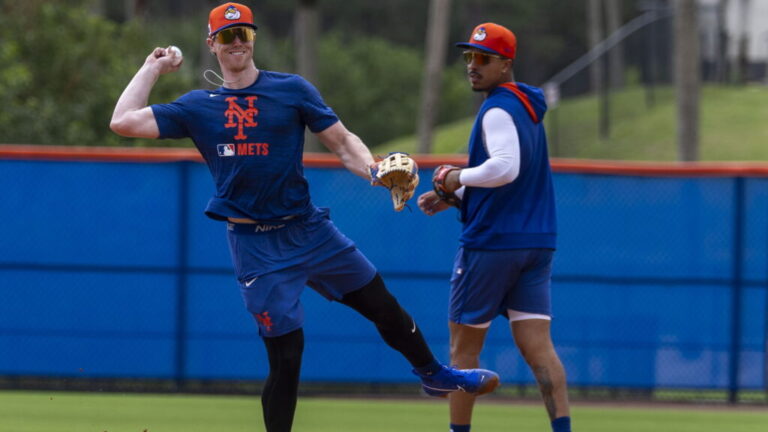
As the chill of the winter begins to fade and the sound of baseball returns to the air, baseball fans across the country are eagerly gearing up for another season of high hopes and fresh storylines. For some fans, this season brings hope in the form of the team’s future making their way to the big leagues, or fresh acquisitions taking the field for the first time.
For some teams, the anticipation of putting together another winning season is all fans can think about. Exciting cores don’t come around frequently, so taking a chance at competing for a World Series title isn’t something to take lightly.
While both sides of the spectrum are exciting in their own right, these are bigger-picture storylines to follow. In order to achieve either a step forward or another postseason appearance, teams must make many smaller moves to get them to the promised land.
These small moves begin with positional battles in spring training, as teams give their players the opportunity to win starting roles on the roster. This season, there are a number of exciting roster battles taking place that could have major implications on each team’s season.
As we dive into the key position battles to keep an eye on this spring, the stakes couldn’t be higher. Let’s dive in and break down each of these battles.
Will Vientos or Baty Be the Mets’ DH?
After a flurry of moves this winter, the New York Mets have flipped a devastating offseason into a very solid potential Opening Day roster. Part of this process was completely rebuilding their infield.
The Mets signed Bo Bichette and Jorge Polanco to multi-year deals, while also bringing in infielder Marcus Semien in the Brandon Nimmo deal. While these moves have undoubtedly made their infield a lot stronger, they’ve combined to leave Mark Vientos and Brett Baty in a weird position.
Currently, the Mets are projected to have their designated hitter spot open, according to RosterResource, which means they’ll have room for one of the two players at the position. For the Mets, this decision may be closer than meets the eye, as both Vientos and Baty have fair arguments to fill this role.
Beginning with Vientos, the 25-year-old took a significant step back offensively during the 2025 season, but he still has plenty of promise. He crushed 17 homers and slashed .233/.289/.413 with a 97 wRC+ this past year, while also posting a whiff rate of 32.5%.
There were two sizable takeaways from his 2025 campaign, though. For starters, Vientos’ season was defined by the two halves, as his wRC+ saw a 35-point improvement during the second half (81 vs 116). Secondly, the batted ball data was encouraging, as his hard-hit rate actually improved by nearly 4%.
Although the numbers on the surface may not jump off the page, his improvements in the second half and his improved hard-hit rate inspire courage that 2026 will be a different story. After all, he slugged 27 homers with a 132 wRC+ in 2024.
In Baty’s case, he went through the complete opposite transition from Vientos. Baty put together the best offensive season of his career in 2025, which came after struggling to make the big league transition in each of his previous three seasons.
Baty finished the season with 18 homers, a .254/.313/.435 slash line, a 111 wRC+, and 2.3 fWAR. In addition to his numbers improving on the surface, he took strides under the hood, too.
For example, Baty’s quality of contact improved drastically. His barrel rate soared to a career-high 12.8%, and his average exit velocity jumped 4.1 MPH. It doesn’t end there, as Baty posted a new career-high max exit velocity of 115.6 MPH, a mark 3.6 MPH harder than his hardest hit batted ball the year prior.
With Baty’s improved batted ball numbers, there is a real chance that he’s finally the player the Mets expected him to be when they selected him 12th overall back in 2019. If this is the case, he has a really solid case to be the team’s designated hitter in 2026.
This spring will provide an opportunity for these two to battle it out for the designated hitter spot, and how they perform during this time could go a long way in determining who gets the job. With both players having their own pros and cons, this will be a battle to keep a close eye on.
The Rays’ Confusing Catching Situation
When I was researching positional battles to highlight in this story, the most confusing situation I came across had to be the Tampa Bay Rays’ catching situation. As it currently stands, the Rays have three catchers in position to fight for the starting job, and none of them has played more than 110 games at the big league level.
RosterResource currently has Nick Fortes in position to take the starting job, but that’s quite a long way from being a guarantee. Fortes spent time with the Rays and Marlins last season, and he combined for a wRC+ of 80, a number significantly below the league average.
Although he was a well-below-league-average hitter, Fortes did manage to post 1.0 fWAR due to his defense. He’s a solid catcher behind the dish, as he posted positive metrics in framing, pop time, and blocks above average last season.
The only other catcher in this race that has big league experience is Hunter Feduccia, and it will likely be an uphill battle for him to make the Opening Day roster. Last season in 38 big-league games, Feduccia slashed just .148/.267/.205 with a 39 wRC+.
This type of production isn’t what the Rays are looking for at the catcher position, but with an entire offseason for adjustments, Feduccia could still make the changes needed to break camp.
The third player in this mix is Dominic Keegan, and he arguably has the most interesting case for a shot at the big leagues. He slashed .241/.306/.429 with 10 homers and an 89 wRC+ in Triple-A last season, but that stint wasn’t a good representation of his game.
In fact, up until last year, Keegan hadn’t put up a wRC+ below 126 at any level, while simultaneously displaying advanced plate discipline everywhere he went. His offensive profile is very intriguing, and with the catcher position wide open, there’s a very good chance Keegan could be the correct choice for this role.
No matter which direction the Rays decide to take with their catcher position, this will be a fascinating battle to monitor this spring.
Which Direction Will the Brewers Go at Shortstop?
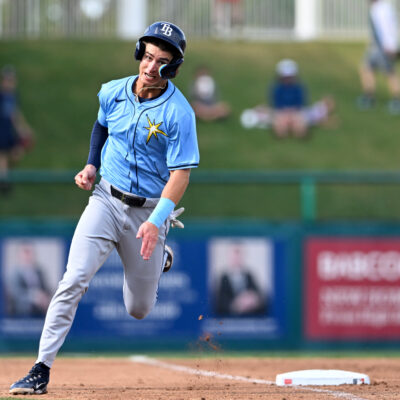
The 2025-26 MLB offseason featured many blockbuster moves, but arguably the biggest trade came when the Milwaukee Brewers dealt their ace, Freddy Peralta, to the New York Mets. In this deal, the Brewers landed Just Baseball’s No. 45 prospect, shortstop Jett Williams.
Williams spent the 2025 season between Double-A and Triple-A, where he put up a very good season overall. Between both levels, Williams blasted 17 homers and slashed .261/.363/.465 with 34 stolen bases. In addition to this, he also posted an impressive 136 wRC+.
Even though his season was impressive overall, it is important to note that Williams struggled through his first 34 Triple-A games. He posted an 81 wRC+ during this span while his walk rate plummeted from nearly 15% to just above 9%.
Despite his struggles in Triple-A, Williams showcased a very refined all-around game during the 2025 season, and this momentum could allow him to compete for the starting shortstop job this spring.
As it currently stands, according to RosterResource, the Brewers’ shortstop is projected to be Joey Ortiz. However, this position could certainly be contested.
Ortiz played 149 games for the 2025 Brewers and was undoubtedly the weakest hitter in their lineup. 11 hitters in the Brewers lineup registered at least 200 plate appearances, and of these hitters, Ortiz was the only one to post a wRC+ below 100.
Although Ortiz’s bat may not stack up against the rest of the lineup, the Brewers would be sacrificing elite defense by choosing to go with Williams. Ortiz posted an OAA of 13 last season, which was the fifth-best mark in baseball by a shortstop.
With the Brewers recently trading Caleb Durbin, Andruw Monasterio, and Anthony Seigler to the Boston Red Sox, they suddenly have a lot of open space on their depth chart at third base. As a result of this, Williams is reportedly getting reps at third base this spring.
If the Brewers aren’t willing to pick between Ortiz and Williams just yet, this is a route they could potentially take in order to fit both players on the roster. In the meantime, it’ll be interesting to see both players battle it out for a spot in the infield this spring.
The Reds’ Quest To Determine a Fifth Starter
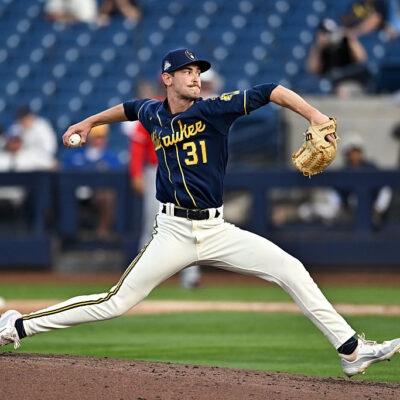
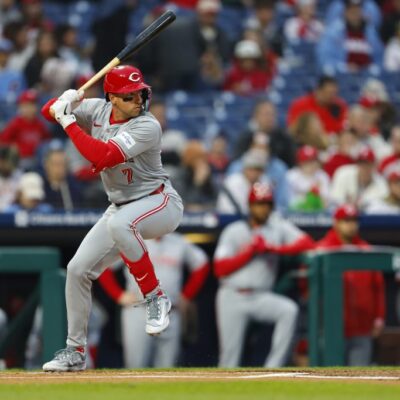
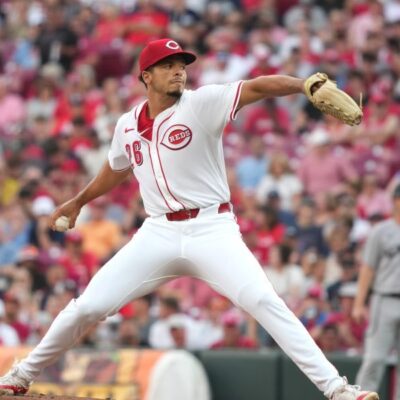
The one battle I’m arguably most excited to watch this spring is the fight for the fifth spot in the Reds’ rotation. The group of players fighting for this role is diverse, exciting, and very talented, which should make this a tight race up until Opening Day.
At the very top of this battle are two Wake Forest alumni with some of the most prospect buzz we’ve seen in recent years: Rhett Lowder and Chase Burns. Despite both going through a similar journey on their way to the big leagues, their situations are very different.
For starters, Lowder flew through the minor leagues during his first full season in 2024, earning his big league debut before the end of the year. In the 30.2 innings he pitched for the Reds, Lowder looked quite sharp, posting a 1.17 ERA with 22 strikeouts along the way.
Unfortunately, since then, Lowder has been struck with a flurry of injuries that have made his journey to the rotation much tougher. He missed nearly all of the 2025 season, only appearing in 9.1 minor league innings as he worked to rehab from his injuries. With Lowder practically missing a year of his development, it may benefit him to begin the year back in Triple-A.
In Burns’ case, the flamethrower also flew through the minor leagues during his first full professional season. He spent just 66 innings in the minors before making his big league debut, where he received a sizable number of innings on the mound, and he held his own while doing so.
The 22-year-old pitched to a 4.57 ERA with 67 strikeouts in his first taste of the big leagues, showing flashes of ace-caliber stuff. Ultimately, Burns did get hit up a little bit, too. For example, his barrel rate sat just shy of 10%, which certainly wasn’t the result he had hoped for. Given this, his spot in the rotation is not guaranteed.
While these two former first-round picks will be the two players with the most hype during this battle for the final rotation spot, they’re far from the only options the club has. Brandon Williamson, Chase Petty, and Julian Aguiar will also be in the running for this spot, making this an even more exciting battle.
Back on Feb. 16th, our Clay Snowden did a fantastic deep dive into each of these choices, and which one makes the most sense for the Reds. For more on this fight, check out his story.
Detroit’s Crowded Infield
The final battle I want to touch on in this story is the Detroit Tigers’ infield, a group that’s filled with talent from top to bottom. With so much infield depth, the Tigers have many options they could choose this spring, and each one could have a huge impact on their potential to compete in 2026.
Currently, RosterResource projects their infield to feature Colt Keith, Gleyber Torres, Zach McKinstry, and Spencer Torkelson. This group is solid in its own right, as none of these four players posted a wRC+ below 109 during the 2025 season.
However, there are an extensive number of players who could also be in the running for an infield spot on the Opening Day roster. Max Anderson, Hao-Yu Lee, Jace Jung, and Trey Sweeney are all currently slated to miss the cut, which says a lot given the prospect pedigree of all four of these players.
RosterResource also projects players such as Javier Baez and Matt Vierling to begin the year on the bench, and with both players having the ability to play the infield if needed, this group becomes even deeper.
Alongside all of these players is one other budding superstar who could make their big league debut if things go well for him this spring: Just Baseball’s No. 2 prospect, Kevin McGonigle.
McGonigle, arguably the best pure hitter in the minors, put up an incredible 2025 season. The 20-year-old hit at a ridiculous pace, slashing .305/.408/.583 with 19 homers and a 182 wRC+ between three levels. In addition to this production, McGonigle pulled off the rare feat of walking more than he struck out (59 BBs to 46 Ks), and he was also named the Arizona Fall League’s most valuable player.
Despite not playing a game above Double-A, McGonigle has quickly run out of things to prove in the minor leagues. As I touched on before, he’s already regarded as arguably the best pure hitter in the minors, and he could certainly handle big league arms.
He may not start the year on the Opening Day roster due to the Tigers’ crowded infield situation, but it’ll be fun to see him have the opportunity to battle it out.
Become a Member of Just Baseball
Subscribe and upgrade to go ad-free!
* Save 25% by subscribing annually.

Written by
Jay Staph, a huge baseball fan and stat nerd, founded and ran his own baseball writing website, BSBWrites, at just 16-years-old. With focal points around prospects,…