
Way-Too-Early 2026 CWS Contenders: UCLA Bruins, LSU Tigers & Mississippi State Bulldogs
These three programs stand out as early contenders for the 2026 championship.
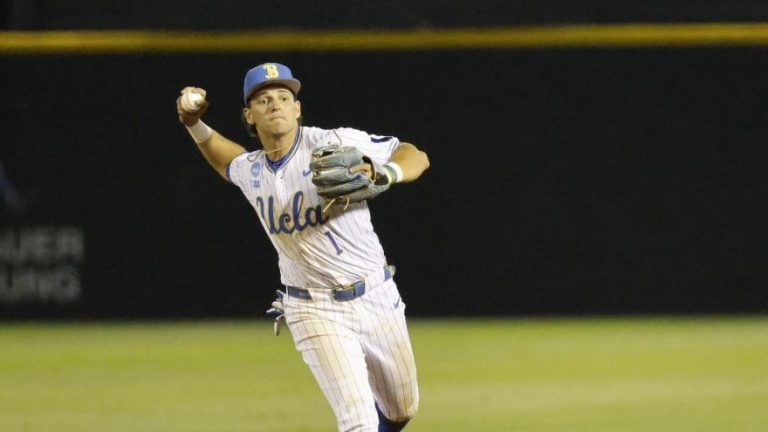
As we look ahead to the 2026 college baseball season, it’s always fun to try to predict who might be next year’s College World Series champions.
While it is, of course, a guessing game at this time of the year, three programs stand out to me as ones that could make a run for the ship: LSU, Mississippi State, and UCLA. Each brings a combination of recent success, roster momentum, coaching stability, and program infrastructure that positions them to make a deep run.
Below, we explore each team’s case, what they’ve done recently, what gives them the edge, and where the risk lies.
UCLA: The West Coast Power on the Rise
After a resurgent 2025 season that saw UCLA go 48–18 overall and return to Omaha for the first time in several years, head coach John Savage’s club looks built to take the next step. The Bruins finished 22–8 in conference play and ranked among the nation’s top 15 in RPI, anchored by elite defense and one of the most disciplined lineups in college baseball.
The centerpiece of it all is Roch Cholowsky, who broke out as one of college baseball’s elite shortstops in 2025. The Brooks Wallace Award winner slashed .353/.480/.710 with 23 home runs and 74 RBIs and enters the year as a consensus top-five pick for the 2026 MLB Draft. His combination of defensive polish, power, and maturity gives UCLA a bona fide star to build around.
Surrounding him is a deep, veteran core, all of whom were part of the same recruiting class as Cholowsky:
- Mulivai Levu provides left-handed thump at first base.
- Dean West brings table-setting speed and consistent on-base ability (.320 AVG, .895 OPS).
- Roman Martin adds balance with gap power and infield versatility (.316 AVG, .952 OPS).
On the mound, the Bruins will again lean on their development pipeline. While their 2025 offense led the way, the staff quietly finished top-15 nationally in ERA. They also bring in a stud freshman arm, Angel Cervantes, who was drafted in the second round by the Pittsburgh Pirates, but opted to head to campus.
Also, with multiple weekend starters and bullpen arms returning, including several who logged key innings in Omaha, the group has the experience and stuff to handle another postseason push.
Savage’s teams are typically built for June. The difference this time is the offensive ceiling. If the lineup maintains its production and the rotation avoids attrition, UCLA could very well bring another national championship back to Los Angeles.
LSU: The Reigning Champs Reload, Not Rebuild
After capturing its eighth national championship in 2025, LSU enters the 2026 season in familiar territory – national title expectations – but with a roster that looks dramatically different from the group that dogpiled in Omaha.
Head coach Jay Johnson once again faces a classic LSU challenge: replacing superstar production without losing championship form.
Gone are cornerstone hitters Jared Jones and Daniel Dickinson and aces Kade Anderson and Anthony Eyanson, all of whom departed for the MLB Draft. Yet, if there’s any program equipped to reload rather than rebuild, it’s LSU.
The new-look lineup will be built around Steve Milam, one of the most polished middle infielders in the SEC. The switch-hitting sophomore impressed scouts as a freshman with his advanced approach and smooth defense, hitting .295 with 11 home runs and anchoring LSU’s infield through the postseason. His all-around consistency makes him the heartbeat of the 2026 offense.
In the outfield, LSU features two of the nation’s top young talents in Jake Brown and Derek Curiel. Brown, a junior left-handed hitter, flashed elite bat-to-ball skills as a freshman and projects as a top-tier leadoff option with plus speed.
Curiel, a highly-ranked prospect in the 2024 high-school class, adjusted quickly to college pitching in 2025 and now looks ready for an even bigger breakout sophomore season. Curiel should he highly sought after in the 2026 MLB Draft. Together, they give LSU a dynamic, athletic outfield capable of impacting games on both sides of the ball.
They brought in some firepower from the transfer portal on the offensive side of the ball with the likes of first baseman Zach Yorke from Grand Canyon University and infielder Brayden Simpson from High Point University. Both have the potential to provide some serious pop.
They also scored a big-time add in former Oregon State infielder Trent Caraway, who was an intriguing name for the 2025 MLB Draft.
You’d think that with losing Kade Anderson and Anthony Eyanson, your pitching staff would naturally take a step back. But LSU looks to be locked and loaded with a lot of returning arms.
Gavin Guidry, who’s been a massive piece for them in the past but missed last year with an injury, is back and should hopefully be healthy for 2026. Casan Evans really broke out as a freshman, posting a 2.05 ERA while striking out 71 in 52.2 innings. Another highly-touted freshman last year, William Schmidt, will be looking to have a breakout sophomore campaign.
You’ve also got right-handers Zac Cowan, Mavrick Rizy, and Cooper Moore, and Jaden Noot, who could make some noise on the mound as well as new lefties Santiago Garcia from Oregon and Danny Lachenmayer from North Dakota State.
While LSU’s 2025 championship team relied heavily on veteran star power, this version may be more balanced, a younger offense with a pitching staff that could quietly become one of the SEC’s best by May.
Jay Johnson has built a dynasty in Baton Rouge by mastering roster turnover, and 2026 represents the next iteration of that formula. The faces have changed, but the expectations haven’t: LSU is still built to win in Omaha, with Milam, Brown, and Curiel forming the next great core of Tiger baseball.
Mississippi State: Brian O’Connor + No. 3-Ranked Portal Class = Immediate Title Ceiling
The offseason that changed everything in Starkville started on June 1, 2025, when Mississippi State hired Virginia Head Coach Brian O’Connor, an ABCA Hall of Famer with seven CWS trips and a national title, as its 19th head coach.
Culture, development, recruiting, and in-game discipline are his calling cards, and he wasted no time importing that identity, many of which followed Coach O’Connor from the University of Virginia.
O’Connor leveraged relationships and fit to assemble the nation’s No. 3 transfer portal class (per 64Analytics). A group that squarely addresses run prevention and athleticism while adding on-base skill and defensive reliability. The headliners following him from Virginia:
- Aidan Teel (OF/UTL) — 2025 Third-Team All-ACC who committed to MSU on June 7; plus runner, gap power, defensive versatility; projects to set the table and pressure defenses.
- Tomas Valincius (LHP) — Freshman standout at UVA (6–1, 70 K, 64.2 IP); brings strike-throwing with real bat-miss and instant weekend-starter potential.
- James Nunnallee (OF) — ACC’s hardest freshman to strike out in 2025 (10.9% K-rate), .296 AVG with 12 doubles; contact engine who lengthens the lineup.
- Chone James (UTL) — Physical, multi-positional bat who followed O’Connor on June 6; adds lineup flexibility and depth.
- William Kirk (LHP) — Another Cavaliers arm who was a highly-recruited prep prospect out of New Jersey and missed last year with an injury. He could bolster their left-handed pitching looks and overall depth.
O’Connor also inherits a strong nucleus of returning talent that already hinted at postseason potential in 2025. Ace Reese is the prize returner. Reese ranks as one of the best prospects for the 2026 MLB Draft and hit .347/.419/.719 with 17 doubles and 21 home runs. He returns as one of the SEC’s most advanced young hitters and a cornerstone for the offense.
Two-way Noah Sullivan also returns as a fifth-year and should provide some leadership for this team. He also provided some serious thump for the Bulldogs, hitting .345 with 18 doubles, 15 home runs, and 46 RBI while also posting a 1.96 ERA on the mound, striking out 15 in 18.1 innings.
Another name to watch offensively from the transfer portal is Drew Wyers out of Bryant. This is a kid who hit over .400 in 2025 and should be a spark plug for the Bulldogs.
Tomas Valincius’ brother, Vytas Valincius, also joined the Bulldogs after transferring from the University of Illinois. He put up real good numbers there, slashing .348/.434/.520 with 14 doubles and 7 home runs.
On the mound, we already mentioned Tomas Valincius, who was a rotation guy for Virginia as a freshman. They also brought in a STRONG freshman arm in Jack Bauer, who has been sitting at an easy 102 MPH this fall.
Transfers Jackson Logar out of James Madison and Tyler Pitzer out of South Carolina are some names you need to keep your eye on as well. Pitzer posted some silly Cape Cod League numbers this summer, posting a 0.34 ERA while striking out 36 in 26.1 innings.
Between the returning core, the portal influx, and a solid freshman class, Mississippi State now features one of the strongest rosters in not just the SEC, but all of college baseball.
At Dudy Noble Field, where college baseball’s most passionate fan base fuels every series, this kind of roster and leadership combination is dangerous. Mississippi State fans have been eagerly awaiting their baseball program’s return to prominence.
Mississippi State isn’t a rebuild, it’s a reboot, executed at warp speed. If the new arms settle in and the offense carries over its 2025 production, O’Connor’s first season could mark a return to Omaha far sooner than anyone expected.

Written by
Jared Perkins is a College Baseball and MLB Draft Director for Just Baseball. He's a Host and Co-Founder of The College Baseball Show.