
Nationals Notebook: Bob Carpenter Retires, Cairo on Pitch Calling
The Washington Nationals say good-bye their longtime TV voice Bob Carpenter, and James Wood has a big day in the penultimate game of 2025.
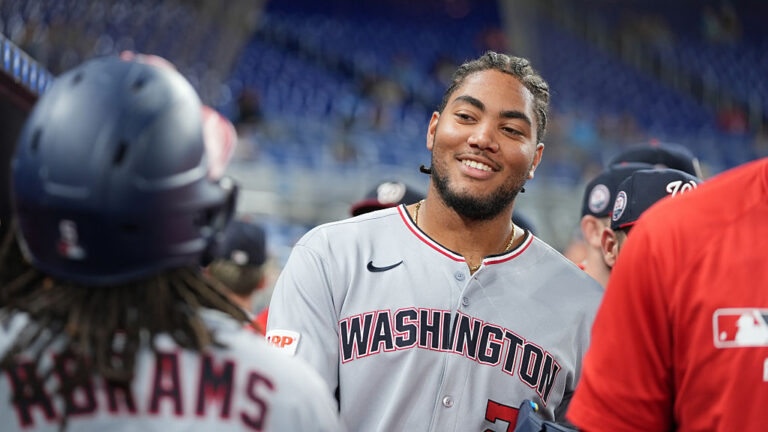
WASHINGTON, D.C. — The Chicago White Sox (59-102) traveled to D.C. to take on the Nationals (66-95) this weekend, with each team hoping for more roster clarity going into next season.
Both teams have been in last place in their respective divisions for the majority of the season. Players on the personnel periphery are hoping to play their way into the team’s mix for 2026, which can still give way to entertaining ballgames – like the ones we’ve seen this weekend between these two.
On Friday, the White Sox jumped out to an 8-1 lead, only to see the Nationals retaliate by scoring eight unanswered runs. In the ninth, White Sox shortstop Colson Montgomery hit the go-ahead home run to give Chicago the 10-9 victory.
Saturday, the Nats narrowly defeated the White Sox, 6-5.
The White Sox opened up the scoring with two-run homers in the top of the fourth inning by both Montgomery and Brooks Baldwin. The Nationals followed by evening things up on two two-run bombs of their own by outfielders Daylen Lile and Jacob Young.
“I love his approach; I love how compact his swing is – he’s short to the ball,” Interim manager Miguel Cairo said, complimenting Lile’s offensive profile. “When you think about [hitting] line drives, you’re going to end up hitting some homers. When you’re thinking about homers, you’re going to be striking out a lot.”
Lile may be Washington’s best hitter recently, but James Wood (.828 OPS), their best hitter over the course of the 2025 season, had a huge game on Saturday. The newly minted Nationals Player of the Year award winner had three hits, including unloading on a go-ahead, 419-foot opposite field homer to give them the lead.
“When he’s hitting the ball that way, he’s dangerous,” Cairo said, of Wood. “When he stays to the middle, left center, he’s dangerous because he’s going to be able to see the breaking pitch and pull the hangers. That ball went out quick.”
Each team would add a run in their final turn at-bat, and Washington closer Jose A. Ferrer earned his 11th save of the season in the pouring rain.
The two teams will be back at it one more time for a rubber match on Sunday. The Nationals will send Brad Lord (5-9, 4.12) to the mound to oppose Shane Smith (6-8, 3.98) of the White Sox.
See You Later, Bob Carpenter
The Nationals organization honored their longtime TV announcer, Bob Carpenter, on Saturday. He will retire after broadcasting Sunday’s season finale, and the team declared the day to be named “See You Later Day,” after Carpenter’s famous home run call.
Carpenter, 72, has been a play-by-play voice of Major League Baseball games since 1984. He spent time broadcasting nationally with ESPN, as well as for five different MLB clubs. Since Washington’s move from Montreal in 2006, he has been the only television voice of the Nationals.
His marquee home run call, “see you later,” is one that Nationals fans will never forget. There have been many “see you laters” over the course of Carpenter’s tenure, but his current cadence began when he called Mark McGwire’s moonshots in 1998.
“These home runs, the likes of which I’ve never seen before, were in the air for so long,” Carpenter recalled at his retirement press conference. “‘See you later’ just didn’t work. So that’s when I started really drawing it out, because I figured: how dumb to be done with your home run call when the thing’s not even coming down yet.”
Carpenter insisted that he never sat down and thought about what his home run call would be, that it was entirely organic. He used the call for all 20 years of his time broadcasting the Nationals with Mid-Atlantic Sports Network (MASN), which made the phrase especially meaningful to those who live in the nation’s capital.
“It’s hard to claim a sentence in the English language as your own, but I guess it’s become synonymous,” Carpenter quipped. “You wouldn’t believe how many texts and emails that I’ve had over the past couple weeks, and every one of them says ‘see you later’ at the end of it.”
Carpenter has called just about every iconic Nationals moment, but his favorite came to him pretty quickly. It was from the Nationals’ incredible comeback victory against the New York Mets in September of 2019, one in which they were trailing 10-4 in the bottom of the ninth inning.
“If I had to do one [favorite “see you later”], because of the situation in the ballgame, it would probably be Kurt Suzuki’s homer against Edwin Diaz,” Carpenter shared. “My sister, Mary, was visiting from St. Louis, and she happened to be behind me in the booth, taping that on her phone. She said, ‘I’ve never seen my brother go to that octave.'”
As for what’s next, Carpenter mentioned spending much more time with his family. He wanted to spend more anniversaries with his wife and more time with his grandchildren. He’s grateful for his time behind the mic, but especially grateful that he got to choose when he could retire.
“In this business, you’re usually told it was your last game after you’ve done that game and you’re not coming back,” Carpenter said. “I’ve had that experience several times in my career: it’s not fun. So, to be able to do it this way, I’m very grateful.”
Cairo on Calling Pitches from the Dugout
Recently, the Miami Marlins deployed a bold new strategy for calling pitches. Their catchers would no longer have control over what offerings would be thrown, and instead, those signals would come directly from the coaching staff in the dugout.
This tactic is not uncommon in youth baseball, but at the professional level it is controversial. Undoubtedly analytically driven, scouting reports are handed down to the coaching staff from the front office, detailing how pitches should be sequenced for each batter.
Despite being a viral topic in the MLB news cycle, there has been little input on how the coaching staffs of other organizations perceive this tactic. So, I figured: why not ask the MLB manager right in front of me?
Before climbing the coaching ladder to become interim manager of the Nationals, Miguel Cairo spent parts of 17 seasons in Major League Baseball. His take on who should call pitches was a little more traditional, likely because of his wealth of playing experience.
“I respect every organization; they’ve got different philosophies,” Cairo said. “Something that I believe in is the catcher calling the game in preparation with the pitching coach and the strategy coach.”
“With that preparation right there, the catcher should be able to call the game, with the pitcher, of course. Guys getting together to make the best plan, I think I like that more than someone calling [the pitches].” Cairo added.
It’s clear that, while Cairo obviously doesn’t want to shade a Marlins organization that is trying to innovate pitch-calling, he wouldn’t be a fan of that strategy as a manager. He prefers to give the players autonomy to call pitches based on what they recall from strategy meetings, as well as what they see on the field.
This topic will be a cause for debate among many organizations heading into the 2026 season.

Written by
Daniel Rotter follows the game of baseball with passion. He was the youngest participant in the inaugural year of The Great Fantasy Baseball Invitational, at 17…