
Kyle Manzardo Has Become a Huge Piece of the Guardians’ Lineup
Manzardo has been a huge producer for Cleveland over the last few months. Is his newfound power sustainable?
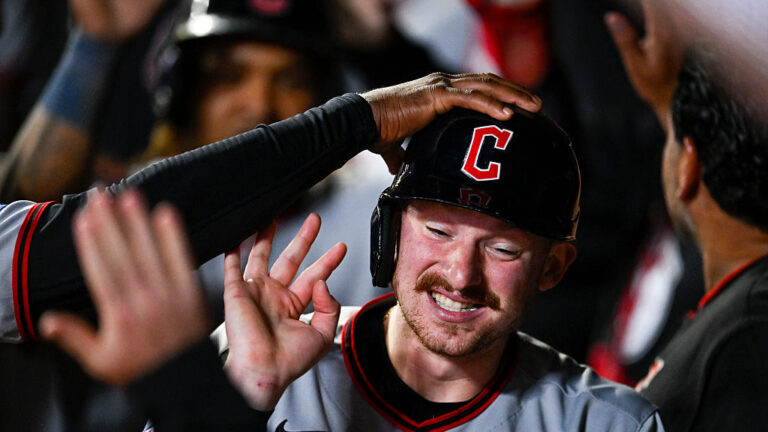
Throughout much of the season, the American League Central looked like it was all but officially wrapped up. The Detroit Tigers held a commanding lead in the division, and it didn’t look like they’d be slowing down anytime soon.
Now, on September 23, the Tigers just sit one game up on the Cleveland Guardians.
The Guardians shipped off Josh Naylor in the offseason and replaced him with free agent signing Carlos Santana. It looked like a solid decision at first, as Santana had a 125 wRC+ at the end of May. However, the veteran slumped badly over the next three months, and Cleveland eventually cut him loose at the end of August.
After years of steady production from Naylor, their hole at first base was suddenly an alarming one. If this team wanted any chance at competing, they’d have to quickly find an answer.
A significant reason for the Guardians’ second-half surge has been the excellent production of first baseman Kyle Manzardo. Still just 24 years old, the former top prospect has finally broken through at the big league level, becoming the hitter the Guardians had hoped he would be.
When trying to envision a replacement for Naylor, I genuinely don’t think the Guardians could’ve hoped for a better outcome than what they’ve received in Manzardo. He’s been an extra-base hit threat to opposing pitching all season long, making him a menacing piece of this team.
What is Manzardo doing differently in comparison to his previous big league stints? Is this breakthrough sustainable? Let’s take a closer look at his 2025 season and see just what has led him to become such an important part of this Guardians lineup.
A Closer Look at Manzardo’s Numbers
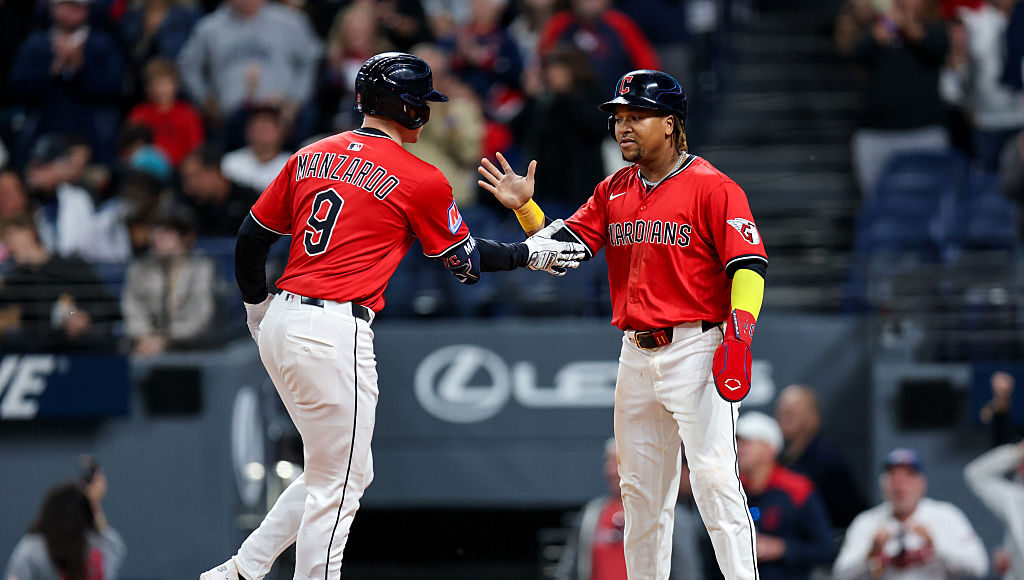
It’s no secret that Kyle Manzardo has always been a very talented hitter. Drafted with the 63rd overall pick back in 2021, the offensive talent was clear early on in his career. He didn’t take long to become a top-100 prospect, and he’s since crushed his way to the major leagues.
Despite this, Manzardo struggled to fully make the adjustment from Triple-A to the majors. Last season, he slashed just .234/.282/.421 with a strikeout rate over 26% and a wRC+ of 98 across his first 53 games. This year, though, it’s been a totally different story.
Through 136 games this year, Manzardo has slugged 26 homers, slashed .236/.317/.456 with a 114 wRC+ and a 1.2 fWAR. He’s been a completely new hitter offensively from the ground up, and it’s on display all throughout his offensive numbers.
For starters, Manzardo is seeing the ball far better than he did during his last stint in the big leagues. His strikeout rate has dipped to 24.9%, a small but noticeable improvement. His improved eye becomes even clearer when looking at his walk rate, which has shot up from 5.8% to just below 10%.
This improved plate discipline has allowed Manzardo to be much better at seeking out his preferred pitches, and he’s been better at honing in his approach. He is swinging slightly more, but chasing and whiffing slightly less.
Even though Manzardo has done a better job at not expanding his strike zone, when he chooses to swing outside of the strike zone, he makes it count. His out-of-zone contact rates have improved slightly. A slight improvement may not seem like much, but making more contact outside of the strike zone can lead to numerous plate appearances going a hitter’s way that previously hadn’t.
When Manzardo does get his pitch, he’s doing a fantastic job at barreling up the baseball. His barrel rate has improved to 11.6%, a number decently above league average.
Overall, while these changes may seem marginal, they show significant growth from Manzardo at the plate. By honing in on his approach and making pitchers pay for their mistakes, he has taken his offensive game to new heights.
How a Small Swing Change Revolutionized Manzardo’s Offensive Game
When a hitter enjoys so many improvements at the plate, there’s usually some sort of mechanical change to his swing. Kyle Manzardo is yet another example of this, as he’s made a tiny adjustment that’s allowed him to have much better results.
Compared to last season, Manzardo is starting a little more closed off in his stance. He’s also dipped his elbow slightly to face the gap in left-center field. These two adjustments have helped him stay in the zone much longer, which allows for much stronger contact.
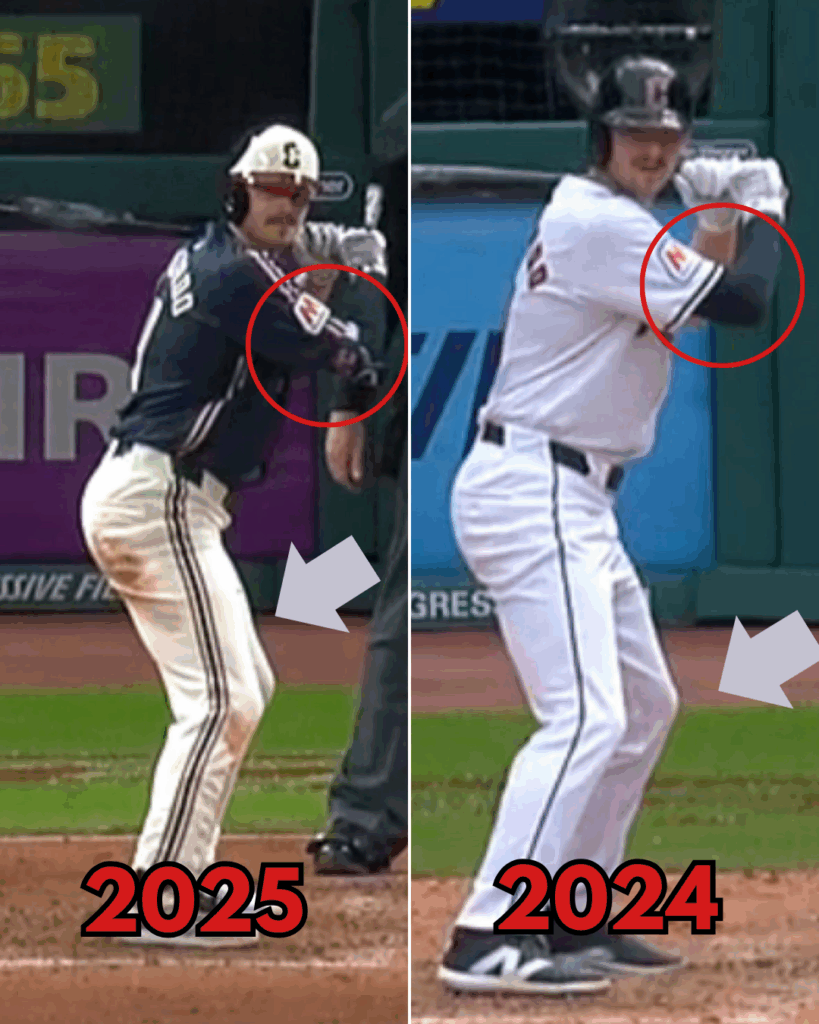
For hitters, the goal is to let the ball travel and to keep your barrel in the zone as long as possible. Instead of pulling off the baseball and not letting his barrel extend through the zone, Manzardo has begun doing the complete opposite. Staying through the baseball allows for much harder contact and fewer rollovers, which has been reflected in his batted ball data.
When we continue to look at the footage of his swings a little further, the impact that this small adjustment has made becomes even clearer.
The following still frame is from right before he makes contact, and you can see how much better of a job Manzardo is doing at getting his barrel in the zone sooner and keeping it there longer, not pulling off the baseball nearly as much as he previously had.
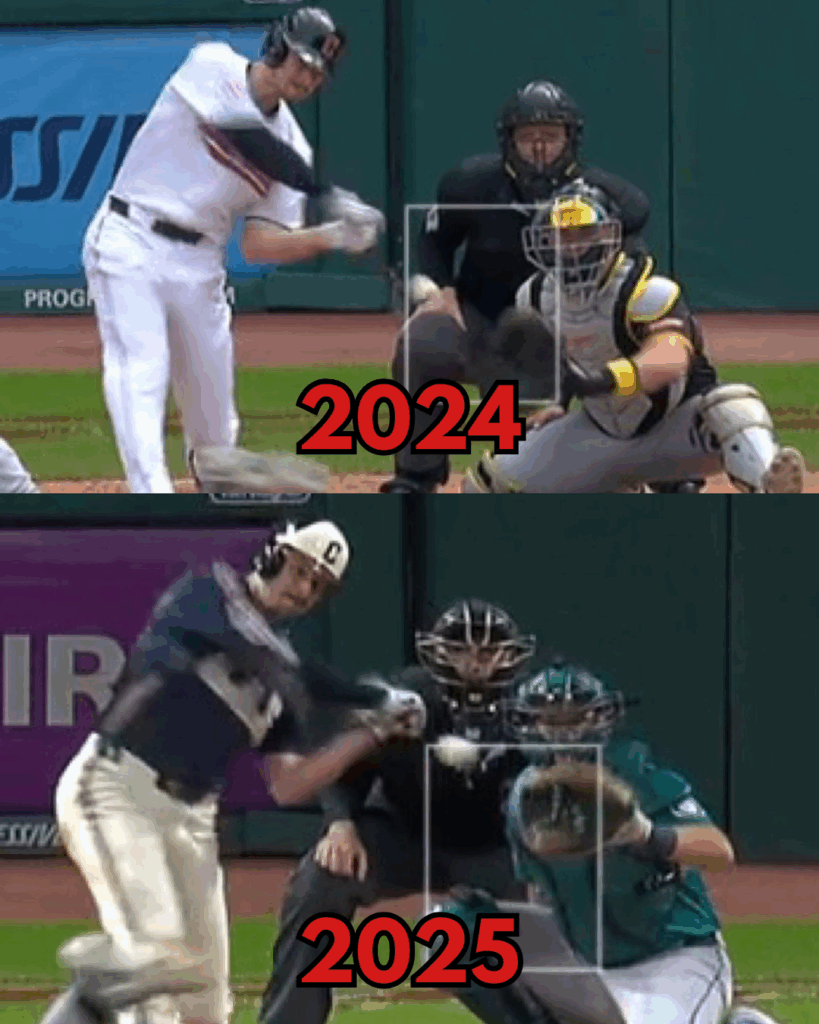
Manzardo’s head is behind the baseball more this season than last year, and his body is working through the baseball. This is similar to how he’d look hitting the ball to left field, but both of these swings are home runs to the pull side. The only difference is that he’s no longer fighting his body to stay balanced and not pull off the ball.
In the next swing comparison, we see these themes develop further once he makes contact. Manzardo is in a far better launch position, as he’s far more connected all the way through contact.
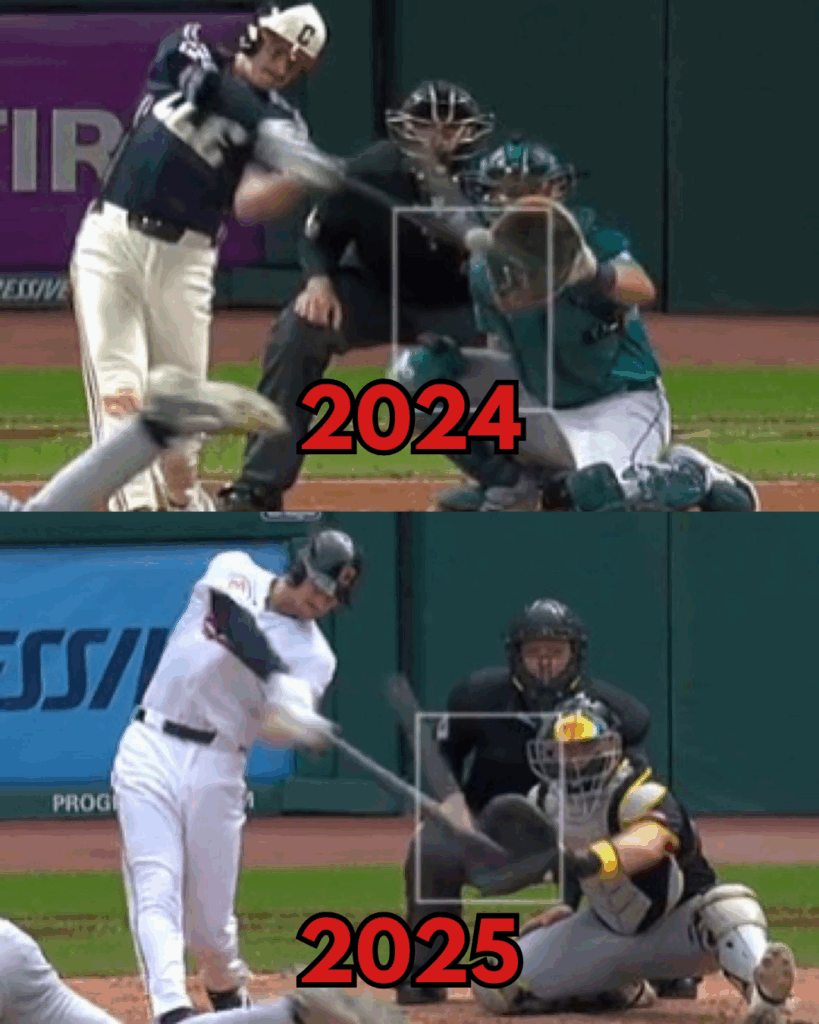
These changes are extremely minor, but their impact is quite the opposite. The fact that Manzardo is able to keep his barrel in the zone a little longer will allow for much better quality of contact results.
In fact, his numbers reflect this same idea. Not only has his barrel rate improved, but he’s also raised his max exit velocity from 109.8 to 111.3 mph. Manzardo’s average exit velocity has followed the same trend, improving from 89.1 to 90.2 mph.
In addition to his exit velocity numbers improving, Manzardo has seen close to a four percentage point increase in hard-hit rate as well. Due to this small swing adjustment, his quality of contact has taken a significant leap forward.
This could also explain Manzardo’s sudden power surge, as he’s hit 26 homers this season alongside 17 doubles. While he’s reached the 20-homer mark in previous minor league seasons, he’s only just started to show off his power at the MLB level.
These adjustments in Mandaro’s offensive profile prove that he’s making real growth at the plate. For a young hitter, this is all you can hope to see after a league-average start to their career.
Is Manzardo’s Production Sustainable?
After taking a look at all the data and swing improvements, I’m left with the question: Is Manzardo’s newfound power surge sustainable, or just a hot streak?
Knowing the swing adjustments Manzardo made and the impact those changes have had on his numbers, I can confidently say that I believe this is sustainable. These adjustments show sustainable growth, as he’s unlocked a new level in his offensive game.
By simplifying his mechanics, Manzardo has found a far more comfortable launch position, unlocking a ton more of his raw power. He’s a freak of nature in the batter’s box, and he has the real potential to be a 30-homer threat if this continues to trend upward.
For the Cleveland Guardians, this result is far more than they could’ve hoped for. Manzardo is a controllable, middle-of-the-order threat, and he only cost them Aaron Civale in return. That trade has suddenly worked out quite well for the Guardians, as Josh Naylor’s replacement has arrived in a big way.
As the team pushes its way toward October, Manzardo is one of the last people I’d want to face at the plate right now. He looks more locked in than ever, which makes for a scary battle in a big moment.

Written by
Jay Staph, a huge baseball fan and stat nerd, founded and ran his own baseball writing website, BSBWrites, at just 16-years-old. With focal points around prospects,…