
Making the Case for Ranger Suárez as the Top Free Agent Starter
He's not the obvious choice, but his youth and his excellent walk year might just be enough to make Suárez the marquee name of this winter's pitching market.
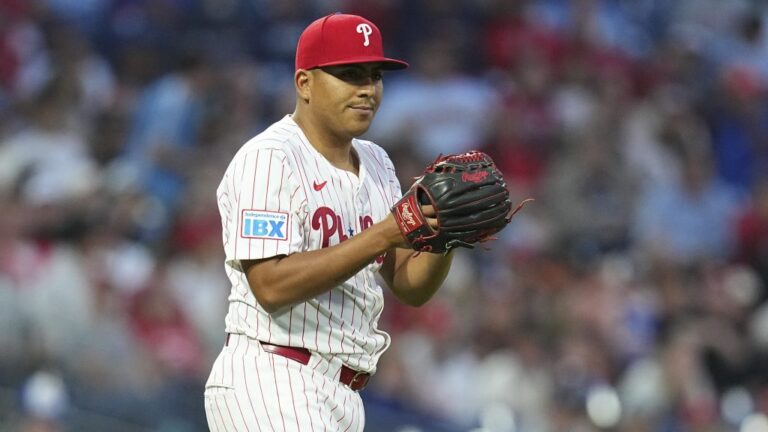
MLB’s 2025-2026 free agent class will be known for two things: starting pitching and sluggers named Kyle. While Kyle Tucker is set to seek out his big money deal and Kyle Schwarber will aim for a high average annual salary, the starting pitcher market looks to be as vibrant as ever.
Teams looking to add a top-of-the-rotation arm will have the luxury of choosing between names like Framber Valdez, Dylan Cease, Michael King, Brandon Woodruff (mutual option for 2026), Shane Bieber (player option for 2026), Zac Gallen and Ranger Suárez.
Suárez, who is having a dominant season in 2025, hasn’t gotten as much attention as some of those others. In fact, Just Baseball’s editorial staff ranked him seventh among impending free agent starting pitchers. So, to suggest he could be this winter’s premier free agent starting pitcher would be controversial. But, is there a case to be made?
| Pitcher | Age | IP (2024-25) | ERA (2024-25) | FIP (2024-25) | K-BB% (2024-25) |
|---|---|---|---|---|---|
| Framber Valdez | 31 | 345.2 | 3.15 | 3.20 | 15.9% |
| Dylan Cease | 29 | 335.1 | 4.05 | 3.35 | 20.5% |
| Michael King | 30 | 231.1 | 2.92 | 3.33 | 19.1% |
| Zac Gallen | 29 | 310.0 | 4.33 | 3.96 | 14.9% |
| Brandon Woodruff | 32 | 53.2 | 3.69 | 3.56 | 23.7% |
| Shane Bieber | 30 | 23.1 | 1.16 | 1.52 | 39.5% |
| Ranger Suárez | 29 | 281.2 | 3.26 | 3.22 | 17.0% |
Injury Concerns
It’s true that injuries have regularly kept Suárez off the field long enough to prevent him from qualifying for the ERA title. Since 2022, three of his four IL stints have been due to his back; it was spasms in 2022, soreness in 2024 and tightness in 2025. While his recurring back problems may seem concerning, his injuries have never kept him out for long periods of time and haven’t seemed to hinder his performance.
Despite never having reached the 160-inning mark, Suárez is one of just 23 pitchers to throw at least 100 innings in each of the last five seasons. Among those 23, he ranks fourth in ERA (3.22), seventh in FIP (3.42) and ninth in fWAR, despite ranking last in innings pitched.
Although missed time has been a constant for Suárez, he’s still been able to make a difference in the Phillies’ rotation year in and year out. It would be a lot easier to make this case if it weren’t for the injuries, but it’s still possible because of what he does when he takes the mound.
A Dominant Walk Year
Suárez made his 2025 debut on May 4, and he has since posted a 3.02 ERA and 3.06 FIP in 131 innings. Dating back to the beginning of May, only Tarik Skubal, Cristopher Sánchez and Paul Skenes have a higher fWAR, while Suárez’s 3.6 mark is tied with Garrett Crochet’s.
Those other four pitchers will likely finish first and second in their respective Cy Young races, and Suárez is right there with them.
As for the aforementioned other impending free agents, none has a lower ERA in that span, and only Valdez has a lower FIP (3.00 to Suárez’s 3.06).
Suárez’s success this year is a story of doubling down on the things he was already good at. He may not have the best swing-and-miss stuff, but he is a master of weak contact – this year especially.
The lefty has allowed 377 batted balls throughout the season. 129 of them, making up 32.4%, have registered at or below an 80-mph exit velocity. Overall, he has an 85.6-mph average exit velocity and a 30.2% hard-hit rate. These numbers not only lead all starters this season, but they rank among the most remarkable we’ve seen in recent years.
Throughout the 2020s, there have been 631 seasons in which a pitcher allowed at least 300 batted balls. Among those seasons, Suárez’s 2025 is tied for 14th in average exit velocity and sixth in hard-hit rate. As things currently stand, only one starting pitcher this decade has finished a season with a higher strikeout rate and a lower hard-hit rate (min. 500 batters faced) than Suárez has right now: his teammate Zack Wheeler in 2021.
And it’s not just that Suárez combines a respectable strikeout rate with consistent weak contact. It’s about where that contact goes.
Grounders & Cans of Corn
| Pitcher | Groundball% | Avg. EV on Fly Balls | Pull% on Fly Balls |
|---|---|---|---|
| Framber Valdez | 60.8% | 93.6 | 14.6% |
| Dylan Cease | 38.6% | 93.0 | 29.3% |
| Michael King | 41.0% | 90.5 | 27.5% |
| Zac Gallen | 44.6% | 91.9 | 23.8% |
| Brandon Woodruff | 34.6% | 92.1 | 37.2% |
| Shane Bieber | 51.0% | 96.0 | 33.3% |
| Ranger Suárez | 50.2% | 89.5 | 26.1% |
This year, opponents’ line drive rate against Suárez has dropped to 19.9%, 4.5 percentage points lower than it was last year. It ranks eighth-lowest among the 111 pitchers with at least 300 batted balls allowed this year. Why is this important? Because line drives produce a leaguewide .629 batting average, while non-line drives sit at just the .230 mark.
Mixing high groundball and fly ball rates with low exit velocities is often a kind recipe for pitchers. Despite being a sinkerball pitcher, Suárez has allowed more balls in the air this year, and most have been lazy fly balls.
This year, he’s allowed 126 batted balls with a launch angle above 25 degrees. Those fly balls and popups have combined to average 84.4 mph in exit velo. Since 2020, 599 pitchers have allowed at least 100 such batted balls in a season. Only Wheeler in 2021 had a lower average exit velo.
In addition, since 2020, a total of 66.9% of fly balls and popups allowed by Suárez have been tracked below the hard-hit threshold of 95 mph. That’s the sixth-lowest average exit velocity against among the 125 pitchers to allow at least 400 balls in the air over the last five seasons. It ranks better than each of the aforementioned other free agents to be.
Although his groundball rate has dropped this year, it still sits at 46.7%, good for the 73rd percentile among qualifiers. This could be attributed to a drop in his sinker usage, which has made way for two other pitchers.
Suárez’s changeup has been his best pitch this year, inducing a .189 opponents’ batting average, .258 opponents’ slugging percentage, and 35.1% whiff rate. His cutter has produced many of those weak fly balls that have driven his success.
Where Does Suárez Stand Out?
There isn’t exactly one note or stat that opens and shuts this case for Suárez, but rather a combination of things that make him stand out above the field.
For one, he is young. On the list of seven free agents, he is one of only three who will be entering his age-30 season next year. This offers flexibility for a longer-term deal. Slightly older starters like Valdez and Woodruff will be chasing higher annual salaries but might not be able to command as many years. Valdez is nearly two years older than Suárez, while Woodruff is two and a half years older.
Woodruff and Bieber are both coming back from major surgery and won’t have pitched many innings this year; they may receive contracts that reflect that. Regardless of how they’ve performed this season, suitors will likely proceed with some level of caution, considering they have missed most of the last two seasons. Teams shouldn’t be quite as cautious when it comes to Suárez, whose missed time has never taken him off the field for the long run.
Cease and Gallen have joined Suárez in surrendering an above-average fly ball rate this year, but there’s a reason those guys watch 12-14% of their fly balls leave the yard, while Suárez only asks for another ball 7.3% of the time. Those two, who allow more fly balls than Suárez, also suffer more barrels on balls hit in the air.
Like Suárez, soft contact is a strength for King, especially on the fly balls he allows. However, heading into free agency after missing the majority of the 2025 season with knee and shoulder injuries might leave teams skeptical about him this winter.
This brings us to Valdez, who, in many ways, is a more extreme version of Suárez. They are both lefty sinkerballs that still strike out a good amount of batters despite that, and they are good at keeping the ball in the yard.
Valdez will almost certainly earn the larger contract in total dollars, but that leaves room for Suárez to be the more “valuable” pick.
While Valdez does have the durability factor that Suárez doesn’t have, the Philadelphia lefty is a year and nine months younger with many of the same strengths, and he is better at inducing weak contact.
Remember earlier when I mentioned Suárez’s hard-hit rate on fly balls being the sixth-lowest out of 125 pitchers over the last five seasons? You know who ranked last on that list? Valdez with a 52.4% hard-hit rate on fly balls.
The caveat to that point is that Valdez allows so few fly balls that it hardly matters, but the hard hits don’t stop there. Opponents have recorded an average exit velocity of at least 89.8 mph against Valdez in each of the last six seasons. His 90.7-mph average exit velocity against since 2020 ranks fourth highest among the 172 pitchers to allow at least 1,000 batted balls in that span.
Suárez is an ace when he is on the mound. What else do you call a guy who is up there with every Cy Young candidate over a four-month span this season and induces weak contact as well as any other starter? He may not get the flashiest contract of the winter, but don’t be surprised to look back in five to seven years and see him as the most valuable starting pitcher signed in this upcoming winter.

Written by
Daniel Curren is a writer with Just Baseball. He loves sabermetrics, baseball history, and the Hall of Fame.