
New York Mets Top 15 Prospects
Headlined by rookie standout Nolan McLean, and fast-rising outfielder Carson Benge, the Mets farm system is suddenly brimming with talent.
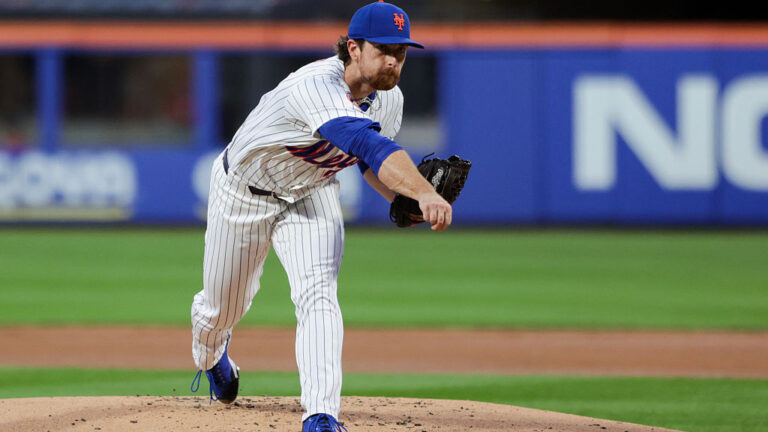
The New York Mets farm system is one on the rise, suddenly looking like one of the best in baseball, especially when looking at the very top, featuring plenty of top 100 prospects.
With President of Baseball Operations David Stearns now having finished his second year at the helm, the Mets have created a strong infrastructure that should yield better returns on the farm in due time.
Formerly in charge of the Astros draft, the Mets nabbed Kris Gross to oversee their amateur scouting. They also poached former big league manager Andy Green from the Chicago Cubs, putting him in a senior role to oversee player development.
Now with real continuity atop the organization, the Mets hope they can more consistently find and develop big-league talent to bolster a team that looks to contend for a long time around the highest-paid player in baseball in Juan Soto.
1. Nolan McLean – RHP – (MLB)
Height/Weight: 6’3″, 215 | Bat/Throw: R/R | 3rd Round (91), 2024 (NYM) | ETA: 2025
| FASTBALL | Sweeper | Slider | CURVEBALL | Splitter | COMMAND | FV |
| 70/70 | 60/60 | 50/50 | 55/60 | 50/55 | 45/50 | 60+ |
Once a two-way prospect, McLean’s impressive feel to pitch has shifted the focus to the mound where he offers exciting projection based on the athleticism and data. He converted the projection into production in 2025, elevating both his quality of stuff and consistency.
Continuing to improve as the year progressed, McLean debuted with the Mets and immediately showcased one of the more unique starting pitch mixes in Major League Baseball.
Arsenal
McLean utilizes a six-pitch mix, headlined by a pair of unique heaters. The four seamer sits a tick harder than the sinker, averaging 95.5 MPH through the second half of the season. His low release and arm angle helps the four seamer generate plenty of whiff at the top half of the zone, creating a difficult tunnel with the sinker that looks the same out of the hand, but with 10 inches of vertical separation and another four inches of horizontal.
Between the above average whiff rates on the four seamer and a gargantuan 80% ground ball rate in 2025 on the sinker, McLean’s two heaters worked in tandem to stifle hitters all year long in completely different ways.
His sweeper averages more than 16 inches of horizontal break at nearly 3,000 RPM. Generally a pitch shape that would yield noticeable platoon splits, the sharpness and McLean’s feel for it makes it effective against opposite-handed hitters as well, though he did hang a few in his big league debut.
Landing it for a strike roughly two thirds of the time as a pro is particularly impressive given how much horizontal action it features in the mid 80s. The platoon splits may be more of a factor in the big leagues, but it should be a wipeout right on right pitch.
McLean really showcases his feel to spin it with his two plane curveball, averaging north of 3,200 RPM with 19 inches of horizontal and 15 vertical. It essentially sits by itself in the bottom left corner of a scatterplot with other MLB arms. With so much break, it can be tough to land for a strike consistently, but even tougher for hitters to do anything with when it is around the zone.
McLean’s upper 80s gyro slider is a good bridge pitch that can also induce ground balls as well as decent whiff numbers from hitters of both handedness. His splitter took a big step forward in 2025 becoming a more trusted pitch for him against lefties with a feel for it that improved as the year progressed.
Outlook
A fantastic 2025 season was capped off by dominance at the highest level that has McLean looking like the best pitching prospect in baseball heading into 2026.
McLean’s deep bag of pitches headlined by a pair of unique fastballs and a rare ability to spin it give him frontline upside while his elite ability to roll ground balls helps solidify the floor. His command continued to improve as the season progressed, which could be the final variable between him being a No. 2 starter and a true ace.
2. Carson Benge – OF – (Triple-A)
Height/Weight: 6’2″, 185 | Bat/Throw: L/R | 1st Round (19), 2024 (NYM) | ETA: 2026
| HIT | PLATE DISC. | GAME POWER | RUN | FIELD | FV |
| 50/55 | 50/55 | 45/55 | 55/55 | 45/55 | 55+ |
Much like his OSU teammate Nolan McLean, Benge was a legitimate two-way talent for the Cowboys. After a big freshman season, Benge tapped into much more power in his draft-eligible sophomore year, making it clear his future was in the batter’s box and there might be room for even more impact.
Hitting
A noisy operation in the box, Benge starts with an open stance and rocks into his back side with a big leg kick and barrel tip. He starts it all very early with impressive lower half control and balance that likely spills over from his experience on the mound.
After struggling to elevate in 2023, Benge slashed his ground ball rate by more than 10%, more than doubling his home run total to 18 while increasing his slug by 130 points. Upon shifting his focus to the batters box, Benge has tapped into much more raw power, posting above average exit velocities in High-A.
Benge could still benefit from getting the ball in the air more frequently and his moves may be difficult to time up against upper-level pitching. He has great hand-eye with impressive swing variance to get to pitches in tough spots.
A patient hitter, Benge has continued to draw walks at a high clip as a pro and can be difficult to put away. With the added raw power, Benge’s ceiling has been pushed a bit higher, with 25+ home runs not completely out of the realm of possibility, but at least the chance to hit at least 20 with plenty of doubles.
Defense/Speed
He predominantly played right field in his collegiate career, but he looks like he can play up the middle. Though he’s closer to an average straight-line runner, Benge’s athleticism paired with the great reads he gets and efficient routes give him a good shot of becoming an average center fielder. If he moves off of the middle, he would grade as an easy plus defender in a corner where his plus arm would play well.
Outlook
Benge is a unique athlete who may just be scraping the surface of the player he can ultimately be. Early returns in 2025 have Benge on an upward trajectory as he has clearly added impact and made a seamless transition to High-A Brooklyn where some hitters can get frustrated by the ball flight.
He has a wiry build and could probably add some more strength without losing speed and It’s not uncommon for two-way players to add mass upon shifting their focus from the mound.
Added strength could also facilitate a simpler operation in the box. Benge has the potential to be an everyday center fielder with average or better tools across the board.
3. Jonah Tong – RHP – (MLB)
Height/Weight: 6’1″, 180 | Bat/Throw: R/R | 7th Round (209), NYM (2022) | ETA: 2026
| FASTBALL | Changeup | Curveball | Slider | COMMAND | FV |
| 70/70 | 70/70 | 50/55 | 40/45 | 40/45 | 50+ |
Tong was the breakout arm in the Mets system for 2024, riding a nearly two tick leap with his fastball to a 3.03 ERA in 113 IP with a ridiculous 34% strikeout rate across mostly Low and High-A. The stuff was even better in 2025, catapulting Tong into the conversation with some of the better pitching prospects in the upper minors.
Arsenal
A unique, over-the-top release and slight cross-fire delivery make Tong an uncomfortable at-bat for hitters. Tong enjoyed another uptick with his fastball in 2025, now averaging 95 MPH the pitch plays up further for Tong as he averages more than 19 inches of induced vertical break from a release height slightly above six feet.
With the carry and deception, Tong dominates within the zone, generating elite whiff rates, while also getting chase at the top. An even bigger development than the uptick in velocity has been Tong’s changeup in 2025. Sitting in the mid 80s, the pitch is difficult to pick up out of his hand. It averages roughly 20 inches of total separation from the fastball, one of the highest marks in MiLB.
Tong’s downer curve ball in the upper 70s flashes above average, but his inconsistent feel for it makes it difficult to rely on. When he is able to locate it, it’s a strong third offering.
Tong made progress with a mid 80s slider in 2024, mostly utilizing it against righties with success, but he will tend to tug it glove side too frequently. The development of his changeup and effectiveness of it right on right has cut into the usage further and much like his curveball, Tong has really struggled to land it consistently.
Outlook
Yet another fastball uptick paired with what now could be a double plus changeup has elevated Tong significantly. When he’s on, there’s few arms in the minor leagues more effective and overpowering. He will need to find more consistency with his spin and overall command to reach his potential as a starter, still fighting to stay above an overall strike rate of 60%. He has middle-rotation upside, but there’s still some reliever risk with the right-hander.
4. AJ Ewing – CF/2B – (Double-A)
Height/Weight: 5’11″, 180 | Bat/Throw: L/R | 4th Round-C (134), 2023 (NYM) | ETA: 2027
| HIT | Plate Disc. | GAME POWER | RUN | FIELD | FV |
| 50/55 | 50/55 | 30/35 | 70/70 | 45/55 | 50+ |
A speedster with advanced abilities at the plate, Ewing broke out in a big way in 2025, looking like a high probability big leaguer with some versatility.
Hitting
A simple operation, Ewing starts with his feet a little more than shoulder-width apart and the bat rested just above his shoulder. He utilizes a moderate gather as he pulls his hands back slightly. His repeatable operation helps him be on time consistently, making posting above average contact rates with good plate discipline.
Ewing has a knack for finding the barrel, producing plenty of line drives and higher exit velocities than what may be expected from a hitter of his archetype, averaging 89 MPH in 2025 with a max of 112 MPH.
His swing path can flatten out at times, with an average launch angle on hard hit baseballs of just seven degrees, but his ability to consistently spray line drives to all fields helps hedge some of that concern. Ewing is comfortable in left on left matchups, actually producing slightly better contact rates against same-handed competition.
If Ewing can generate a bit more loft to the pull side, the exit velocities are there to produce more homers, but given his speed, production and ability to find the outfield gaps, it may be more of an “if it ain’t broke don’t fix it” kind of thing.
As he currently stands, Ewing should still be able to mix in a hand full of homers with the ability to compile plenty of doubles and triples (he had 11 of the latter in 2025). His above average plate discipline and ability to hit lefties only helps solidify what is a strong floor for a hitter.
Defense/Speed
An elite runner, the Mets have continued to up Ewing’s reps in centerfield where his reads are improving, but his closing speed already compensates enough to get by.
While his routes can be indirect at times, Ewing’s ability to unlock another gear and athleticism to finish plays has him looking like a capable centerfielder, but with more refinement, he can grow into an above average defender out there. Ewing looks comfortable at second base, where he could also provide at least average defense.
One of five minor leaguers to steal at least 70 bags in 2025, Ewing was the second most efficient of that group and should be an elite base stealer at the highest level.
Outlook
Between the advanced offensive skill set, speed and defensive versatility, Ewing has a high floor as a player who should at least land in a utility role if the bat stalls. That said, his propensity for hitting line drives and solid exit velocities point towards what could be an everyday center fielder who can jump onto the dirt when needed. With a little bit more progress defensively up the middle, Ewing should be an above average regular who could be an intriguing table-setter at the top of the order.
5. Ryan Clifford – 1B – (Triple-A)
Height/Weight: 6’3″, 210 | Bat/Throw: L/R | 11th Round (343), 2022 (HOU) | ETA: 2026
| HIT | Plate Disc. | GAME POWER | RUN | FIELD | FV |
| 40/40 | 45/50 | 60/65 | 30/30 | 45/45 | 50 |
Drafted in the 11th round by the Astros, Clifford signed for second-round money ($1.25 million) to forego his Vanderbilt commitment before being traded alongside Drew Gilbert for Justin Verlander at the 2023 deadline. Clifford made some mechanical adjustments during the 2025 season which helped him cut down swing and miss.
Hitting
Clifford starts wide with his hands rested on his shoulder, before pushing his hands up and back to his slot with a pronounced coil as he loads. The emphasis on the coil is likely in an effort to mitigate his tendency to be heavy with his front foot, but during the 2025 season, he cut down his stride which in turn helped him hold his back side longer.
Now not pushing onto his frontside as early or heavily, Clifford’s barrel did not drag nearly as much, turning around velocity much more effectively. His contact rate on fastballs 93+ MPH jumped from 63% to 74% in 2025 with an OPS up roughly 200 points.
His improvements against velocity seemingly helped him control his at bats better as well. Now looking less rushed in the box, Clifford was much more effective against changeups as well, recognizing and staying back more easily.
Utilizing his lower half more effectively also translated into more consistently strong exit velocities. His hard hit rate jumped by 14% with a gaudy 90th percentile exit velocity of 108.5 MPH. His patience in the box can border on passivity at times, but Clifford’s swing decisions improved in 2025.
The contact rates are unlikely to be better than fringy at the highest level, though it is much easier to envision a quality power bat as he has rounded out some of the edges to his offensive profile while further tapping into his plus raw power in 2025.
He may ultimately be sheltered from left on left matchups, but Clifford has the offensive skill set to be a three true outcome hitter who can push north of 30 homers if he can maintain his contact gains at the highest level.
Defense/Speed
A below average runner, Clifford has seen action both in right field and first base. His easy plus arm could be more of an asset in right field, though his limited range and iffy reads could result in him playing most of his games at first base.
Outlook
Clifford’s easy plus power has always been his calling card, and with improved contact rates and approach, he is knocking on the door of the big leagues going into his age 22 season.
While his glove is not an asset, the ability to at least plug into the outfield corners in addition to first base helps his case. Ultimately, Clifford projects best as a bulk-platoon, three true outcome power bat, capable of launching 30+ homers.
6. Jacob Reimer – 3B – (Double-A)
Height/Weight: 6’2″, 205 | Bat/Throw: R/R | 4th Round (119), 2024 (NYM) | ETA: 2027
| HIT | Plate Disc. | GAME POWER | RUN | FIELD | FV |
| 40/50 | 60/60 | 50/55 | 45/45 | 40/45 | 50 |
A California prep bat, Reimer was selected in the fourth round of the 2022 draft, turned in an impressive first pro season in 2023 before injuries limited him to just 21 regular season games in 2024. The Mets sent Reimer out to the Arizona Fall League to make up for lost reps, where he posted mostly average numbers, but started to make the mechanical adjustments that have him breaking out in 2025.
Hitting
Reimer previously started with his weight stacked on his back side and back knee bowed out towards home. Starting so stacked with his back knee at that angle likely made it more difficult to hold his weight back as he began his launch, resulting in some drift forward.
He now starts more upright, coiling into his back side with rhythm along with his barrel getting into a slot that is much easier to get on plane (he dropped his hands too low with the bat more vertical as he loaded before).
These improvements have Reimer’s barrel living in the zone much longer while putting him in a more powerful position to hit. He has cut his ground ball rate by 10% while his hard hit rate has jumped from 33% in 2023 and 2024 combined to a whopping 49% through his first 50 games in 2025.
While finding more barrel depth, Reimer has maintained solid contact rates while his pitch recognition skills and feel for the strike zone stand out. There’s above average power potential with the feel to hit and approach to get into it.
Defense/Speed
Not necessarily the fleetest of foot, Reimer’s range is fringy at third base, but he has an above average arm and is comfortable throwing on the run and from different angles. He may ultimately profile best at first base, but Reimer should be able to provide passable defense at third.
Outlook
Earning high marks for his work ethic and knowledge of his swing, Reimer followed an injury-riddled 2024 season with tangible adjustments in the box and added strength that have him breaking out offensively in 2025. Even if there is limited value beyond the bat, Reimer has the offensive ingredients to get on base at an above average clip and hit 20-25 homers.
7. Jack Wenninger – RHP – (Double-A)
Height/Weight: 6’4″, 230 | Bat/Throw: L/R | 6th Round (186) – NYM (2023) | ETA: 2026
| FASTBALL | Splitter | Slider | COMMAND | FV |
| 55/55 | 60/65 | 50/50 | 50/55 | 45+ |
A sixth round pick in 2023, Wenninger’s fastball jumped nearly three ticks in 2025, facilitating a breakout as he nearly halved his ERA in his first year at Double-A while tossing 135 2/3 innings.
Arsenal
After averaging roughly 92.5 MPH on his heater in 2024, Wenninger sat above 95 MPH in 2025, seeing his velocity continue to climb as the season progressed. Over his final 10 starts, Wenninger averaged 95.8 MPH with his four seamer and a half tick below that with his sinker.
Wenninger’s four seamer gets some run and ride, generating good whiff numbers within the zone and really crowding right-handed hitters on the inner half hitting just .170 against the pitch at Double-A.
His best pitch is his plus splitter in the mid 80s, getting plenty of vertical separation from the fastball, often looking like it runs out of gas just before home plate. While it is his preferred secondary to lefties, the way the pitch works off of his fastball makes it effective to righties as well, generating a chase rate north of 40% while going to more than 20% of the time.
Wenninger’s go-to secondary against righties is his mid 80s gyro slider. He’ll throw it nearly 30% of the time to same-handed hitters with far better results than when he mixes it in to lefties. It’s likely an average third offering that flashes above.
Outlook
Already comfortable filling up the zone with each of his offerings, Wenninger was able to maintain a walk rate south of 8% as his quality of stuff took a massive leap in 2025.
The strike throwing ability and pitch mix give him a great chance to sit in the back of a rotation as a sturdy innings eater. Wenninger has the upside of a No. 4 starter and reached closer to that with the way he closed out his season at Double-A, making him a candidate to see big league action with the Mets in 2026.
8. Jonathan Santucci – LHP – (Double-A)
Height/Weight: 6’2″, 195 | Bat/Throw: L/L | 2nd Round (46) – NYM (2024) | ETA: 2027
| FASTBALL | Slider | Curveball | Changeup | COMMAND | FV |
| 55/55 | 60/60 | 40/50 | 35/45 | 40/45 | 45+ |
A southpaw with an exciting fastball, slider combination Santucci had plenty of first round buzz heading into his draft year before a rib injury and command issues pushed him to the second round. Santucci looked like a first round talent in his first pro season, cutting down the walk rate and improving as the season progressed, dominating at Double-A in the second half.
Arsenal
Santucci gets above average carry on a 94-95 MPH fastball, generating above average whiff numbers within the zone. His gyro slider pairs well with his fastball with the vertical action to make it effective to both lefties and righties, with strong whiff and ground ball rates. He commands the slider better than any of his offerings, with a strike rate of nearly 70% in 2025.
The southpaw is still looking for a consistent third offering, with his low 80s curveball looking more reliable than his firm upper 80s changeup. The shape of his curveball is similar to that of Noah Cameron’s, flashing at least average, but without much consistency and less than 10% usage.
Outlook
Santucci’s 2025 season has him rising up the Mets ranks as the best left-handed pitching prospect in their system. Though the control improved mightily in his pro debut, Santucci’s command is still a work in progress, with a strike rate of just 61% on all offerings other than his slider.
The fastball, slider combination gives Santucci the floor of an effective left-handed reliever, but his improved ability to throw strikes and at least signs of a third offering have earned him plenty of runway as a starting pitching prospect where he could be a quality No. 4 starter if it comes together.
9. Elian Peña – SS – (DSL)
Height/Weight: 5’10″, 185 | Bat/Throw: L/R | IFA: $5M, 2025 (NYM) | ETA: 2029
| HIT | PLATE DISC. | GAME POWER | RUN | FIELD | FV |
| 40/55 | 45/55 | 40/55 | 55/55 | 35/50 | 45+ |
The centerpiece of the Mets 2025 IFA cycle, Peña accounted for more than 80% of the Mets bonus pool, selling David Stearns and co. on his above average tools across the board and advanced left-handed stroke.
After an 0-for-26 start to his pro career, Peña OPS’d north of 1.000 the rest of the way, launching nine homers and walking more than he struck out, generating plenty of buzz heading into his 2026 season.
Hitting
Peña syncs his upper and lower half well for a teenage prospect, helping him repeat his moves and create leverage. He starts upright with his hands rested just above his shoulder, getting into his back side with a moderate gather and smooth, rhythmic hand load.
Of course, it’s more difficult to maintain rhythm against more challenging pitching, but Peña has better control of his timing and mechanics than most hitters his age. As a result, he is able to pull the ball in the air at a high clip, translating into nine homers and 23 extra base hits over his final 44 games of the 2025 season with a 35% ground ball rate.
Peña recognized spin well in the DSL, walking more than he struck out while producing strong numbers in left on left matchups. It’s early in his development, but Peña’s 2025 campaign made it easy to see why he was the crown jewel of the Mets IFA class.
Defense/Speed
An above-average runner, Peña made gains with his straight-line speed and overall quickness, helping his chances of being able to fend off a move to third base. How Peña progresses physically will play a large part in his defensive outcome. His plus arm and good hands would profile well at third base if he does slow a bit.
Outlook
Steve Cohen and David Stearns have made it a point to improve the organization’s ability to acquire international talent and made the biggest splash of the 2025 period outside of Roki Sasaki. The Mets will give Peña every opportunity at shortstop, where he has enough going for him to have a chance at sticking.
In the more likely event that he moves over to the hot corner, Peña’s offensive upside is exciting enough to meet the higher offensive bar the position demands and then some. His advanced blend of hit, power and plate discipline in the DSL should ease his transition stateside in 2026 with a chance to hit his way off of the Complex to Low-A quickly in his age 18 season.
10. Nick Morabito – OF – (Double-A)
Height/Weight: 5’11″, 185 | Bat/Throw: R/R | 2nd Round-C (75), 2022 (NYM) | ETA: 2026
| HIT | Plate Disc. | GAME POWER | RUN | FIELD | FV |
| 45/50 | 50/55 | 35/35 | 70/70 | 55/55 | 40+ |
Arguably the fastest runner in the Mets system, Morabito also led all Mets minor leaguers in hits and batting average in 2024 and followed up with a solid year at Double-A in 2025.
It’s a direct and rather flat swing, resulting in higher ground ball rates and an average launch angle of just three degrees. The good news is, Morabito has the speed to beat out weakly hit ground balls and choppers, but as defenders become better, those kinds of hits become less easily attainable.
Morabito has the ability to be an above average defender in center field, demonstrating good instincts and range with an above average arm. He is a major factor on the base paths, but could be a bit more efficient, swiping 59 bags on 74 tries in 2024 and 49 on 60 tries in 2025. Morabito has a great chance of at least landing as a fourth outfielder.
11. Mitch Voit – 2B – (Low-A)
Height/Weight: 6’0″, 200 | Bat/Throw: R/R | 1st Round (38), 2025 (NYM) | ETA: 2028
| HIT | Plate Disc. | GAME POWER | RUN | FIELD | FV |
| 40/50 | 50/55 | 35/50 | 60/60 | 40/50 | 40+ |
Voit was a two way player for the Michigan Wolverines, shining more with the bat, but still giving them 62 1/3 innings in his draft year. At the plate, he mashed his way to a 1.140 OPS, matching his previous year home run total of 14, but with improved bat to ball and plate discipline.
It’s a simple operation at the plate, somewhat reminiscent of Cam Smith–albeit with less raw impact–but there’s some hope that Voit can tap into some more hitting-conducive strength now that the pitching days are behind him.
Defensively, Voit is limited to second base, but he should be a fine defender there with his plus wheels translating more on the base paths. The bat will need to carry the profile here and there’s potential for at least average hit and power.
12. Will Watson – RHP – (Double-A)
Height/Weight: 6’1″, 185 | Bat/Throw: R/R | 7th Round (203) – NYM (2024) | ETA: 2027
| FASTBALL | Slider | Cutter | CHANGEUP | COMMAND | FV |
| 50/50 | 60/60 | 40/45 | 50/55 | 35/45 | 40+ |
Initially a two-way player at California Lutheran, Watson shifted his focus to the mound full time before transferring to USC where he pitched his way from the bullpen to a starter’s role. His athleticism is evident, working down the mound well, releasing from a roughly 5 foot height with a long arm action that can make it difficult to consistently hit his spots.
Though his fastball averaged 95 MPH and is released from a low slot, it seemed to be relatively easy for hitters to stay on, with a 45% Hard Hit rate allowed and a swinging strike rate below 8%. His best pitch is his plus slider at 85-87 MPH that decimated right-handed hitters in 2025. His equalizer for lefties is an above average changeup, but he will mix in a fringy cutter as well.
Watson has big league stuff and the athleticism to dream on some more, but his command will need to improve to fend off a move to the bullpen.
13. Chris Suero – C/1B/OF – (Double-A)
Height/Weight: 6’0″, 200 | Bat/Throw: R/R | IFA: $10,000, 2022 (NYM) | ETA: 2026
| HIT | Plate Disc. | GAME POWER | RUN | FIELD | FV |
| 35/40 | 45/45 | 50/55 | 60/60 | 45/50 | 40 |
A unique profile, Suero continues to see action behind the dish, in the outfield and at first base. He’s a plus runner with a good arm, inspiring the Mets to continue to move him around the diamond. He made a leap in the power department in 2025, launching 19 homers between High-A and Double-A with a career-best 35 stolen bases as well.
He is pull-happy, but successfully pulls the ball in the air at a high clip with above average exit velocities. Higher end pitching velocity could make Suero looked rushed at times, hedging with the ability to hammer mistakes far more consistently, OPSing north of 1.000 vs sliders.
While the hit tool will likely be fringy at best, his unique skill set could position him like a more athletic David Fry. His plus wheels, above average pop and defensive versatility helps his chances of sticking on a roster.
Other Names to Consider
R.J. Gordon – RHP – (Double-A): A 13th rounder in 2024, Gordon impressed with his polish in his pro debut, compiling 128 2/3 innings between High-A and Double-A while pitching to a 3.36 ERA and striking out 27% of batters.
Gordon’s fastball only sits 92-94 MPH, but his ability to locate spin stands out. He landed his slider and curveball for a strike north of 70% of the time, mixing in a serviceable splitter to lefties as well. Gordon looks the part of a depth starter who could miss enough bats to be a back end innings eater.
Ryan Lambert – RHP – (Double-A): An 8th round selection in 2024, Lambert bounced Northern Iowa Area Community College in 2022 to Missouri State in 2023 and Oklahoma in 2024.
His fastball and overall intensity on the mound caught the attention of big league clubs and translated into a dominant first full pro season, pitching to a 1.62 ERA in 50 innings, striking out 81. His 70 grade fastball averages 97 MPH and gets plus carry from a short arm delivery that results in big whiff within the zone and chase at the top. The slider is still a work in progress off of it, but the fastball alone makes him a high probability big league reliever.
Jonathan Pintaro – RHP – (MLB): Pintaro went undrafted out of Division II Shorter University in 2022, pitching in the Pioneer League until he garnered the attention of the Mets.
Pintaro ripped through High-A and Double-A in his first affiliated season, making one start at the Triple-A level at the end of the year. Pintaro was utilized somewhat as a swingman between Double-A and Triple-A in 2025, regressing in the run prevention department, but continuing to strike out batters in droves (29% strikeout rate).
It’s a hard and harder approach with a fastball and sinker in the mid 90s and a cutter in the low 90s leading the way along with a changeup that he will mix in. Pintaro has the stuff to be a middle relief option if he can cut down on the free passes.
Yovanny Rodriguez – C – (DSL): A $2.85 million pay day and rave reviews from scouts created plenty of hype for the Venezuelan catcher, but he stumbled out of the gate in his pro debut. His impressive defensive skill set did not immediately translate while posting a .715 OPS at the DSL in 2024.
This had the Mets keep the 18-year-old in the DSL for another year before bring him stateside, and he produced much better results in 2025. Rodriguez hit .331/.446/.493, with a .939 OPS. Rodriguez has the defensive tools to be a big league catcher, and the improvements with the bat were encouraging.
Dylan Ross – RHP – (MLB): A 13th round pick in 2022, Ross did not make his pro debut until the end of the 2024 season after requiring UCL revision surgery to rectify the initial Tommy John surgery he underwent just two starts into his 2022 season. After his brief cameo in 2024, Ross burst onto the scene in 2025, climbing from High-A to Triple-A, pitching to a 2.17 ERA in 54 innings with 80 strikeouts.
Ross’s fastball averages 98 MPH with a wipeout splitter working off of it in the low 90s. Across all three levels in 2025, opponents hit below .100 against Ross’s split. He’ll also mix in an above average slider. Ross has big league leverage stuff if the command can improve (he walked 15% of batters in 2025).
Needing to protect him from the Rule 5 Draft anyway, the Mets added Ross to the big league roster at very the end of the season, but he never made it into a game. Now on the 40, Ross should be squarely in consideration for big league opportunities early in 2026.
Eli Serrano – OF – (High-A): A fourth round pick by the Mets in the 2024 Draft out of NC State, the Mets snagged Serrano as a draft-eligible sophomore despite him putting up rather pedestrian numbers, betting on his fascinating upside.
The raw exit velocities have been there for the 6-foot-6 outfielder, as have the contact rates, but he has struggled to translate it into production. Serrano’s hard hit rate of 47% and contact rate of 76% in 2025 were both respectable, however he left the yard just seven times with a .690 OPS at High-A.
The Mets are hoping Serrano can add more strength to his very slender frame, which paired with his surprisingly solid bat-to-ball, could turn him into an exciting corner bat.
Zach Thornton – LHP – (Double-A): Another Mets pitching prospect who took a leap in 2025, Thornton was drafted in the fifth round in 2023, turning in a decent first pro season before dominating to a 1.98 ERA in 72 2/3 innings at High-A and Double-A in 2025.
A pitchability southpaw, Thornton fills up the strike zone with his low 90s fastball that generates above average carry and extension. His slider is his best swing and miss pitch to both lefties and righties while mixing in a cutter, sinker and curveball as well.
Thornton’s breakout was cut short due to an oblique injury, but he is a high probability depth arm who could potentially miss enough bats to round out a rotation.

Written by
Aram Leighton is the Co-Founder and Executive Editor for Just Baseball. A Syracuse University grad, Aram is one of the hosts of the Just Baseball Show…