
Trade Reaction: Shane Baz to the Orioles for an Absolute Haul
The cost of starting pitching on the trade market is exceptionally high, as Shane Baz was just traded for four prospects and a draft pick.
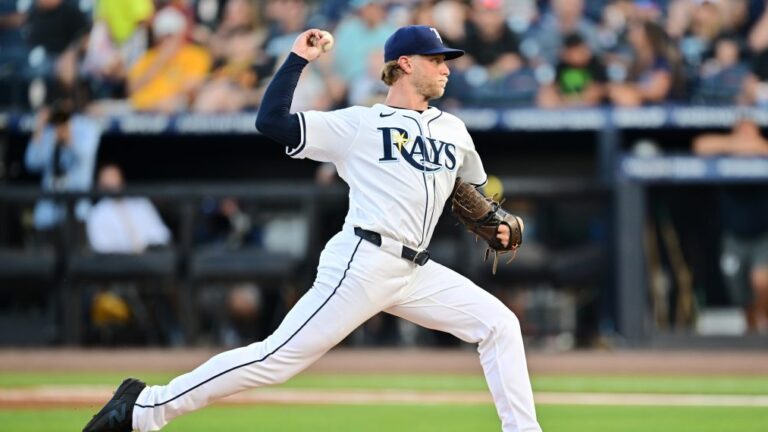
The Baltimore Orioles acquired right-hander Shane Baz from the Tampa Bay Rays in a deal that reflects two organizations operating from very different competitive positions.
For the Orioles, the move signals a willingness to pay real prospect capital for controllable upside in the rotation. For the Rays, it represents a familiar pivot—turning a volatile but talented arm into a diversified package of athleticism, pitching upside, and draft flexibility.
In return for Baz, the Orioles sent the Rays outfielder Slater deBrun, catcher Caden Bodine, right-hander Michael Forret, outfielder Austin Overn, AND a Competitive Balance round A draft pick.
Shane Baz: Why Baltimore Targeted Him
Shane Baz is an attractive trade acquisition for Baltimore because he offers something that is increasingly difficult to find: an elite fastball foundation paired with multiple viable secondary offerings and remaining developmental upside.
Baz’s four-seam fastball is the clear carrying pitch. The shape allows it to miss bats at a high rate, generating a 26.4% whiff rate, and gives him a weapon that can anchor the arsenal of a #2 starter.
Fastballs with this combination of ride and velocity provide margin for error and allow pitchers to build entire sequencing plans around them, particularly in high-leverage and postseason environments.
His knuckle curve has emerged as his primary secondary offering. It is his second-most-used pitch and has performed well by both contact quality and swing-and-miss measures, yielding a .295 xwOBA with a 29.5% whiff rate.
The pitch gives Baz a distinct vertical breaking look that pairs naturally with his fastball, allowing him to change eye levels and finish hitters once ahead in the count.
Baz made a notable adjustment in 2025 by leaning more heavily on a cutter in place of his slider as his tertiary pitch. While the cutter has functioned as a stabilizing offering rather than a bat-misser, it provides a different look to right-handed hitters and helps him navigate lineups multiple times.
That said, arguably his most intriguing secondary pitch remains the changeup, which features a unique horizontal profile with 16.7 inches of arm-side run. The pitch gives Baz a weapon that can neutralize left-handed hitters and further diversify his arsenal beyond vertical movement alone.
Despite these strengths, Baz’s surface-level run prevention lagged in 2024, as he posted a 4.87 ERA and 4.08 FIP.
However, his underlying indicators paint a more encouraging picture, with a 3.85 xERA and 3.88 xFIP, suggesting that his true talent level outpaced his results. For a team with confidence in its pitching infrastructure, this gap represents opportunity rather than concern.
Baz will turn 27 in June and remains under team control through the 2028 season, giving Baltimore multiple seasons to extract value and potentially unlock another level of performance.
When combining age, control, fastball quality, and underlying indicators, it’s easy to see why the Orioles viewed Baz as a worthwhile bet to bolster their rotation with upside that extends beyond the immediate season.
Caden Bodine (C)
Caden Bodine was selected 30th overall in the 2025 draft out of Coastal Carolina and immediately profiles as a high-probability major leaguer.
His value is anchored by elite defensive ability behind the plate, while his offensive profile carries a strong floor, highlighted by an 85% contact rate in his professional debut and a 15% walk rate in his final collegiate season.
As a switch-hitter with advanced feel for the strike zone, Bodine offers offensive utility without needing to be a bat-first catcher. For Tampa Bay, he represents a near-term solution at a premium defensive position, with a realistic path to contributing to the big-league catching mix by 2027.
Michael Forret (RHP)
A 14th-round pick in 2023, Michael Forret emerged as one of Baltimore’s fastest-rising arms, posting a 1.58 ERA across 74.1 innings between High-A and Double-A during his age-21 season.
His calling card is a biting gyro slider that tunnels effectively off his fastball and gives him a legitimate bat-missing weapon.
Forret also introduced a kick change as a distinct look against left-handed hitters, adding another layer of deception to his arsenal.
As a high-upside pitching bet with underlying traits to build on, Forret fits the exact profile Tampa Bay has consistently targeted and developed into major league contributors.
Austin Overn (OF)
A third-round selection in the 2024 draft out of USC, Austin Overn brings a rare power-speed combination to the deal.
In his first full professional season, he posted a 123 wRC+ across High-A and Double-A, stole 64 bases in 112 games, and showed emerging pop with 13 home runs, including five in just 30 Double-A games.
Overn is a double-plus runner with twitchy athleticism, though his profile does carry swing-and-miss risk, particularly during his brief Double-A stint after showing strong plate discipline earlier in his career.
While he doesn’t fit the traditional three-true-outcome mold at 6-foot, 175 pounds, his athleticism and versatility give him a realistic path to a fourth-outfielder role with upside in Tampa Bay’s system.
Slater de Brun (OF)
Yet to make his professional debut, Slater de Brun was an overslot Competitive Balance Round A selection (37th overall) in the 2025 draft, with Baltimore committing $4 million to sign him away from an Oregon State commitment.
A twitchy, well-built athlete at 5-foot-10, 187 pounds, de Brun combines plus speed with a strong feel for the barrel, allowing him to maximize contact quality despite not being a prototypical power bat.
His offensive foundation is underscored by elite swing decisions, evidenced by a .616 on-base percentage on the summer circuit leading into his draft year.
De Brun won’t turn 19 until June 2026, giving Tampa Bay a long developmental runway with a high-upside athletic profile they’ve historically valued.
Trade Summary & Organizational Context
The inclusion of a Competitive Balance Round A pick is a meaningful component of this return, particularly for a team like Tampa Bay.
Beyond the player attached to the selection, the pick carries additional bonus pool flexibility, which is especially valuable in a draft where the Rays hold the second overall pick.
That additional pool money could materially influence Tampa Bay’s strategy at the top of the draft, whether enabling an overslot selection at No. 2 or providing flexibility later in the round.
From Baltimore’s perspective, this deal represents a high-upside swing predicated on belief in Shane Baz’s ceiling and the sustainability of his underlying traits.
The Orioles paid a steep price in prospect capital to acquire that upside, fully accepting the risk that comes with Baz’s injury history and uneven run prevention.
For Tampa Bay, the trade is a classic value conversion—cashing in on a pitcher who flashed elite ability but never consistently sustained it, and turning that volatility into depth, athleticism, and draft leverage.

Written by