
The ‘Run Prevention’ Mets Need to Find Run Production
How soon is too soon to panic about the New York Mets' struggling offense?

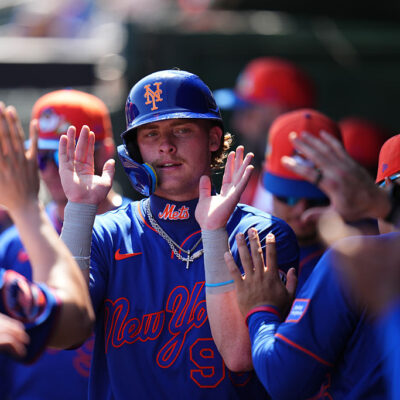
The New York Mets‘ pronounced offseason strategy was to increase their team’s run prevention, placing an emphasis on both pitching and defense. However, throughout the first few weeks of the 2026 season, New York has sported a feeble offense.
The new-look Mets offense has appeared weak nearly everyday thus far, and that creates a lot of questions.
What is going on with this group? Is it simply a slow start? Is it a case of a team with an overhaul of new players who have not gelled yet? Or perhaps, it’s an issue with the coaching staff. All of the above could be the answer as well.
No matter what the real issue is, one thing is certain: New York is going nowhere in 2026 if it does not turn it around at the plate.
Stats were taken prior to play on April 16.
By The Numbers
New York has scored just 65 runs so far, placing it 26th in baseball. As a team, the Mets are slashing .220/.286/.331, resulting in a bottom-two OPS of .617.
If that weak slugging percentage did not already tell you enough, New York has suffered a power outage, slugging only 14 home runs in 19 games.
Last week, I alluded to how hitting with runners in scoring position was an issue for this group. It has improved slightly in that area since then but has struggled to come through with two outs, hitting just .174 as a team in those crucial situations.
New York has not struggled with strikeouts and has been putting the ball in play, however. The issue is that the quality of contact on those balls in play has been poor. As a team, New York has recorded only 34 total barrels, which amounts to 6.9% of balls in play, ranking them 23rd in the big leagues.
The lack of home runs and clutch hitting directly correlates with the lack of quality contact. You could chalk it up to colder New York weather in April, but the Mets’ simply have not performed at the plate so far.

The Good
I have good and bad news, but I’ll give you the good news first!
For starters, what has taken place offensively for the Mets so far does not fall on the shoulders of Luis Robert Jr. and Fransisco Alvarez. Both Alvarez and Robert have started the season hot and carried the load for New York, making major strides in areas where they once struggled.
Alvarez is barreling the ball at a 21.6% rate, nearly 10 ticks higher than what he posted last season. He has not particularly hit the cover off the ball in terms of exit velocity, but his quality of contact has been rock solid.
Robert has shown remarkable patience, completely contradicting what we have seen from him in the past. His 17.1% walk rate is nearly eight percentage points higher than last season and plays a major role in his on-base percentage of .371. His production has certainly been a silver lining for the Mets.
The Bad
Outside of those two, everyone else has been an issue.
The most prominent of which is Fransisco Lindor, who once again is off to one of his patented slow starts with a 71 wRC+. Bo Bichette has joined Lindor with a lowly 65 wRC+ mark, as two of New York’s marquee bats are off to dreadful offensive starts.
When Lindor goes, so do the Mets. In the past two seasons, Lindor has hit under .200 in games the Mets lost. 51 of his 64 home runs across the last two seasons have come in wins. He is the fuel that powers the engine for this franchise, and in order for this ship to turn around, he has to get going.
Another issue is that the players who are supposed to beef up the middle and back end of this order simply have not. Brett Baty, Marcus Semien, Jorge Polanco and Mark Vientos have all struggled overall, providing next to no length in the lineup.
This does not even account for the absence of Juan Soto, who is out a calf strain. The Mets’ individual struggles have only increased without the anchor of their lineup, who remains on the shelf.
Looking Ahead
It is early in the season, but New York cannot simply sit around and wait for Soto to return before it starts hitting. The Mets recently went on a stretch of not scoring a run in 20 consecutive innings, a dreadful stretch that is defined by all the factors discussed above. No matter how early it may be, that always should raise a red flag.
They have lost eight in a row and, and despite their struggles, they are still 7-12. Record watching this early in the season is not a major concern, but each day that passes without the Mets finding their groove leaves less time to recover.
The talent is undoubtedly there, and the hope is that, with time, this group gels and begins to click as expected. But perhaps it never will, and the Mets will be left to look back on an offseason full of mistakes.
Become a Member of Just Baseball
Subscribe and upgrade to go ad-free!
* Save 25% by subscribing annually.

Written by
Joe Browne is an aspiring sports journalist and is currently a sophomore at St. John's University. Joe is a lifelong Mets fan who is also passionate…