
Roki Sasaki Is Embracing His New Role With the Dodgers
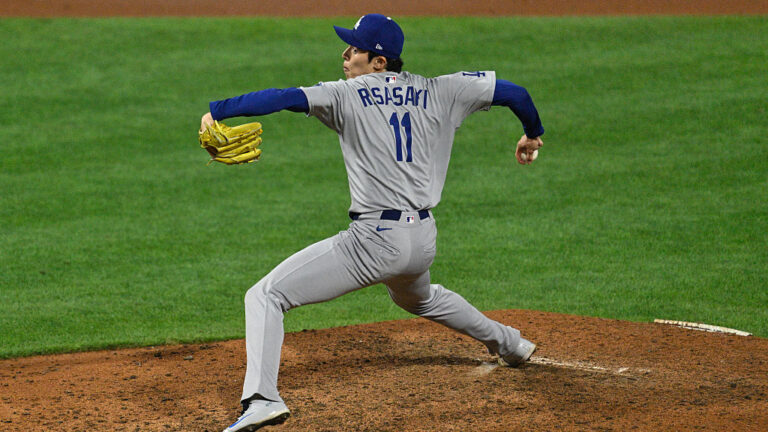
The biggest question mark for the Dodgers coming into this postseason was their bullpen. Now healthy, Sasaki is helping turn things around.
 | |
| | 
As Roki Sasaki walked off the mound on May 9, it appeared his season may have been over.
He had just given up five runs over 4.0 IP, failing to record a strikeout while allowing two home runs in the process. Even worse, Sasaki’s velocity continued to decline. He averaged 94.8 mph on his fastball, dipping as low as 92.8 mph.
Sasaki would be relegated to the injured list shortly after this start. The Los Angeles Dodgers cited a right shoulder impingement, similar to the issue that had plagued him during his final years in Japan.
With no timeline for recovery provided, it was reasonable to assume the Dodgers may simply shut Sasaki down for the year. After all, his 4.72 ERA and 1.49 WHIP left much to be desired at the time.
However, Sasaki was determined to make his way back. After a few months of recovery, he began to ramp back up on rehab assignments in the minor leagues.
Sasaki’s first few rehab starts did not go well, as he allowed 20 hits and 14 runs over 18.2 innings of work. He also walked 12 batters while striking out just 16. However, something seemed to click in his next appearance.
On September 18, Sasaki pitched in relief for the first time, notching two strikeouts in a hitless inning. Notably, both Sasaki’s fastball and splitter saw significant velocity bumps. His fastball in particular averaged 98.9 mph, topping out at 100.1 mph.
Sasaki followed this outing up with another scoreless outing. Shortly after, he made his return to the Dodgers and fired off two more scoreless appearances.
For a Dodgers bullpen that has struggled significantly throughout this year, Sasaki’s arrival was crucial. Now midway through the NLDS with the Dodgers up 2-0 on the Phillies, he has more than shown why.
Bullpen Blues
The Dodgers’ bullpen put up a collective 4.27 ERA throughout the regular season. This figure places them squarely in 20th place across MLB, despite leading the league with 657.2 innings pitched.
Some players performed well throughout the year, with Jack Dreyer, Alex Vesia, and Anthony Banda being the primary standouts. However, several key bullpen arms struggled mightily.
Tanner Scott, the Dodgers’ $72 million closer signed this past offseason, went 1-4 with a 4.74 ERA in 61 appearances. Their other bullpen signing, Kirby Yates, similarly worked to a 5.23 ERA in 50 appearances.
Even Blake Treinen, a major part of their 2024 World Series run, had a brutal year. Over 32 appearances, Treinen worked to a 5.40 ERA and recorded seven losses.
In fairness, the bullpen seems to have gotten slightly unlucky. They struck out batters at a high rate, and were closer to the middle of the pack in terms of walk percentage and home run rate.
However, they gave up far more fly balls than ground balls, posting the sixth worst GB/FB ratio in the league. They did not give up hard contact often, ranking eighth in MLB in soft contact rate. But, because of the low ground-ball rate, many of these instances resulted in base hits to the outfield.
The most concerning factor for the Dodgers bullpen was their performance in high-leverage situations. Their bullpen ranked 28th in FanGraphs’ “Clutch” — a statistic indicating how much better (or worse) a team does in high-leverage than in context-neutral situations.
The Dodgers entered the postseason with real concerns for the late game. Luckily, they also have a wealth of starting pitching to draw from.
Monster of the Reiwa Era
Because the Dodgers only need a four-man rotation for the postseason, players like Tyler Glasnow and Emmet Sheehan have been able to take some pressure off the bullpen.
However, Sasaki has taken this a step further and become the Dodgers’ de facto closer. He has now made three scoreless postseason appearances for the Dodgers, each coming in the ninth inning.
Sasaki’s first outing came on October 1. He entered the game with a four-run lead and a chance to secure a trip to the NLDS for the Dodgers. He struck out two batters and allowed no hits, averaging 100.6 mph on his fastball.
Three days later, Sasaki took the mound in the ninth inning of NLDS Game 1 against the Phillies. Sasaki allowed one hit and notched another strikeout, again averaging over 100 mph on his fastball and securing the victory for the Dodgers.
Sasaki closed out Game 2 in dramatic fashion. Up 4-1, the Dodgers were hesitant to bring in Sasaki for the second time in three days, so they opted for Treinen to start the ninth.
Unfortunately for the Dodgers, this was a costly mistake. Treinen surrendered three hits in a row, loading the bases with no outs. Manager Dave Roberts then turned to Vesia with a string of lefties coming up.
Vesia was able to record two outs, but the Phillies brought home two runners, cutting the Dodgers lead to one run. Finally, Roberts called upon Sasaki to finish the game out.
With runners at the corners and NL batting champion Trea Turner at the plate, the immediate pressure on Sasaki would be immense. However, this seemed not to phase him.
Sasaki retired Turner on a ground ball to second base, notching his second MLB save. He became the first pitcher since saves became an official statistic in 1969 to record his first two career saves in the postseason.
The Path Ahead
The Dodgers now command a 2-0 lead on the Phillies in the NLDS. They are heading back to Los Angeles just one win away from another trip to the NLCS.
Roberts announced today that Sasaki will serve as the Dodgers’ top option to close out games for the remainder of October. The Dodgers will still need their starting rotation to provide depth, but Sasaki is a major stabilizing force for the bullpen.
All in all, Sasaki has pitched 4.2 scoreless innings as a reliever, recording seven strikeouts without walking a single batter. He has thrown 38 of 49 pitches for strikes, and has mostly sat around 100 mph on his fastball.
Sasaki has looked like an entirely new player since his return. While Sasaki had struggled at times with command, he has pitched with confidence and fervor. Even in pressure-filled situations, Sasaki has largely been unfazed.
Describing what it was like to be faced with a jam-packed Citizens Bank Park in the most pivotal appearance of his MLB career thus far, Sasaki played it cool.
“I don’t understand English that well, so I didn’t even know what they were saying,” he relayed via an interpreter. “I just tried not to let it bother me. I’ve had similar experiences back in Japan, so I was able to stay focused and pitch without being affected.”
The Dodgers still have a tough road ahead, and the Phillies could still mount a comeback in this series. However, Sasaki’s emergence has helped shore up the Dodgers’ most vulnerable weak point.
Written by