
Playing GM: 5 Moves To Complete the Baltimore Orioles Roster for 2026
The Baltimore Orioles are trying to bounce back from a disappointing 2025 season. These five moves will help them return to contention.
 | |
| | 
The Baltimore Orioles told us they were going to sign an impact bat this winter, and they meant it.
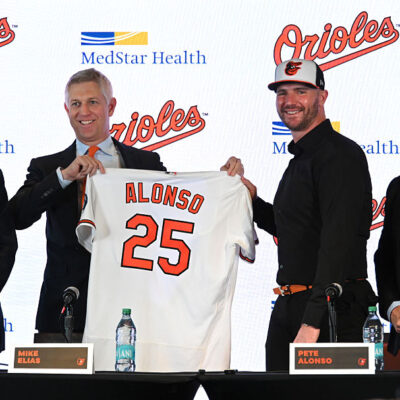
After whiffing on Kyle Schwarber, president of baseball operations Mike Elias quickly pivoted to Pete Alonso, signing the former Mets first baseman to the second-largest contract of the offseason and the second-largest contract the Orioles have ever awarded. By average annual value, it’s the largest of both.
Five years. $155 million. $31 million per year. Though really, the most important number is 264. That’s how many home runs Alonso has hit in his seven big league seasons. He’s more than halfway to 500, and he only just turned 31.
Considering that Chris Davis – whose seven-year, $161 million deal from 2016 remains the most lucrative in franchise history – had already played in Baltimore for five seasons, it wouldn’t be hard to argue that signing Alonso was the biggest splash this team has ever made in free agency.
That’s not all the O’s have done this winter, either. Before signing Alonso, Elias added more right-handed power in the form of Taylor Ward.
By giving up Grayson Rodriguez in exchange for Ward, the Orioles POBO showed he wasn’t afraid to sacrifice long-term potential to raise his team’s immediate floor. Rodriguez could prove to be a great starting pitcher for years to come, but Ward is a sure thing to improve the offense right now.
Since his first full season in 2022, Ward has been an above-average hitter every year. He is particularly dangerous against left-handed pitchers, and Baltimore needed help in that department. You can argue the Orioles gave up too much to acquire him, but there’s no denying that a hitter like Ward was exactly what they needed.
Turning to the other side of the ball, Elias also signed Ryan Helseley to a two-year, $28 million contract.
The All-Star closer struggled last year, particularly after the trade deadline, but he was unquestionably one of the game’s best relievers from 2022-24. In 152 games, he pitched to a 1.83 ERA, striking out 225 hitters while giving up just 10 home runs.
Individually, his pitches looked nasty as ever in 2025, even when he was giving up hit after hit (after hit) with the Mets. Whether his problem was pitch tipping, game planning, or just plain bad luck, Helsley is a strong candidate to bounce back. If he does, he’ll make the loss of Félix Bautista for most of the season much more manageable.
Joining Helsley in the bullpen will be his former Cardinals teammate, Andrew Kittredge. The first major move the Orioles made this winter was reacquiring Kittredge from the Cubs. They had sent him to Chicago at the deadline this past summer.
The veteran right-hander will be 36 next year, but he has a 2.70 ERA and 3.28 xERA in 216 games across the last five seasons. Only eight relievers have thrown as many or more innings as Kittredge with a lower ERA and xERA in that span: Emmanuel Clase, Jason Adam, Andrés Muñoz, Edwin Díaz, Jhoan Duran, Raisel Iglesias, Devin Williams, and Alex Vesia.
All of this to say, Elias is off to a strong start. He has significantly improved an offense that finished 24th in runs last year and a bullpen that finished 25th in ERA.
Still, the Orioles have work to do if they’re going to return to contention after a 75-win season. So, on a recent episode of the Just Baseball Show, hosts Peter Appel and Aram Leighton put on their GM caps and discussed five more moves that would complete a successful offseason for Baltimore. Here’s what they came up with.
Editor’s note: This episode of the Just Baseball Show came out before the Orioles traded Caden Bodine (JB’s No. 7 Orioles prospect), Michael Forret (No. 11), Slater de Brun (No. 12), Austin Overn, and a Competitive Balance Round A draft pick to the Rays for starting pitcher Shane Baz. The rest of this piece will analyze Peter and Aram’s five moves in light of the Baz trade.
1. Trade for Freddy Peralta
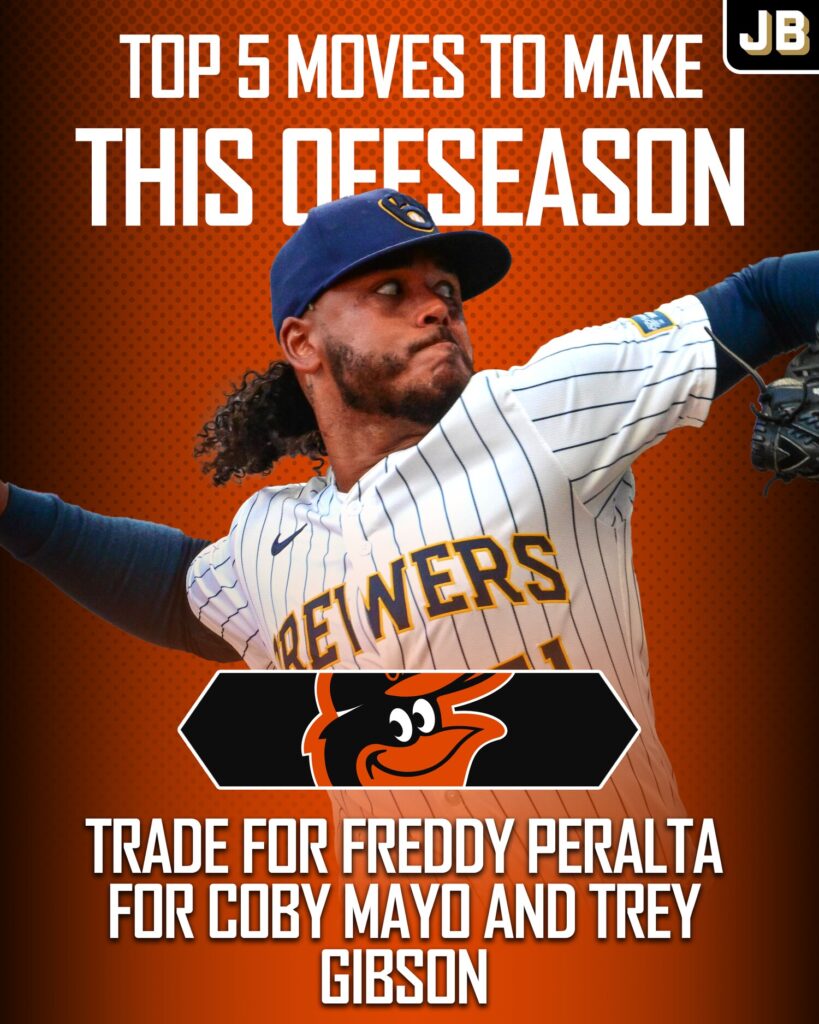
- Brewers get: Coby Mayo and Trey Gibson (JB No. 96 overall prospect)
- Orioles get: The proven frontline starter they need
With Shane Baz, the Orioles added a high-upside arm who has proven he can make 30 MLB starts in a season. They don’t have a lot of other pitchers who check both boxes.
Yet, a proven frontline starter Baz is not.
In an ideal world, any one of Baz, Trevor Rogers, or Kyle Bradish could pitch Game 1 of a playoff series for Baltimore. If Baz finally lives up to his potential, if Rogers keeps doing what he did last season, and if Bradish can just stay healthy, the Orioles might have a trio of aces on their hands.
However, relying on too many what-ifs? and best-case scenarios is precisely what threw this team into such disarray last season.
The Orioles need a slam dunk to lead their rotation. They need the starting pitching version of a Pete Alonso.
How about Freddy Peralta?
Take a look at these numbers from the last five years:
- Peralta: 14.8 fWAR, 9.47 WPA
- Alonso: 15.8 fWAR, 9.78 WPA
Since his first season as a full-time starting pitcher in 2021, Peralta has thrown 738.1 innings with a 3.30 ERA and 3.28 xERA. The list of pitchers with more innings, a lower ERA, and a lower xERA in that span is short. Very, very short.
- Zack Wheeler
- Corbin Burnes
- End of list
Peralta has been consistent, too. His ERA has been at least 10% better than league average in each of the past five seasons. He has also made at least 30 starts in each of the past three years. No one else on Baltimore’s starting staff has reached 30 starts more than once in his career.
Trading for Peralta would bump Tyler Wells into a depth role, which wouldn’t be a bad thing. Elbow surgery has limited Wells to seven starts in the last two years. His career high in innings is 118.2 from 2023, and his career numbers as a starter suggest he’s more of a back-end arm than another ace waiting to break out.
The Orioles could trade Wells if they’re worried they won’t have enough for him to do, but having an arm like his waiting in the bullpen (or even at Triple-A) would be a luxury, not a problem.
Coby Mayo and Trey Gibson are talented players. You have to give up talent to get talent. But Mayo is a first baseman/DH who doesn’t have a path to playing time with the Orioles. At-bats will be much easier for him to come by in Milwaukee.
Gibson is a promising arm who is nearly ready for the majors. No one ever wants to give up a prospect like that, but the righty doesn’t really factor into Baltimore’s plan next year. The Brewers have plenty of starting pitching themselves, but only a few locks for the rotation after Peralta. One would imagine they’d love to tinker with an arm like Gibson’s.
2. Sign Nick Martinez
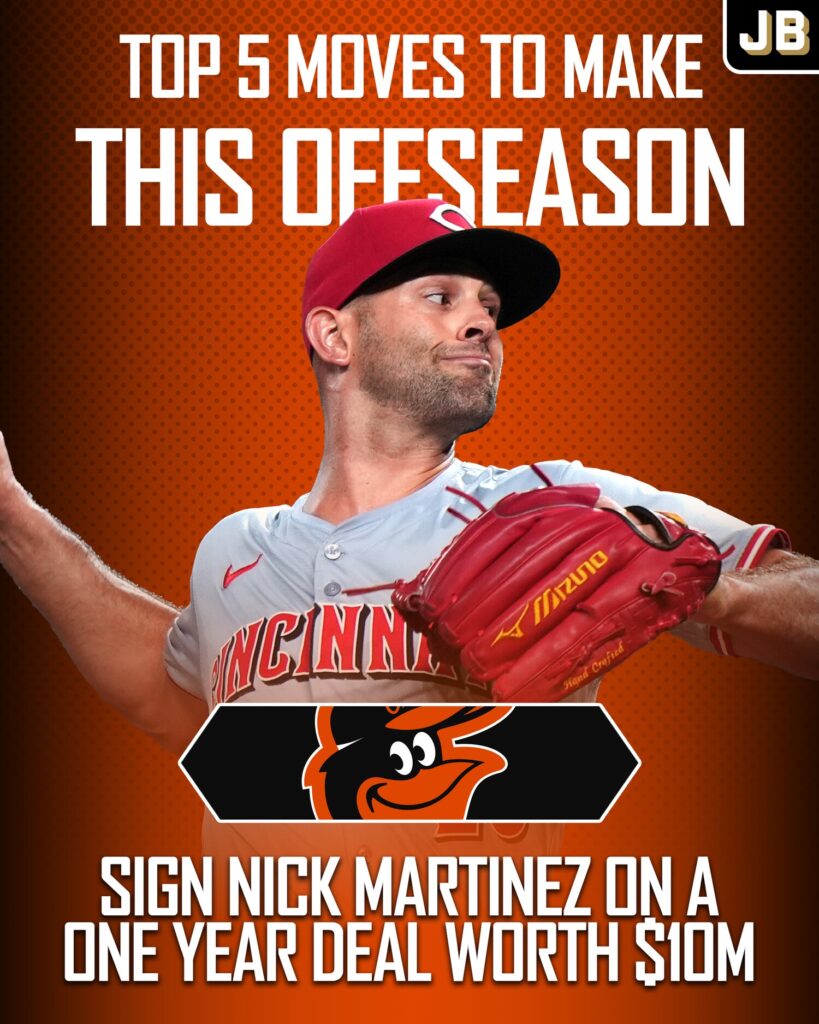
Of the five moves I’m writing about in this article, this one is the most likely to be affected by the Baz trade.
As constructed, could the Orioles still use Nick Martinez? 100%. But if they add a frontline starter, and they absolutely should, the rotation picture gets a lot more crowded.
Here’s the question: Do the O’s still need Martinez if Wells and Povich are their sixth and seventh starters?
I say yes.
The reason Martinez is such a valuable pitcher is his ability to seamlessly transition between the rotation and the bullpen.
Since he returned to MLB in 2022, Martinez has made 192 appearances, 61 of which were starts. He has a 4.10 ERA and 4.19 FIP as a starter and a 2.94 ERA and 3.58 FIP as a reliever. Even better, he has never gone on the injured list in that time.
The best-case scenario? Martinez pitches out of the bullpen all year, and the Orioles never need to call on him to join the rotation. Would he be slighlty over-priced as an inning-eating middle reliever? Sure, but not wildly so.
Martinez took the qualifying offer ($21.05 million) last year, but he’s another year older and coming off a worse season. He’s looking at a one-year deal in the low eight figures. Elias should happily pay that kind of money for the kind of rotation insurance he needed so badly (and didn’t have) in 2025.
3. Sign Pete Fairbanks
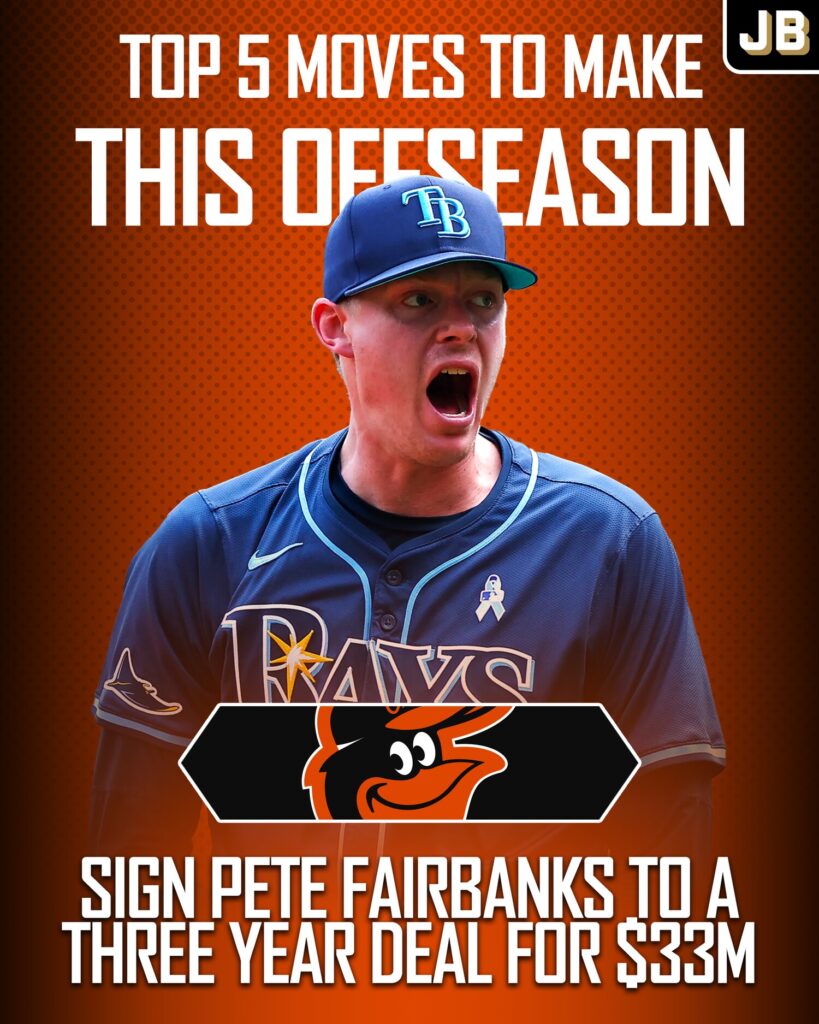
This is the move I’m least convinced the Orioles will actually make. Pete Fairbanks has a closer’s pedigree, and he’s the only free agent left on the market who does.
Over the last five years, Fairbanks has a 2.89 ERA and 2.87 xERA in 227 games. He has 88 saves, 23 holds, and 265 strikeouts across 217.2 innings pitched.
That means that despite his checkered injury history and diminishing stuff, he’s going to get paid. Having already signed Helsley, I’m not convinced the O’s will be the ones to pony up.
At the same time, the Orioles should still have money to spend this winter, and none of the other moves I’ve laid out are going to cost them much.
RosterResource estimates that Baltimore’s payroll currently sits at $140 million. That’s $20 million below last year’s final tally.
Peralta is only making $8 million in 2026. Signing Martinez and the next two names in this piece (more on them in a moment) could cost less than $15 million.
So, if the Orioles are willing to increase their payroll by more than a few million bucks, and they really should be, then signing Fairbanks is possible. And another high-leverage reliever would go a long way for this club.
With all due respect to trusty veterans like Kittredge and Martinez, a team with World Series aspirations needs more than one reliever who genuinely frightens opposing lineups. Helsley can’t do it alone.
Bautista could be that guy if he ever makes it back on the field. Yennier Cano could be that guy if he bounces back from a rough 2025.
Or Fairbanks could be that guy – if Elias makes it happen.
4. Sign Sean Newcomb
The only left-handed relievers on Baltimore’s 40-man roster are Keegan Akin, Dietrich Enns, and Grant Wolfram. The only southpaw in the projected rotation is Rogers, with Povich waiting in the wings.
So, the Orioles could use another lefty.
Left-handed bullpen arms have been flying off the board lately, from Calebs Thielbar and Ferguson to Drew Pomeranz.
Yet, there’s one lefty still on the market who’s coming off a better season than any of them.
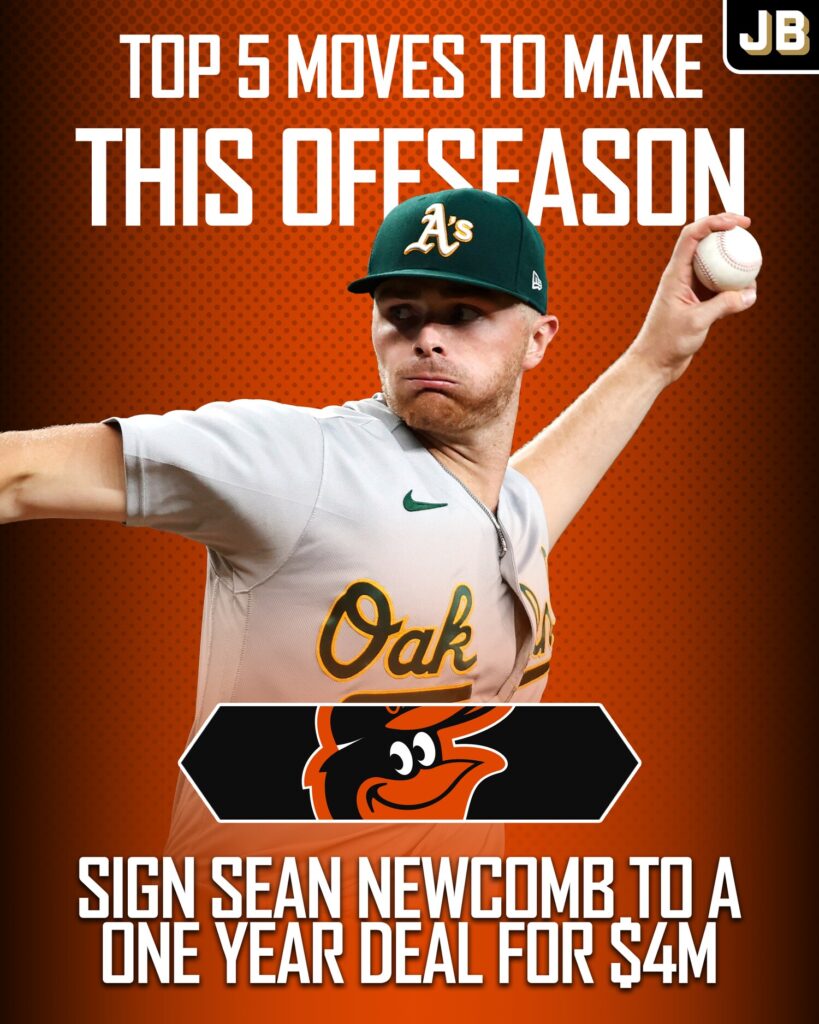
Sean Newcomb threw 92.1 innings for the Red Sox and Athletics, with a 2.73 ERA and 3.81 xERA in 48 games (five starts). His 1.65 WPA put him among the top 10 southpaw relievers.
The underlying stuff isn’t spectacular, and the chances he’ll repeat his 2025 success are slim. But the Orioles don’t need him to be a bullpen ace – especially if they sign Fairbanks. If Newcomb can give them innings and another trustworthy option against tough left-handed hitters, they’ll be happy.
After all, a limited track record means Newcomb won’t command eight figures or multiple years. Something like one year and $4 million probably gets it done.
5. Sign LaMonte Wade Jr.
We’ve reached the minor league signing portion of this exercise.
The fact that a player who will most likely sign a non-guaranteed deal is on this list says a lot about the Orioles: They already have a damn good lineup.
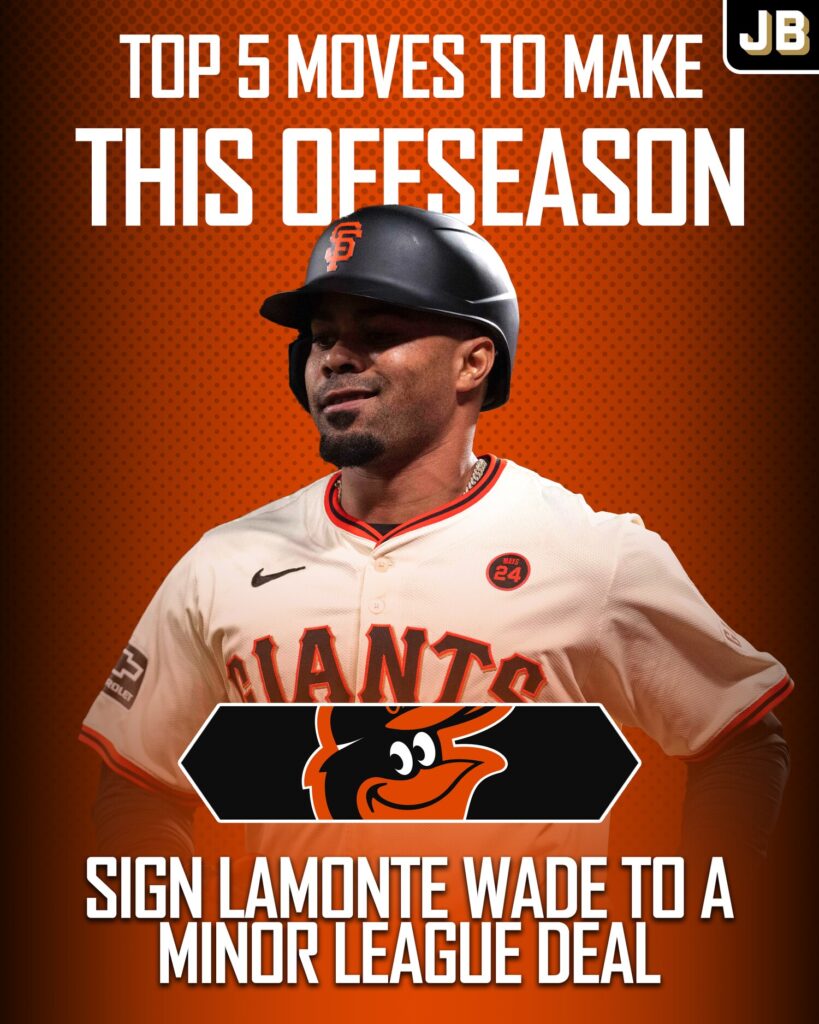
Their lineup is strong enough that RosterResource has Tyler O’Neill and Ryan Mountcastle sitting on the bench. So, the O’s don’t need another big bat. However, adding depth is always important, and signing LaMonte Wade Jr. could be a sneakily strong depth move.
Wade played so poorly last season that after the Angels (the Angels!) released him in early August, he couldn’t even find a taker to let him finish out the season.
Yet, from 2021-25, he posted a .352 OBP and 115 wRC+ in 438 games, splitting his time between first base and the outfield corners. In three of the four seasons prior to 2025, he put up a wRC+ between 18 and 20% better than league average.
Wade’s chief asset is a keen eye at the plate, and even in his dreadful 2025, he still walked 11.2% of the time and rarely swung at pitches outside the zone. Considering he turns just 32 on New Year’s Day, Wade is a low-risk, high-reward bounce-back candidate.
That’s precisely the kind of signing Elias needs to be making.
His projected lineup is already complete. But if the Orioles are going to weather the storm of a 162-game season, they need backup plans. Wade fits the bill.
Written by
Leo Morgenstern is one of the managing editors for Just Baseball. He is also the managing editor at Jays Centre. His writing has appeared all over…