
Who Will Be the Brewers’ Starting Third Baseman in 2026?
After trading away their entire third base depth on Monday morning, who are the leading candidates to take over at the hot corner for the Brewers in 2026?
 | |
| | 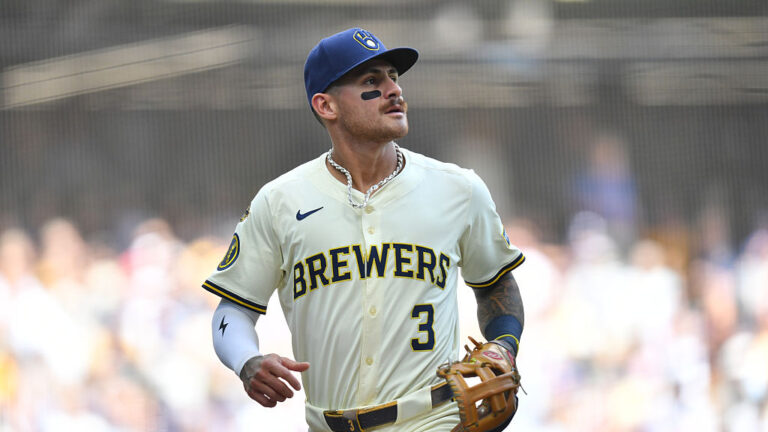
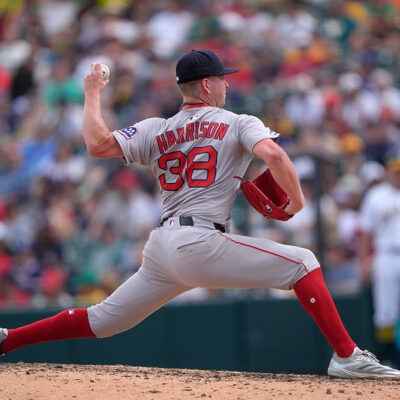
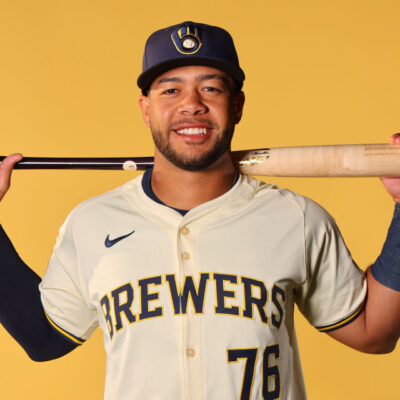
On Monday morning, the Milwaukee Brewers sent third baseman Caleb Durbin and infielders Andruw Monasterio and Anthony Seigler (along with a Comp B pick) to the Boston Red Sox in exchange for hurlers Kyle Harrison and Shane Drohan and infielder David Hamilton.
The move was a stunner to say the least. While it greatly bolstered Milwaukee’s pitching depth, it also completely sapped their depth at third base.
Durbin started 119 games at the hot corner last season, Seigler started 16 games, and Monasterio started five games. The other two players who started at third for Milwaukee last season — Oliver Dunn (11) and Vinny Capra (11) — are also no longer within the organization; the former left via minor-league free agency, and Capra was designated for assignment in May of 2025.
It goes without saying, but the Brewers all of a sudden have a serious puzzle to solve at third base with the offseason coming to a close.
Not only was the timing of the trade unexpected with the first full-squad workout taking place on February 17, but it also appeared that Durbin had a solidified spot on the roster heading into spring training.
Acquired in a package from the Yankees for Devin Williams last offseason, Durbin put together an impressive rookie campaign. He finished third in NL Rookie of the Year voting after ending the season with 2.6 fWAR and a 105 wRC+.
More importantly, he really embodied the Brewers’ brand of baseball with a disciplined approach, good baserunning, and respectable defense at the hot corner as a 25-year-old. Now the team must find a replacement for their 2025 everyday third baseman as they look to defend their division crown and return to World Series contention.
Milwaukee Brewers Internal Options at Third Base
The Brewers could go in several different directions to fill Durbin’s role at third base in 2026, but early indications are that the front office is comfortable with the players they have in house to get the job done.
Reports suggest, as highlighted by Curt Hogg of The Milwaukee Journal Sentinel, that the Brewers made this trade without another move lined up. While that could certainly change, it doesn’t feel as if this move was a predecessor for a bigger transaction, especially with how late we are in the free-agent cycle.
When Arnold spoke to the media on Monday, he noted that they are confident in the options they have coming through the farm system to handle the left side of the infield down the line. While most options are likely still a year off, it feels as if the front office does not want to block the position with a major transaction.
With that being said, they still need a starting third baseman with camp getting underway in less than a week. Who appears to be the likely candidates to fill the position? Here are the top options.
Joey Ortiz
The first potential solution may be the most likely: Joey Ortiz slides from shortstop back to third base.
With Jett Williams on the cusp of making his MLB debut, this would give him an opportunity for regular playing time as the Brewers’ everyday shortstop. Alternatively, it could open the door for Turang to move over to shortstop and Williams to take his place at second base.
Regardless, it’s been well documented just how much Ortiz struggled in 2025. Though he had a strong year defensively, he had arguably a better season at third base in 2024 than he did at shortstop in 2025 (+11 OAA and +8 DRS in 2025, +12 OAA and -2 DRS in 2024).
Ortiz was also undoubtedly a more confident hitter in 2024 than he was a season ago. Whether or not that was tied to the position change is unknown, but perhaps moving back to the position where he already succeeded is what he needs to gain his confidence back.
In short, Ortiz can’t be a worse hitter than he was in 2025, he already proved that he can be a top-flight defender at third base, and it would help give Williams — whom the organization clearly regards quite highly — room for consistent playing time elsewhere.
It would be a bold move, but it’s also one that would make a lot of sense with how the roster is currently structured.
Jett Williams
Alternatively, the Brewers could elect to keep Ortiz at shortstop and plug in Williams at third base.
There’s clear risk in this approach, however, as Williams has never played third base at the professional level. But it’s already confirmed that he’ll get reps at third base in spring training, and the Brewers have taken a similar approach with Ortiz and Durbin in previous seasons, both of whom had minimal professional experience at third base before being named the starter.
Williams is undersized at 5-foot-7, and there’s questions as to whether he has enough defensive ability to stick at third. Still, if the Brewers preferred to keep Ortiz — who is the superior defender — at shortstop, then third base would be Williams’ best path to regular playing time.
That said, it’s yet to be seen how Williams will adjust to MLB arms for the first time, and a move to third would put even more pressure on his bat to perform. Perhaps that is a situation the Brewers will look to avoid.
But the Brewers clearly think very highly of the player Williams could become. If the goal is to get him the most major-league action from the get-go without moving too many of the regulars around, this route would accomplish that.
Should Williams pass the eye test in spring training, Williams is certainly one of the top candidates to replace Durbin at third.
David Hamilton
Newcomer David Hamilton could also be in the running for reps at third base, although he has just over an inning of work at third base in his professional career.
The Brewers value him for his defensive versatility and his baserunning, so even if he isn’t the everyday starter, there is a good chance he gets at-bats one way or another at third base in 2026.
Hamilton is far from an offensive weapon, as he sports a career wRC+ of just 77 across 204 MLB games. His best big-league season came back in 2024 when he was a slightly-below league-average hitter by wRC+ (94), but he did manage to rack up 1.6 fWAR in 98 games while stealing 33 bases and hitting nearly .250. That’s the version of Hamilton the Brewers are hoping to get in this deal.
He doesn’t bring much power to the table, and it’s yet to be seen if he even has the defensive ability to stick at third. That said, the Brewers likely brought him in as Andruw Monasterio’s replacement on the MLB roster, which suggests he will get some practice at the hot corner in some capacity this coming year.
It isn’t the flashiest option, but he appears to be one of the leading candidates for reps at third simply by virtue of how the roster is currently constructed.
Sal Frelick
Do the Brewers open the door to moving Sal Frelick to third base once again, an experiment they toyed with in spring training of last year? Arnold suggested on Monday that it is certainly a possibility.
This is likely the most far-fetched option on this list, but it’s not out of the question.
Frelick is coming off a career year in 2025, posting 3.6 fWAR while hitting .288 with a 114 wRC+. Given that he is a lock to play Gold Glove-caliber defense in right field, subtracting his glove from the outfield would be a major risk.
What’s more, moving him away from the position he has gotten so comfortable with could stunt his development as an MLB player. It would, though, allow all the puzzle pieces to fit together.
If the Brewers believe that the outfield is Jett Williams’ the best path for success in 2026, then this route would allow him to get those reps.
As it currently stands, Jackson Chourio, Garrett Mitchell, and Sal Frelick are in line for regular at-bats in the outfield. Christian Yelich, Jake Bauers, and Blake Perkins should be vying for outfield reps as well. Baring an injury to one of the regulars, it will be difficult to get Williams the necessary outfield reps with how the roster is constructed.
Point being, this is something the organization has already considered in the past, and the fact that Arnold didn’t shut this idea down makes me think that it has potential. This route is likely last in the pecking order, but it should be acknowledged regardless of how unlikely it may be.
Written by
Joey Peterson is a graduate of the University of Wisconsin-Madison and an editor for Just Baseball. Joey covers the Milwaukee Brewers, along with general MLB topics…