
How Much Can the Royals Still Lean on Salvador Perez’s Bat?
What kind of production should the Royals expect from their captain in 2026?
 | |
| | 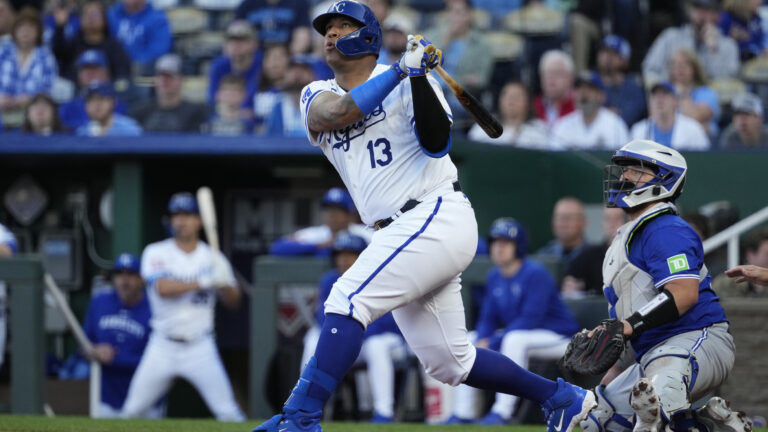
There’s no question that Salvador Perez of the Kansas City Royals will be a borderline Hall of Fame player when it’s all said and done.
Yes, there are questions about his framing, which has affected his defensive metrics, and thus, his overall WAR values (35.8 bWAR; 19.0 fWAR). However, the list of accolades on his resume, especially after Venezuela’s World Baseball Classic victory, is pretty ridiculous when lumped together.
After signing a two-year extension this offseason, Perez has at least a couple of more seasons under his belt in Kansas City. By the time this contract ends, he’ll be 37 years old, so it will be interesting to see if Salvy will try to push through one more season or if he’ll call it quits and finally hang it up.
Regardless, he will finish his career in Kansas City, a rare feat in today’s game where small-market teams have a hard time keeping their franchise players.
While Perez’s status in Kansas City is guaranteed for two more seasons, his impact in 2026 remains to be seen. That said, for the Royals to return to the postseason after missing out with an 82-80 season in 2025, they will need not just a healthy Salvy, but a productive one at the plate.
Despite being in his age-35 season in 2025 (he turns 36 this May), Perez had one of the most productive offensive seasons of his career.
In 641 plate appearances, the Royals captain hit 30 home runs and collected 100 RBI. His 30 home runs were the second-highest total in a season in his career, with the only other higher HR mark being in 2021, when he led the American League in home runs and tied the franchise record with 48.
Furthermore, his 100 RBI season last year was not only the first time in his career he had back-to-back 100+ RBI seasons (he had 104 in 2024), but also the third time he’s had 100+ RBI in a season (the other being in 2021).
Granted, there was some regression in some key areas for Salvy last season. His .236 batting average was his lowest since 2018, and his .729 OPS was his lowest since 2023 (when it was .714). He also had a 95 wRC+ and a 0.5 fWAR, both underwhelming marks considering the number of at-bats he received.
So, what should fans expect from Salvy in 2026? What did he do well last year that could be carried over to 2026? What may cause regression? And what do the projections say? Let’s take a look at the answers to those questions below.
The Hard-Hit and Bat Speed Data Were Solid Last Year
When it comes to hitting the ball with authority, Salvy did that considerably and showed last year that he has the skills to do it again this season.
In terms of evidence, xwOBA, hard-hit rate, and bat speed are good indicators to see how well a hitter connected with a ball and whether or not it can be sustainable in the future. This data is available via Baseball Savant.
When it comes to looking at his overall metrics in those categories a season ago, Perez posted a .357 xwOBA, a 46.7% hard-hit rate, and 72.9 MPH average bat speed. Those numbers ranked in the 86th, 70th, and 64th percentiles, respectively. In terms of pure ranking, among catchers with 200 or more plate appearances last year, Salvy ranked fifth in xwOBA, 15th in hard-hit rate, and 13th in bat speed.
That’s pretty impressive, especially for a catcher who was 35 years old.
In addition to his overall numbers in those three categories, it’s also important to see the trends in those areas over the course of last season. That gives an idea of what Salvy developed in terms of power skills over the past year and whether any red flags could arise in 2026.
Here’s a look at his xwOBA rolling chart:
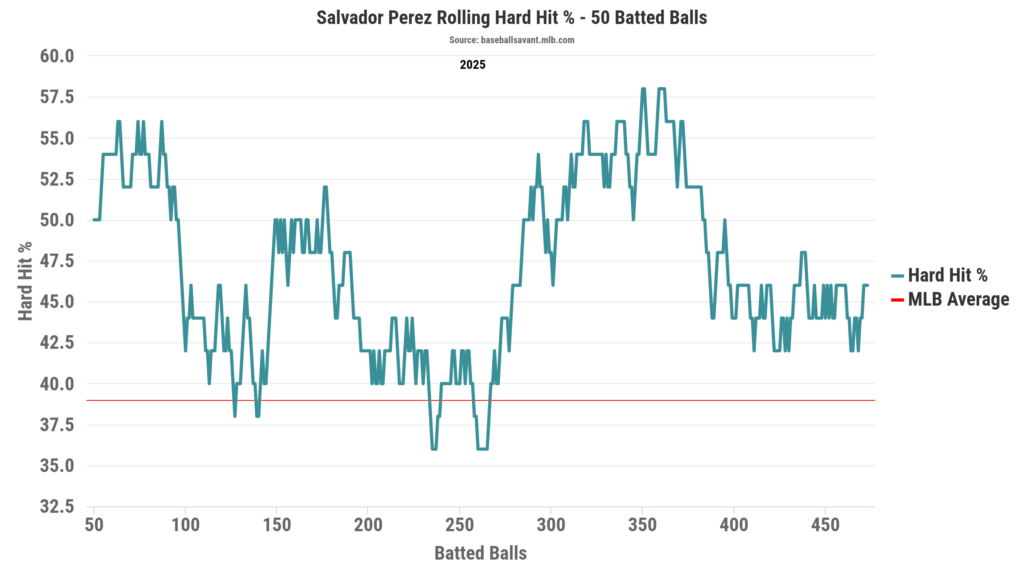
After a strong start, Salvy dipped around his 200th plate appearance. He was mostly below average for the next 50 plate appearances.
However, around the 260 PA mark, he spiked up and remained above average in xwOBA for the remainder of the season, with tiny dips below average here and there (and it was only BARELY below average to boot).
Now, let’s take a look at his hard-hit rolling chart, via Savant:
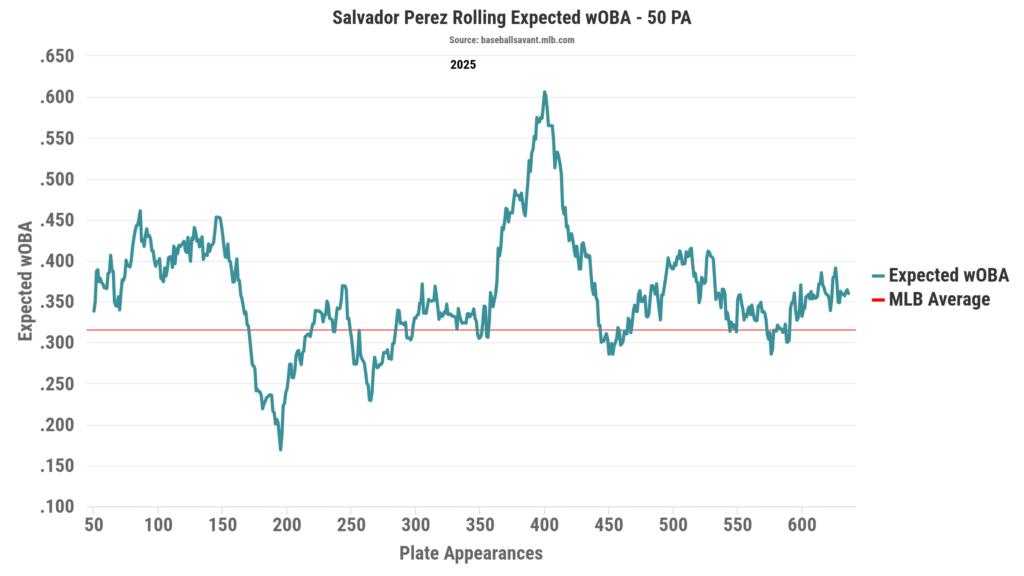
In terms of hard-hit rate, Salvy looked even better. Yes, he was slightly below average around the 120th batted-ball mark and had some valleys around the 240th and 260th mark as well. That said, he was a well-above-average hitter in terms of hard-hit in 2025, with peaks reaching near the 60% mark around the 350th batted-ball range.
It’s hard to see Perez suddenly dipping below average in hard-hit rate unless something happens to him injury-wise.
Lastly, let’s take a look at his bat speed and how that fared a season ago:
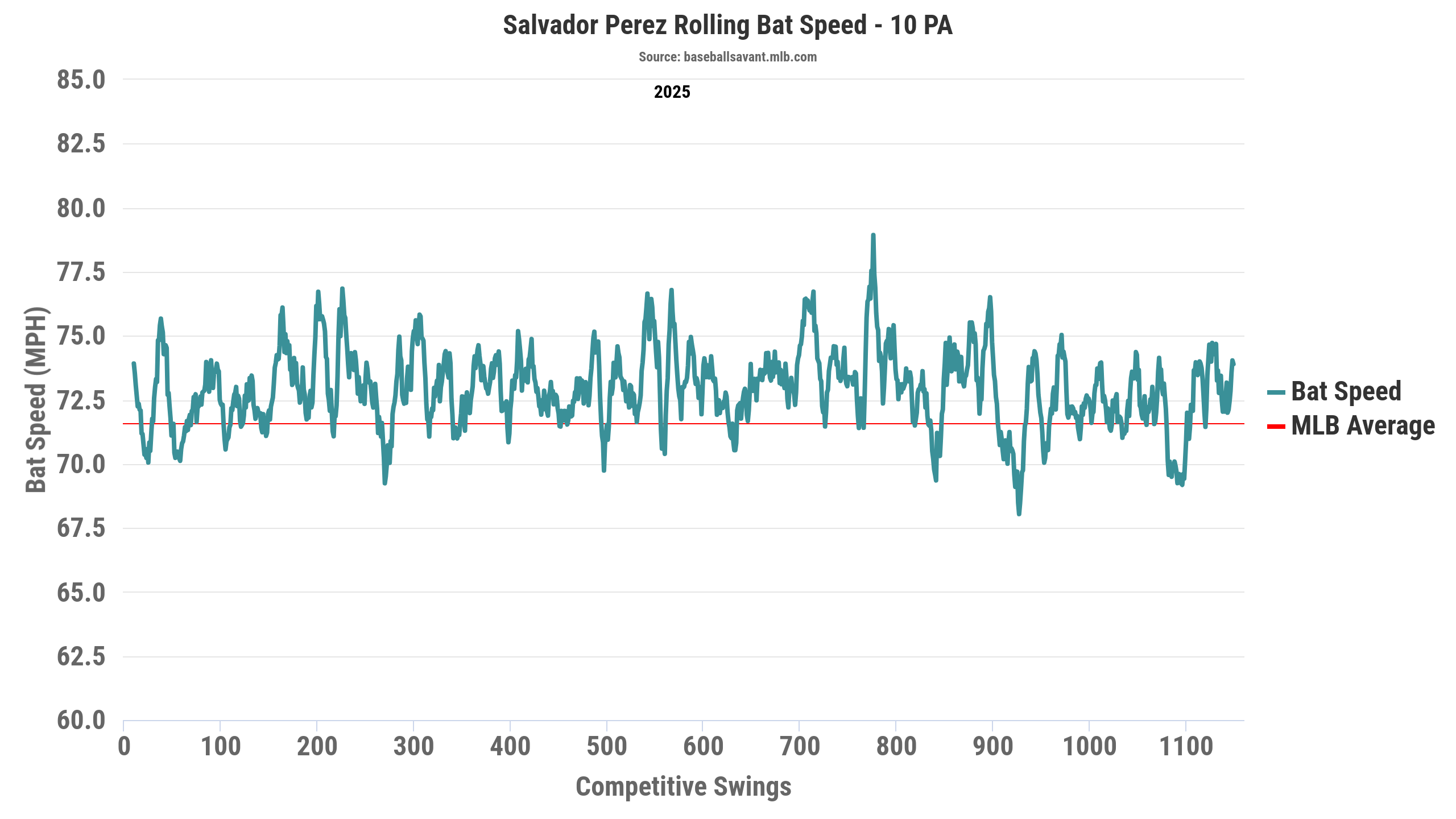
There are some dips here and there, especially around the 910th competitive-swing range. Still, he’s clearly an above-average hitter when it comes to generating batting speed, regularly surpassing 75 MPH and touching near 80 MPH on occasion. Strong bat speed often leads to positive outcomes, especially for power hitters.
Hence, based on his xwOBA, hard-hit rate, and bat speed trends from a season ago, fans have a lot to be encouraged about with Salvy for this season.
Chases and Lack of Walks Still a Concern
While Salvy has proven himself as a power bat in his older age, his plate discipline hasn’t gotten much better.
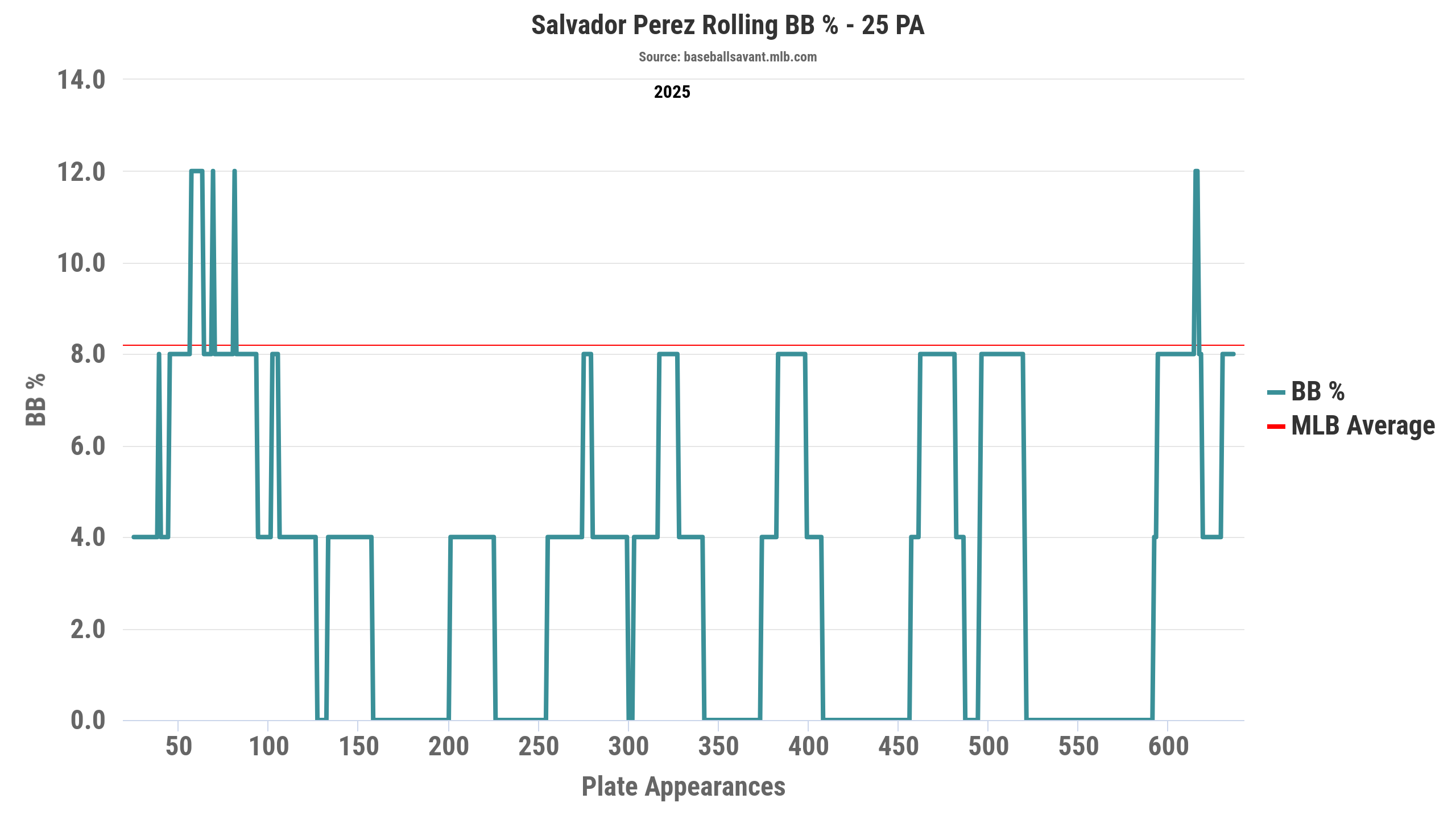
After posting a 0.34 BB/K ratio in 2024, his best mark since the 2013 season (when it was 0.44), Perez saw his BB/K ratio regress to 0.22 a year ago. His K% remained stable at 19.5% last year, just a 0.3% difference. However, his BB% fell from a career-best 6.7% to 4.4% last year, more in line with his career 3.9% BB%.
According to his BB% rolling chart from a season ago, Salvy showed some encouraging progress with an above-average BB% early in the year. However, it dipped heavily after a certain point and stayed low for the remainder of the year (his BB% ranked in the third percentile last year).
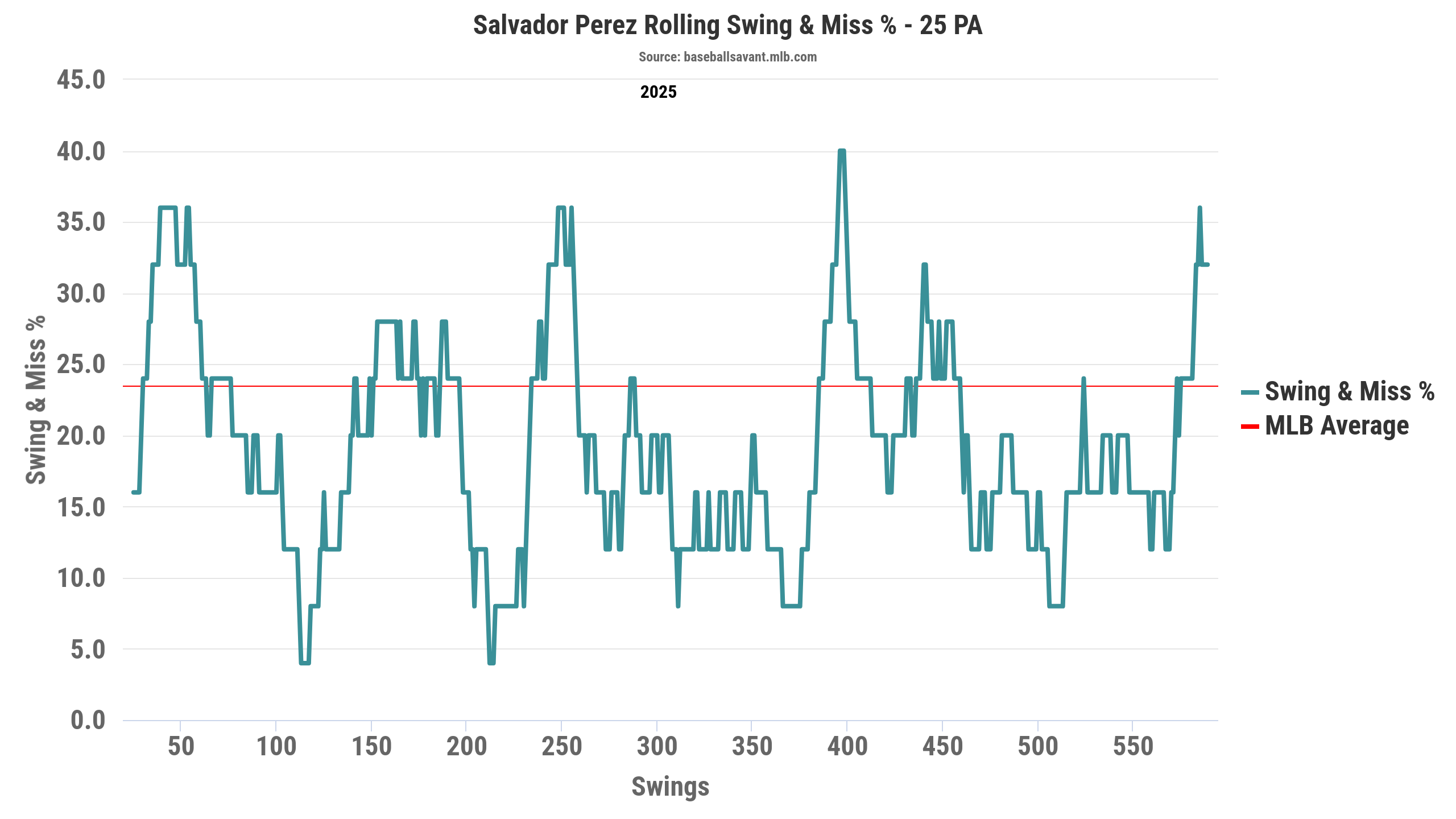
A big issue with Salvy’s lack of walks isn’t a lack of contact ability. His 26.9% whiff rate was high, ranking in the 33rd percentile last year. However, that’s 30 spots better than his walk rate.
Furthermore, while he had some bad swing-and-miss spikes last year, he also had long stretches where it sat below average, according to Savant.
Rather, the real contributor to Salvy’s lack of walks is his over-eager and free-swinging approach.
His 42.4% chase rate ranked in the second percentile last season. Furthermore, he had the second-worst O-Swing% of catchers with 200 or more plate appearances last year, according to FanGraphs. The only one worse? Houston’s Yainer Diaz, whose O-Swing% was 3.7% higher in 2025.
An interesting trend for Salvy is that he’s not just chasing breaking balls. In fact, he showed a regression in the chase rate of breaking balls a season ago.
Conversely, his chase rate against changeups, which has always been his worst pitch group when it comes to chase, saw an increase last year. The same was true with fastball pitches.
Here’s a breakdown of those chase trends against pitch groups over his career, via Savant.
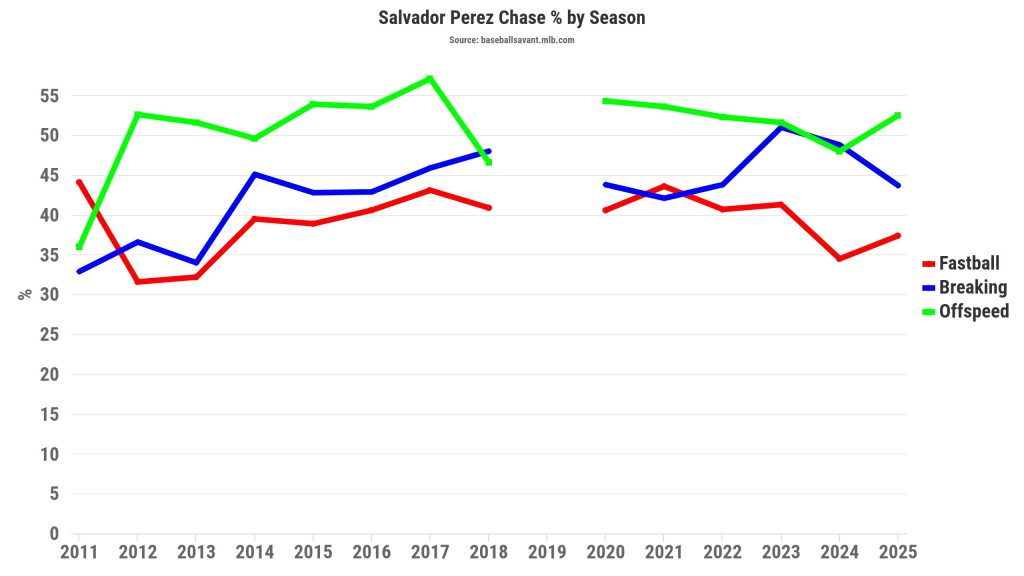
In 2024, he saw some improvement in limiting chase against changeups and fastballs. In 2025, those trends spiked back up.
Can Salvy see positive chase trends again versus changeups and fastballs? If so, that could result in him improving in his batting average and wRC+ categories in 2026.
What Do the Projections Say?
When it comes to hitter projections, there are three that seem to provide the best picture of a hitter’s outlook: ZiPS, THE BAT X, and PECOTA. ZiPS and THE BAT X can be found on FanGraphs, while PECOTA is exclusive to Baseball Prospectus.
When it came to looking at what metrics to use to compare, standard 5×5 categories for fantasy baseball, minus stolen bases, made the most sense for Salvy. That includes average, runs, home runs, and RBI.
Here’s a breakdown of each of those projections for Perez in 2026 (including projected plate appearances).
- ZiPS: 575 PA, .246 average, 52 R, 24 HR, and 80 RBI.
- THE BAT X: 576 PA, .250 average, 65 R, 29 HR, and 92 RBI.
- PECOTA: 594 PA, .253 average, 70 R, 23 HR, and 81 RBI.
PECOTA and THE BAT X were the most optimistic when it came to batting average, as both expected Salvy to hit .250 or above. ZiPS was pretty optimistic with home runs, with 24, despite having the fewest projected plate appearances of the three.
THE BAT X had the best overall projections for Perez, especially in terms of home runs (29) and RBI (92).
Thus, the projections expect Salvy to be a hitter who can continue to lead this Royals offense in 2026, especially in the cleanup or No. 5 spot in the batting order, which was the case a season ago.
Final Thoughts on Salvy
With his age, there will be concerns about Salvy, especially given his playing such a tough position. However, it seems like manager Matt Quatraro has pushed the right buttons by balancing Salvy’s playing time among catcher, designated hitter, and first base.
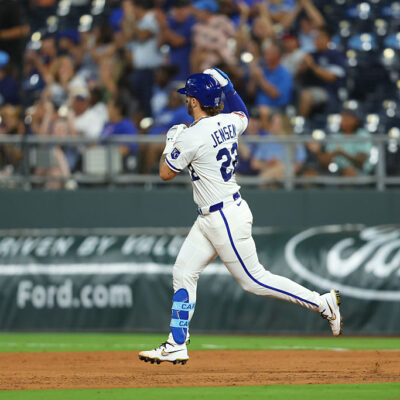
Last year, Perez caught 761.2 innings behind the plate, which was 3.1 innings fewer than his mark in 2024. That number could be even lower in 2026, especially with the emergence of Carter Jensen, the Royals’ top prospect.
In limited action, Jensen hit .300 with three home runs and a 153 wRC+ in 69 plate appearances last September. As a result, Quatraro will likely use Jensen to get Salvy enough spells behind the plate to keep his bat fresh.
If the Royals had a lesser backup catcher, there would be more worry about the chase and whiffs going up, simply because of the fatigue from catching carrying over to his at-bats. However, with Jensen, Salvy should get the rest he needs, which will help him maintain the power and bat speed he demonstrated a season ago.
At 36 years old, Perez won’t be a sure thing in 2026. The injury bug can strike a player in mysterious ways sometimes, especially at that age.
That said, all the trends from last year suggest that Perez can still be depended upon to be a key bat at the top of the batting order for the Royals. His presence and production should help the Royals improve upon their 82-win total from 2025.
Become a Member of Just Baseball
Subscribe and upgrade to go ad-free!
* Save 25% by subscribing annually.
Written by
Kansas City Royals Team Writer for Just Baseball; Editor and Writer for Royals Keep.