
Jakob Marsee’s August Tear Has Earned Him a Longer Leash
After a slow start to his 2026 season, some incremental changes have led to an encouraging late-season turnaround for Jakob Marsee.
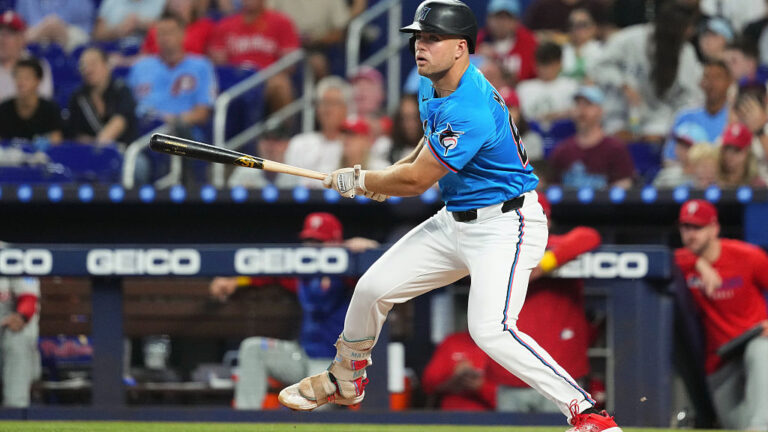
As a society, we all tend to be far more reactionary than we probably should. In reference to baseball specifically, many tend to quickly jump off the ship of a player who is failing to meet the expectations we set for them, especially after a hot start to their big-league career.
Jakob Marsee is one of the more recent examples of this.
After being acquired in 2024 from the Padres, Marsee had the opportunity to take the reins as the starting center fielder for the Miami Marlins, and in the 55-game sample he provided us with last year, it looked as if the Marlins had found their future at the position.
Marsee had a .292/.263/.478 slash line in that time, hitting five home runs, swiping 14 bags, generating a 134 wRC+, and accumulating a 2.2 fWAR. It was one of the more impressive showings that the Marlins fan base had seen in quite some time.
Now, coming into 2026, many were expecting him to pick up right where he left off. Unfortunately, this was not the case. Heading into the month of May, Marsee’s .175 batting average and .254 slugging percentage had many wondering how much more run he would actually get.
Thankfully, Marsee was able to snap into things once the calendar flipped to August, and we are now starting to see the flashes of the center fielder we all came to love just one year ago.
What’s New?
Dating back to his time in the minor leagues, the one thing I always found incredible was the fact that he was always able to maintain contact rates over 80%, especially when he came over from San Diego. Even through the early-season struggles, that number didn’t dip.
Entering Thursday, September 3, his contact percentage sits comfortably at 83%, pairing well with his 92.5% in-zone contact rate for the year. That mark would actually be the best of his career to this point, even dating back to his time in the minors.
The struggles likely stemmed from the fact that he has been a bit more selective at the plate than he was in the past. His 39.2% swing rate is more than a full percentage point lower than his career mark. While this has led to a bump in his walk rate compared to last season, the lack of aggression is causing him to fall behind in counts, expanding the strike zone and causing more swing-and-miss in his game.
Nevertheless, since August began, Marsee is hitting .259 with a 130 wRC+ and, even though the power numbers aren’t being replicated at the same rate as last season, the three home runs have proven to be timely, including the one on Wednesday against the Royals.
Another difference that I’ve noticed is that he has been able to cut his strikeout rate over the past month from the mid-20s to just under 17%, all while still being able to maintain a walk rate of 13.7%.
Earlier this season, I wrote an article touching on reasons why Marsee was struggling, and a lot of it had to do with him being extremely pull-heavy. Now, when you take a look at his spray chart, you see him reverting to the approach where he is spraying the ball to all fields.
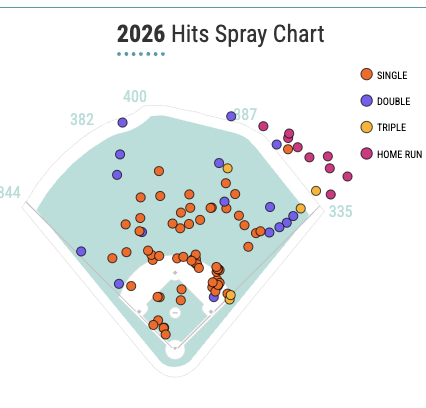
The spray chart still shows a decent amount of his production coming via the pull side, but there is still evidence of him being able to spray the ball around with success, which has contributed to the second-half turnaround we are currently witnessing.
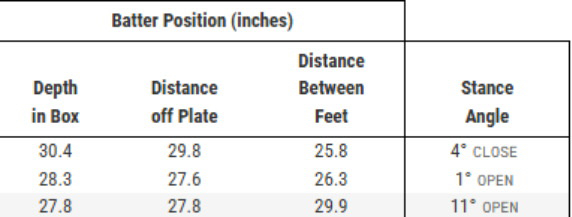
We also have data that shows Marsee tweaking his stance in the box, bringing it closer to where he stood in 2025.
This first image is from the article I wrote earlier in the season, breaking down how significant of a difference there was in his stance during the first couple of months compared to last year:
This second one shows where his markers stand heading into play on September 3:
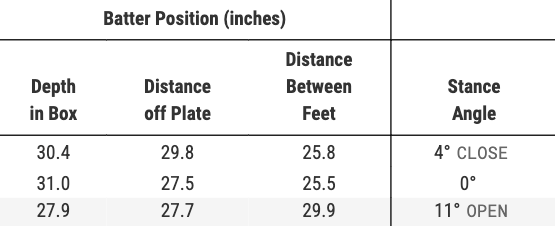
The two points that stand out the most would be how the depth in the box and the distance between his feet have made the difference. Staying closer to the back of the box, as well as shortening his batting stance, has allowed him to read the pitches better and have more time to react and make adjustments as necessary, depending on the pitches coming in.
While we have slowly started to see incremental changes made to his game to help him mitigate the struggles, there is still one aspect of Marsee in 2026 that has not been able to catch up just yet.

There is a stark difference in his numbers against the different pitch types, none more significant than his results against breaking balls. To go from a .319 slugging percentage against them last season to a .183 in 2026 is going to cause a dip in overall production like this. Even beyond that, his average against fastballs has also seen a near-.050 drop.
Needless to say, while Marsee did debut with his hair on fire and 2026 hasn’t lived up to the lofty expectations, there are still signs proving we may finally be seeing the turnaround we had been waiting for.
Is He Still the Future?
I find it difficult to write off a player after 189 career games at the big-league level. The regression from one year to the next hit hard, but it is not like we have seen him dramatically fall off a cliff, especially with the past month proving to us that he still has it in him to perform at a high level.
There were always concerns with Marsee’s profile as he was progressing through the minors as to whether he was going to be able to hit enough to stay on a big-league roster. The fact that he has proven he can make adjustments when needed in order to break out of a prolonged slump shows maturity from the young outfielder that is going to bode well for him as he continues to grow in this league.
We were going to see regression to the mean with Jakob Marsee. We see it in every player. What he is capable of providing in this lineup on both sides of the ball is not something that can simply be written off.
While the leash is still on, he has shown that he is deserving of having it loosened up just a bit, providing him with more runway to show the organization that he is capable of being the future for this team in center field.
Become a Member of Just Baseball
Subscribe and upgrade to go ad-free!
* Save 25% by subscribing annually.

Written by
Cristian has been at Just Baseball since 2021, when he first started writing about prospects. He spent eight years working in Major League Baseball with the…