
1994-1995: Baseball on Strike
As the upcoming CBA negotiations come into focus, it's worth exploring the last time a salary cap was proposed in MLB: the 1994 CBA standoff.
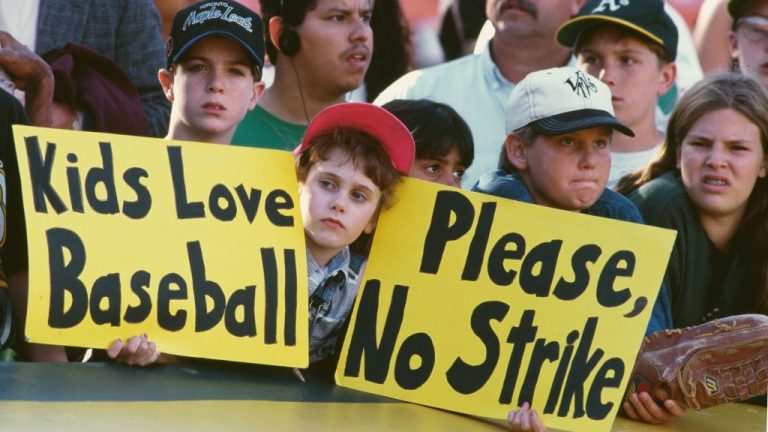
Negotiations for the upcoming expiration of MLB’s collective bargaining agreement have officially begun.
Both MLB owners and the MLBPA have submitted their initial proposals for the next CBA. Unfortunately for fans, it is safe to say that the two sides are very far from coming to an agreement.
As a result, rumblings of a lockout being instituted following the current CBA’s expiration this December have popped up across the baseball world. The driving factor in this possibility is, unsurprisingly, the MLB owners’ proposal of a salary cap.
Players are vehemently opposed to a salary cap, arguing that a cap does little to benefit the players or baseball’s competitive integrity while further enriching the owners. Conversely, owners are adamant that a cap is necessary due to rising salary expenses and the widening gap between MLB’s highest and lowest payrolls.
This debate is anything but new. Historically, the salary cap has been a point of contention between owners and players practically since the inception of the game of baseball. Within the current context of MLB, players and owners have been telegraphing their disagreement on the issue for over a year now.
Tensions are running high at the moment. Fans are very anxious at the possibility of losing the 2027 MLB season. At the same time, MLB players and owners have to have some uncertainty as well. After all, they have been here before.
Given the commotion caused by these initial proposals, it is well worth taking a look at the longest work stoppage in MLB history: the 1994-95 players’ strike.
Free Agency and Fallout
With the ratification of the 1976 CBA, MLB formally introduced the first iteration of their free agency system. This initial free agency clause allowed for players to become free agents after playing in the major leagues for six years.
However, owners were still incredibly frustrated by the loss of the reserve clause. They posited that, without it, payrolls would skyrocket as players continued to drive market value up in subsequent years. As a result, they put forward a number of compromises in proceeding CBA negotiations.
The first of these came in the form of compensation picks, where teams that lost players to free agency would receive a compensatory draft pick from the team that signed them. The players were largely against this idea, believing that compensation would undermine the value of free agency.
This resulted in the 1981 players’ strike that led to the cancellation of over 700 games. Eventually, MLB and the MLBPA reached a compromise, allowing for a compensation system that instead allowed for teams to pick from a pool of players left unprotected by all clubs, rather than just one.
Relations between the players and ownership cooled down somewhat after this, but it would not last long. Another lockout was instituted in 1990, after arbitrators had determined that owners had colluded in suppressing wages in the mid-1980’s.
While this lockout did not last long, it was clear that long-standing distrust between both sides was beginning to bubble to the surface once again. The owners and players agreed to table discussions of further CBA changes for a few years.
In 1994, the dam burst yet again, and the baseball world was plunged into one of the most consequential labor disputes in MLB history.
Tensions Rise Once Again
MLB owners had attempted to find compromise during the 1990 CBA negotiations. To address the widening disparity between MLB revenue and payrolls, they proposed a revenue sharing system that would help promote parity amongst small and large-market teams.
However, this also came with the stipulation that MLB would institute a salary cap on each club. The players were vehemently opposed to this, and ultimately no long-term resolution was achieved.
When it came time to negotiate again in 1994, the owners again pressed for a salary cap. They argued that small-market clubs would fall by the wayside unless teams agreed to share local broadcasting revenues and enact a cap. On June 14, the owners proposed what they believed was a compromise.
The proposal, brought by Richard Ravitch, would eliminate salary arbitration, reduce free agency service time requirements from six down to four years, and bring back a weaker version of the reserve clause via qualifying and matching offers.
MLBPA director Donald Fehr resoundingly rejected this proposal. The players believed the salary cap was a way for owners to limit their expenses, without any demonstrable benefit to players.
Additionally, the players had just spent nearly a century fighting for the right to free agency. The idea of allowing for their newfound market power to be diluted in any way represented a massive step backwards.
As negotiations continued, ownership began to leverage their wealth, withholding $7.8 million that would fund player pensions and benefits. With the Senate Judiciary Committee failing to hold MLB accountable to antitrust laws, Fehr and the MLBPA believed there was no other choice than for the players to strike.
A Long, Long Standoff
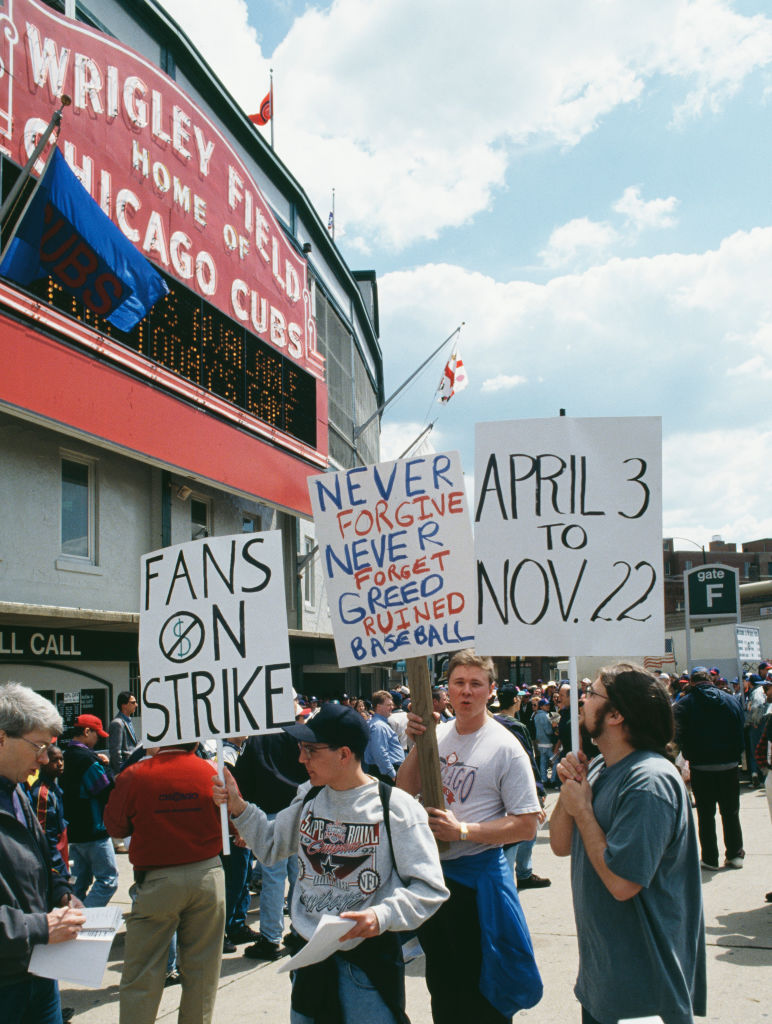
Beginning on August 12, 1994, the MLBPA enacted a players strike that would total 232 days. The strike led to the cancellation of nearly 1000 MLB games, including the 1994 postseason and World Series.
This strike was the culmination of decades of distrust between the two sides. The players were especially frustrated after it was found that MLB owners colluded to suppress player salaries in the 1980s. And, after these early 1994 CBA negotiations, they felt they were being backed into a corner.
Negotiations continued through the early fall, but neither side would budge. The MLBPA made counterproposals attempting to address market disparities, but ownership claimed their proposals would not meet rising salary costs. Finally, on December 6, Ravitch resigned, and labor talks quickly fell apart.
Against the will of the MLBPA, MLB owners approved a salary cap plan by a 25-3 vote on December 15. They agreed to withhold implementation to give room for another round of talks with players. Just a few weeks later, the owners unilaterally implemented this plan on December 23.
The players were furious, as this represented a massive grievance for hundreds of players, and a complete sidestep of labor negotiations. On January 4, 1995, five bills aimed at ending the strike were introduced to Congress, adding more fuel to the fire.
In response to the changes and mounting pressure from MLB and lawmakers, MLBPA director Fehr declared all 895 unsigned MLB players as free agents the next day. The owners would now be unable to enact their plan without substantial challenges.
On January 26, players and owners were called upon by then-President Bill Clinton to resume bargaining and reach an agreement by February 6. However, this deadline would pass with no resolution, though owners agreed to revoke the salary cap on February 1.
Replacement Players
With the 1995 season approaching, MLB was getting desperate. Cancellations from the prior season had resulted in an estimated $580 million in lost revenue. While the players had lost about $230 million in their own salaries, they remained resolute.
Thus, MLB’s executive council agreed to bring in replacement players to start the 1995 season. In response, the MLBPA announced on March 14 that the union would refuse to end the strike if replacement players were used in games. They also demanded that results of any games featuring replacement players be voided.
Replacement players posed a number of challenges for MLB outside of their labor disputes. For one, the Toronto Blue Jays could not play games with replacement players in Ontario, as their labor code prohibited the use of replacement workers.
Additionally, labor lawyer and Baltimore Orioles owner Peter Angelos announced that replacement players would not be used, cancelling spring training games on March 20. Maryland governor Parris Glendening went so far as to sign legislation that barred any team from utilizing replacement players at Camden Yards.
Challenges continued to mount with regards to the use of replacement players. MLB announced that the 1995 season would drop from 162 games to 144 on March 26. By this point, the strike had caused considerable financial damages for all stakeholders in MLB, with TV stations in particular taking a huge hit.
MLB and the local NBC and ABC stations lost nearly $600 million in collective advertising revenue. This would up leading to the collapse of their TV deal. To make up for this, Fox became MLB’s national broadcast partner in 1996.
Pressure had begun to mount on all fronts. Still, neither the owners nor the players were willing to concede. Regardless, facing the potential of another doomed season, it became clear: something had to give.
End of the Line
On March 29, players voted to return to work if a U.S. District Court judge supported the NLRB’s unfair labor practice lawsuit against the owners. Meanwhile, the owners voted 26-2 in support of the use of replacement players. Thus, it appeared the gridlock between MLB and the MLBPA would continue indefinitely.
However, the players would score a victory shortly thereafter. Judge Sonia Sotomayor, a future Supreme Court Justice, issued a preliminary injunction against MLB’s use of replacement players in the. The owners requested to stay the ruling, but Sotomayor’s ruling was upheld by the Second Circuit Court of Appeals.
As a result, the strike would finally come to an end on April 2. MLB and the MLBPA would be bound to the terms of the expired CBA until a new agreement could be reached. The 1995 season began a few weeks later, though fans expressed immense frustration with both players and owners alike for the stoppage.
On August 3, the Senate Judiciary Committee would right their mistake from the year prior, calling to repeal MLB’s antitrust exemption in a 9-8 vote. A month later, a three-judge panel unanimously upheld Sotomayor’s injunction yet again.
Most prominently, the panel ruled that the Player Relations Committee for MLB had illegally attempted to eliminate free agency and salary arbitration. After a long and tenuous fight, the players prevailed over MLB ownership and paved the way for a more equitable system of player compensation.
What Can We Learn?
To this day, the system remains far from perfect.
Many problems have persisted, but MLB has undergone significant transformation over time. In the present day, MLB is currently undergoing one of its best periods of fan engagement and league-wide success in modern history.
That is part of what makes the current moment feel so daunting. All of this progress, all of this momentum, is being put at stake with the proposition of a salary cap. Whether you are for or against a salary cap, a lockout would still undoubtedly harm the fan experience, players’ livelihoods, and MLB as a whole.
One way or another, the two sides will have to come to an agreement. If history were to repeat itself and a prolonged strike occurred, there would be immense consequences on both ends.
Given the history of this issue, the players are unlikely to give up – understandably so. They fought for decades to even have the ability to elect free agency. Besides, the owners still stand to benefit handsomely if they compromise and kick the can down the line.
The 1994-95 strike led to the loss of hundreds of millions of dollars for players, owners, and stakeholders across MLB. It led to the cancellation of the 1994 World Series, and arguably the eventual loss of the Montreal Expos.
Ideally, we don’t see the same thing happen this winter. MLB and the MLBPA are still far off from any kind of final proposals, so there is still a chance. For now, here’s to hoping the two sides can get creative and come to an agreement in time for next season.
Become a Member of Just Baseball
Subscribe and upgrade to go ad-free!
* Save 25% by subscribing annually.

Written by
Ryan Murphy is a contributing writer for Just Baseball and graduate of James Madison University. The former Southern California native is an avid fan of the…