
The Fascinating Correlation Between Framing and ABS Results
Intrigued by new Statcast metrics, we decided to specifically test whether or not framing ability actually correlates to ABS success. The results were fascinating, and not what we expected.
 | |
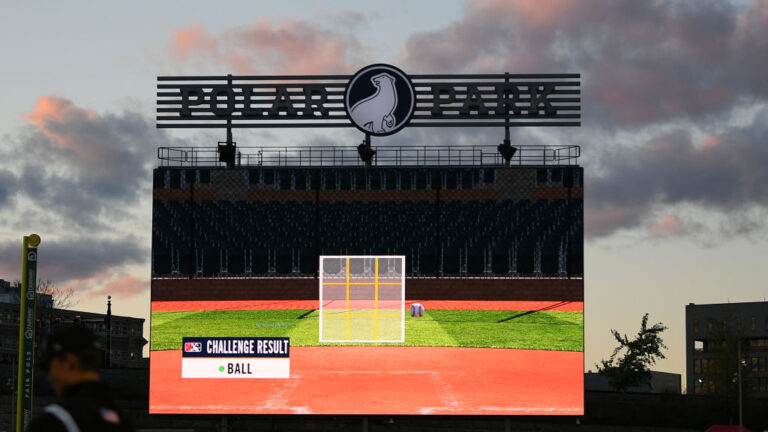
| | 
Late last September, MLB announced it would implement the long-awaited ABS (Automated Ball-Strike) challenge system in major league games. With this announcement came excitement, speculation, and curiosity about how it would work and which players would adapt best to this system.
Now, as spring training marches on, the results from big leaguers figuring this system have been nothing short of interesting to see. Of course, with any new addition to the sport would also come new Statcast metrics. The results have been extremely thought-provoking, as they’ve raised more questions than we previously had.
One of the most interesting things we’ve seen so far has been the correlation between framing and the ABS challenge system. Many people thought that the art of framing and receiving would be lost with this new addition, or that a player’s framing ability (by extension, their awareness of the strike zone) could make them better or worse at using the system.
Intrigued by the new Statcast metrics, I decided to specifically test whether or not framing ability actually correlates to ABS success. The results were absolutely fascinating, and not what I expected in the slightest.
Let’s dive into my findings.
Editor’s Note: Data for this story was collected before play on March 11th, 2026.
Establishing a Theory
Before fully taking a look at the findings of this experiment, we first have to establish the theory or hypothesis that we’re hoping to test through this process. My inspiration for this specific point came from former MLB reliever Trevor May, who brought up a riveting idea when breaking down the Statcast data on his YouTube channel, More Mayday.
May explained that the data showed that batters have actually had more success than catchers when using the system, which is far from what people expected. He theorized that this is because of catchers’ framing skills and the fact that they’re used to stealing borderline pitches for strikes.
“It’s telling me that these guys who have been receiving so well and gotten really good at it are starting to fool themselves, which is fascinating,” May said regarding the early flaws catchers have shown when using the system. “That is something that I was not expecting to happen. And seems like it’s happening,” he continued.
After hearing this, the gears in my head instantly started turning. On the surface, it makes a ton of sense. The best receivers in the league, like San Francisco Giants’ catcher Patrick Bailey, for example, have long been able to frame pitches (even ones far off the plate) to look like strikes.
In fact, they’ve gotten so good at stealing strikes that it’s reasonable to believe that catchers immediately assume that they can get pitches on the black to be called strikes, thus making some balls register mentally as strikes.
To me, this idea is incredibly interesting. On the surface, I’d automatically expect the better framers in baseball to be more aware of the strike zone, and thus better at using the ABS. However, if they’re actually fooling themselves, the results could be the exact opposite.
This tension between expectation and reality is exactly what made me want to test this. If the very skill that makes catchers so elite might actually backfire in the ABS challenge, then the results could reveal something surprising.
By examining success rates, tendencies, and decision-making under the system, we can see whether the mental habits developed in the field actually help or hurt catchers when navigating this new challenge.
Running the Numbers
Now that we’ve established a theory and some potential outcomes we might expect to see, it’s time to actually test these ideas and see if the stats support any of these ideas.
For these experiments, I conducted a few separate tests.
Test One: Creating a Graph
The very first thing I did was make a graph where each catcher’s framing percentile was on the x-axis, and the y-axis was the percentage of correct calls they’ve made so far this spring. This way, I could get a visual idea of how the data might be laid out, and it would also immediately show me any sort of trend in the data set.
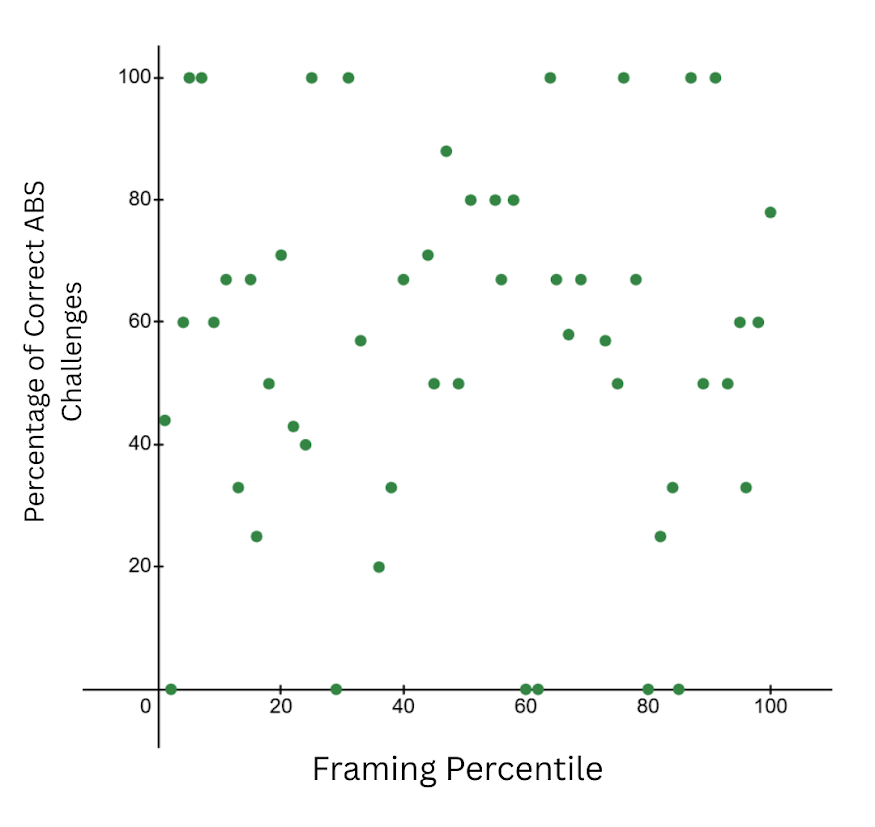
When looking at the data, we see a few things. First off, on the surface, the correlation doesn’t seem to be strong. The data points are spread all across the graph, meaning no trend immediately stands out.
However, this is where the line of best fit comes in. Adding this line will allow us to see any slight trends that may not immediately stand out when looking at the graph, giving us a better idea of the true relation between framing ability and correct ABS challenges.
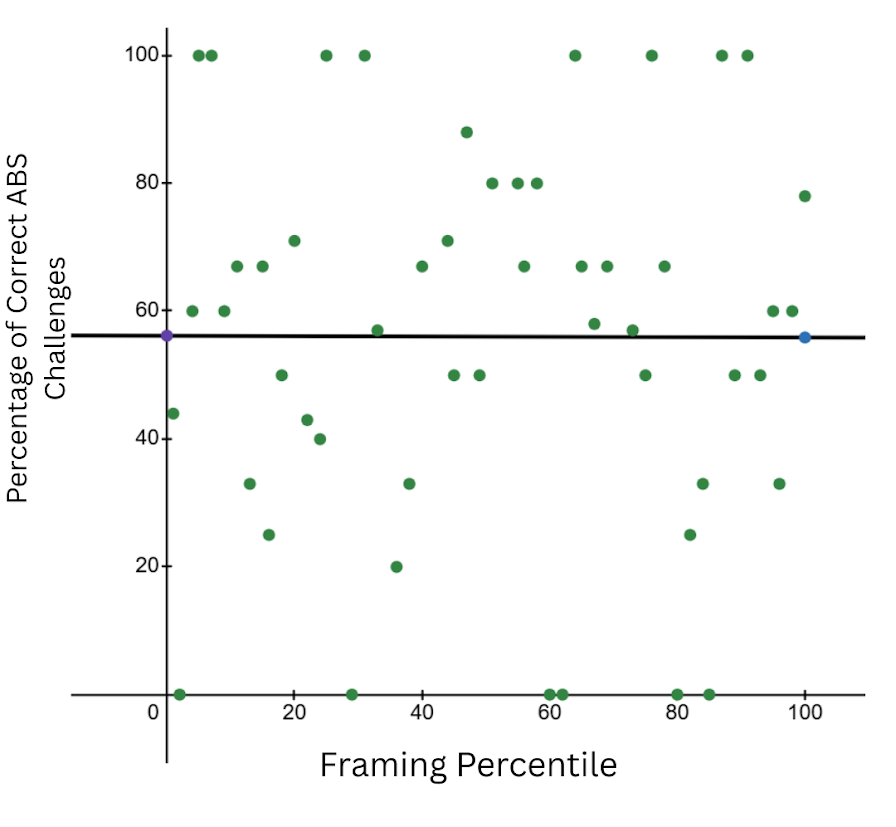
Once again, this is a pretty straight line, which implies that there’s no obvious, strong correlation in the data. This is where things get really interesting, though.
The graph actually shows a very slight decrease of 0.27655 units from the left of the graph to the right, which corresponds to a regression of approximately -0.492% over that range.
In other words, this means that while the correlation isn’t incredibly strong, there’s enough evidence to suggest that as the catchers got better at framing, they slowly got a little bit worse at using the ABS system.
Test Two: The Percentages
Now that I had proof of a potential link between the best framers in baseball being slightly worse than the worst framers in the game, I wanted to examine each case a little closer.
Next, I took all 51 players and separated them into three groups: Positive framers, negative framers, and the zeros (the players who were neither positive nor negative framers).
The first group, the positive framers, produced some fascinating results. According to the research I conducted, the 23 catchers in this group have correctly challenged 62 times out of their 104 attempts (60% success rate).
Once I had that number, I wanted to compare that to the negative framers. The 24 players in this group have correctly challenged 82 of their 136 attempts (approximately a 60.3% success rate). Yet again, this confirms the fascinating idea that better framers tend to be worse at using the ABS system.
While these results are already very head-turning, the four players in the middle are pretty interesting as well. Their sample size is much smaller, but the four of them combined to correctly challenge 13 of their 18 tries (72.2% success rate).
Another Interesting Finding
Before continuing, I first want to talk about a few other things that stuck out to me about the data from these two tests.
Firstly, if we break things down even further and take a look at just the top- and bottom-five of the positive and negative framers, the results are mind-boggling.
The five best framers in baseball last season have correctly challenged 17 of their 29 attempts (approximately a 58.6% success rate). Meanwhile, the five worst framers have correctly challenged 16 of their 26 attempts (approximately a 61.5% success rate).
In other words, the five worst framers in baseball last season have actually done better at using the ABS challenge system than the top five best framers.
Out of the top five, Patrick Bailey was the only player to produce a success rate over 60%. Multiple players in this group performed quite poorly as well, like Austin Wells, who produced a 33% success rate during his limited time in the spring.
To put in perspective just how wild this is, the worst framer in baseball last year, Edgar Quero, has produced a 44% success rate so far.
Taking a Look at the Video
With two tests confirming the idea of better-framing catchers being ever so slightly worse at using the ABS system, we can revisit the bigger idea: better framers have gotten so good at framing that they’re actually fooling themselves.
In order to see if this could really be happening, I decided to look at a few clips of some of the challenges by the best framers in the league. This way, I could get an idea of whether these players are truly just missing or if they think these pitches are strikes due to good framing.
All three players in this video were top-five framers in baseball last season, and all of these pitches were incorrect challenges. In just these four examples, you can see multiple instances where they seem to frame a pitch very well just off the plate, challenge it, and end up being incorrect.
Although it’s only four instances, these clips serve as pretty damning evidence that this theory may actually be true. It seems like catchers are indeed tricking themselves at times into thinking pitches they’re usually able to steal for strikes are actually inside the strike zone.
Problems with These Tests
Between examining the data and actually taking a look at some of the incorrect challenges made by the top framers in the sport, there seems to be sufficient reason to believe that this theory may be correct. However, there are some flaws in this test to keep in mind before directly drawing a conclusion.
The biggest issue is likely the sample size of ABS challenges this spring. Across all of these tests, we only had 258 challenges to use, which is a very small number considering the size of the regular season. While there’s sufficient reason to believe that this may be happening, I’d feel a lot more confident with a full season of data to examine rather than 258 challenges.
However, we might still get the same result at the end of the season. MLB.com’s Mike Petriello took a look at an idea very similar to this with Triple-A data from last season, and concluded that good framing didn’t equal good challenging.
On top of the issue with this sample size, the correlation in the data set still isn’t very strong, to say the least. Let’s face it, a 0.3% difference in success rate is virtually negligible at best, but it’s something to keep a close eye on regardless. In the end, a difference is still a difference, but the significance is what truly matters.
Also, let’s not forget about arguably the biggest potential problem with this study: It’s still spring training. For some players, it takes them some time to truly get acclimated to the game after taking a few months off, so their understanding of the strike zone may be a little off compared to the challenges we’ll see in the middle of the season.
The Verdict
After running the numbers, watching film, and breaking down some potential issues with this data, I think it’s reasonable to assume that the theory of catchers fooling themselves is definitely plausible.
I’m hesitant to truly commit to this being true due to the issues I mentioned above, but it’s something to monitor throughout the season and revisit once we have a larger sample size at the end of the season.
Regardless, even if there are just a few instances where someone tricks themselves, it’s still an utterly fascinating concept. The idea that the very skill that makes elite framers so successful could actually backfire in the ABS challenge system adds an intriguing layer to our understanding of the game.
Become a Member of Just Baseball
Subscribe and upgrade to go ad-free!
* Save 25% by subscribing annually.
Written by
Jay Staph, a huge baseball fan and stat nerd, founded and ran his own baseball writing website, BSBWrites, at just 16-years-old. With focal points around prospects,…