
The Colorado Rockies’ Early Feedback on the ABS Challenge System
It’s been nearly four weeks of MLB’s latest innovation and the early results have been positive for the national pastime. We hear from the Rockies on how they're feeling with the new system.
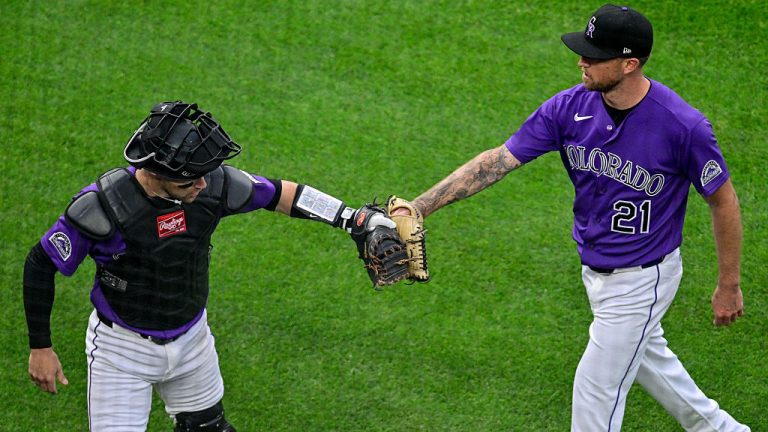
DENVER, Colo. — It’s been nearly four weeks of Major League Baseball’s latest innovation and the early results have been nothing but positive for the national pastime.
The Automatic Ball-Strike (ABS) Challenge System has changed a lot for players, managers, umpires and fans alike with all four groups undergoing different experiences as baseball continues to tinker with how the game is represented.
“I think it gets the fans more interactive in the game,” Colorado Rockies reliever Zach Agnos said. “You can hear them. They’re living and dying by every pitch when the ABS pops up on the scoreboard. So I think it’s pretty fun.”
On the 8,000 square foot scoreboard in left field at Coors Field, an average of 31,783 fans per game in Denver get a crystal clear view of whether or not the home plate umpire made the correct call.
ABS has provided a helpful reminder of how accurate umpires are behind the plate. Umpires, who get about 94% of calls correct, have seen 55% of challenges overturn their original call.
“They’ve been really good, actually, because the balls are (outside the zone by) this much,” said manager Warren Schaeffer. “So it’s impressive. Kudos to the umpires.”
In-Game Components
One of the more interesting developments coming from year one of ABS has largely gone under the radar: less bench jockeying and arguing about balls and strikes.
“The biggest thing for me has been I haven’t heard any chirping at the umpire,” Schaeffer said. “That’s like a huge difference, a big part of baseball, and it’s been gone. At least in our dugout.”
Others have also noticed a reduction in outward grumbling as a byproduct of ABS.
“I love it. It cuts out complaining. If you don’t like it, challenge it,” Agnos said. “That’s why I like it so much because I was kind of tired of the complaining about it. If you challenge on something outrageous, that’s your fault.”
Despite less unintentional timeouts dedicated to bickering, the average time of game is actually up by five minutes since last season. Is that due to the delay brought upon by challenges? Not exactly.
When MLB first implemented ABS during spring training 2025, the average challenge slowed down a game by nearly 14 seconds. With an average of four challenges during those Cactus League and Grapefruit League contests, ABS contributed to an increase of only one minute per game.
Abstinence and Indulgence
When Michael Lorenzen went to his cap during the second inning against the Los Angeles Dodgers during a 9-6 win on Sunday, he became only the second Rockies pitcher to challenge a pitch following fellow veteran starting pitcher Jose Quintana.
Home plate umpire James Jean pointed toward Lorenzen and informed the crowd of the challenge.
The video review showed the 83.7 mph curveball had just barely clipped the top of the zone. The call was overturned and Lorenzen became only the 12th pitcher this season to win their challenge, increasing the success rate of his brethren to 48% (12-for-25).
As luck would have it, the 34-year-old didn’t mean to challenge the pitch, nor did he mean to during an at-bat in the next inning.
“I’m looking at [Hunter Goodman], and I’m thinking, ‘Goody, Do you think (that) is that close?’ I’m not trying to challenge any. I don’t want to challenge anything,” the 12-year veteran explained of his accidental gesture. “And so, it was just a natural reaction, like, ‘Goody, what do you think, Goody?’ I got to come up with a different signal.”
Pitchers with even less big league experience might not even go so far as to gesture to their batterymate at this point.
“I trust my catcher – and it also depends on the situation,” said defacto closer Victor Vodnik. “If it’s that high leverage situation and it’s a really close pitch, and it’s going to change the outcome of the game, I think for sure, challenge it, even if it’s close. I think it’s good to have. It’s a cool tool.”
Agnos, who celebrates the one-year anniversary of his debut on Monday, is likely to never utilize ABS.
“I’m not going to use it because I don’t want to get my emotions tied into it,” the 25-year-old said. “I’m a pretty emotional guy, so, I trust (Hunter Goodman), (Brett Sullivan) and Braxton (Fulford) whenever.”
Colorado has not told any player directly that they cannot challenge a pitch – either as a batter or when fielding as a catcher or pitcher – but there’s a growing sense that pitchers should never challenge and that catchers have the greatest advantage for winning challenges over everyone.
Catchers have won their challenges 59% of the time entering Sunday, compared to batters at 47% and pitchers at 42%.
“The catcher knows the strike zone because he’s right there with his eyes,” Schaeffer said. “Pitchers are throwing, their heads moving, and there’s a lot of emotion involved.”
Case in point. During an at-bat by Dodgers shortstop Hyeseong Kim, Goodman went to his helmet immediately after his club was down to their final challenge in the third inning against a division rival.
The 26-year-old backstop is ranked third-best in the sport at calling challenges according Baseball Savant’s Overturned vs. Expected Net Overall For, trailing only Gold Glove Award winners Salvador Perez of the Kansas City Royals and Dillon Dingler of the Detroit Tigers.
Goodman can’t quite pinpoint why he’s been rated so favorably. For him, it’s simply a matter of feel. Tracking the ball into the glove is what gives him the best sense of whether the pitch hit the edge of the strike zone or not.
“I feel like if I think it’s there, I would just challenge it,” Goodman said Sunday. “If I think it’s a good situation and I’m unsure, I’m probably still gonna challenge it. But if it’s not the best situation, and it’s a borderline pitch, I’m probably just gonna save it for a better situation. That’s kind of how I tried to go about it.”
After the Rockies lost their first challenge on Sunday in the top of the third due to Lorenzen’s second miscommunication in as many – and with only one more incorrect challenge remaining for the final 7.5 innings for Colorado – Goodman challenged the very next pitch. This time, the umpire’s call was overturned for his 12th successful challenge in 17 tries.
It was a gutsy call and, according to Schaeffer, underlines the confidence Goodman and the rest of the Rockies have in him.
“You get down to one (challenge) early in the game, and it makes you kind of hesitant to call it,” Goodman said of the situation. “When you get down to one early, you want to have one late in the game. But when I think a pitch is there, and I’m 90% confident, and I’m gonna use it either way.”
Finding An Edge
The numbers for ABS are still in its infancy. The information made available to the public doesn’t detail if challenges are more successful during daytime affairs than at night. Maybe umpires miss more calls during later innings or when it’s a one-run ballgame.
Some teams have been aggressive with their challenges, like the Minnesota Twins who have tapped the top of their batting helmet an MLB-leading 33 times entering Sunday. On the other end of the spectrum is the Dodgers (10), the club with the best record in the game.
The Miami Marlins have challenged the most times (38) with moderate success (58%) when fielding. Conversely, the Tigers, who are 29th in terms of challenges in the field, are rated the best according to Baseball Savant’s metrics.
“I think there’s leverage situations on both sides that you need to use it,” Schaeffer said of using challenges on one end more than another. “I think game-state matters in that. If you’re winning late in the game, maybe you want some more defensive challenges. I think in that sense, yes, but I think there’s leverage of both sides involved, especially in one-run games.”
First-year pitching coach Alon Leichman feels similarly in terms of these early days. “Every team is going to have to create strategies around the ABS. It’s going to be super interesting to see where that path goes.”
Future Wrinkles
Many with the Rockies haven’t had much issue with the ABS Challenge System at this point in the season. Players have two seconds to make a challenge and once that brief window has closed, no challenge can be made. Minus a stopwatch though, it can be hard for umpires to nail down that time limit to the millisecond.
“I think a couple times there’s been – I’ve seen where it’s kind of a late call,” Agnos said. “So I think that rule needs to maybe be a little bit refined, but I think it’s good.”
While suggestions haven’t been flying in terms of improvements that should be made to ABS, players and coaches have some thoughts on what might come in future iterations of the rule.
Currently the ABS Challenge System exists full-time outside of the big leagues only in Triple-A. Adding it permanently to all lower levels of the minors would be beneficial, according to some within the organization.
As far as the limit of two challenges per game, Goodman wouldn’t mind seeing both teams get an extra challenge in the ninth or extra innings.
“I think nobody wants the game to end on a bad call. Nobody wants that,” Goodman said. “It’s the best players in the world. You want to see him compete in that ninth inning, and you want to see (the umpire) make the right call. Given the opportunity to have kind of a say in that, I think it would be good.”
Eight days before José Caballero of the New York Yankees became the first player in MLB history to challenge a pitch, the World Baseball Classic came to a close. Could the WBC be the next to get the ABS treatment?
“I think that would be – that’ll be great for sure,” said Willi Castro, who played with Puerto Rico in the 2026 WBC. “I think it’s going to be really good for the WBC. Let’s see if they put it in next time.”
What most players agree with universally is that having an automatic ball-strike system would be too much. Every pitch being decided by cameras and technology would remove the human element that’s much of the soul of the sport.
“So far you’ve been seeing the challenge system,” Vodnik said. “Yeah, it’s fun. I like it. I think it makes the game fun. The challenge system is fine, but I wouldn’t like the full on ABS, robots just calling it. I don’t agree with that. You lose the art of pitching, the art of catching, art of framing. I think if you put in the ABS, that takes the fun out of it. And then the umpires too. (That) basically takes away their job. Then what’s the point of having an umpire?”
Diamond Details
Will switch-hitters have a better chance of challenging close pitches?
- “When I get really locked in, I’m pretty good on both sides,” Castro said. “Because you see more righties than lefties, and sometimes we have like a week or two weeks without seeing a lefty, and you go right side. It’s pretty difficult.”
- Castro is 0-for-1 through his first 65 plate appearances this season. His lone challenge came from the left-hand side of the plate against RHP Bradgley Rodriguez on April 9.
Who will be the best on the Rockies when it’s all said and done?
- “I’m feeling like Jake McCarthy,” Agnos said. “I didn’t like his at-bat when I faced him in spring training. He got me, got a couple knocks off of me. I think he just has a really good feel for the zone.”
- Through 49 plate appearances, McCarthy has yet to challenge. Only Brenton Doyle has more plate appearances (65) than McCarthy without a challenge. Edouard Julien is ranked first on Colorado by Baseball Savant thanks to his 75% success rate (3-for-4).
Where do the Rockies rank amongst MLB’s 30 clubs?
- As the fielding team, the Rockies 21 successful ABS challenges are tied for the second-most in baseball through Saturday. They have won 21 of 31 challenges as the fielding team, a 68% win percentage that is seventh in the Majors.
- The Rockies rank second in the Majors with nine “+K flips” (strikeouts gained by the challenging team) and are tied for third with three “-BB flips” (walks eliminated by the challenging team), per Baseball Savant.
Become a Member of Just Baseball
Subscribe and upgrade to go ad-free!
* Save 25% by subscribing annually.

Written by
The Host of The Rockies Insider podcast, Patrick Lyons covers the Colorado Rockies for Just Baseball. He is also a BBWAA member.