
Chase Burns is Flashing Ace Potential for the Cincinnati Reds
While Chase Burns has a lot of work today to become an ace, the potential is clearly there with the plus stuff he has shown for the Reds.
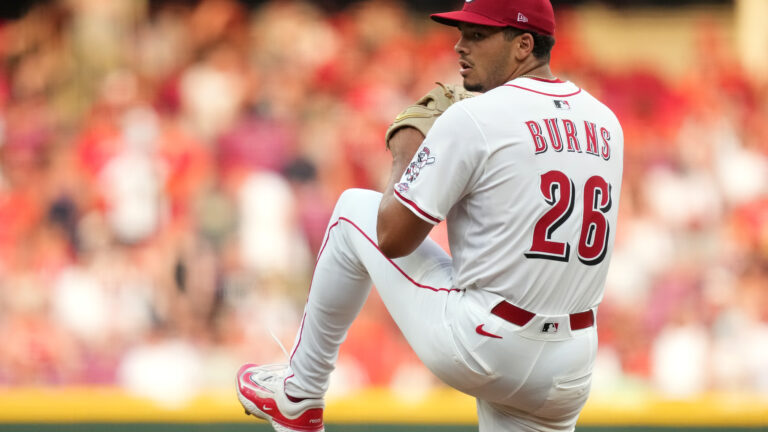
When the Reds selected Chase Burns second overall you could see the upside. An electric fastball paired with plus slider racked up tons of strikeouts and put him on a path to join the Reds sooner rather than later. Burns did not pitch in the Reds system after being drafted last season, but that did not slow his timeline.
Just a year after the draft, Burns is already in the Reds rotation and dazzling fans while making batters look foolish.
Burns started the year in Double-A Chattanooga which was simply too easy for him. A 1.29 ERA and 1.78 FIP with 55 strikeouts across 42 innings earned him a promotion to Louisville, which wasn’t much harder. Two starts was all it took before the Reds called him up to help with their playoff push.
Although there have been some growing pains, and more to come, what we have seen from Burns in his first several starts is remarkable. We aren’t talking about a player with a few good moments, either. We are talking about a rookie dominating with a few costly mistakes.
The Good
If you have watched Burns pitch, even if only for an inning, you notice his fastball. A novice eye can tell that his four-seamer is different, and batters would agree. Not only does Burns throw 100 mph, but it comes with 18 inches of induced vertical break which gives it that “rising” imitation that you often hear about.
As you can see in the video above, the ball jumps out of Burns hands and batters struggle to catch up to his velocity. Part of the reason why Burns has been effective is because of his command. Although he doesn’t always hit the catchers glove right where he puts it, dotting the black and throwing a pitch just outside of the zone is exactly what he needs to do to be effective.
Often times we see pitchers with high velocity fastballs spray the pitch leading to too many uncompetitive pitches and high walk numbers. He still needs to do so with more consistency, but that will come with time.
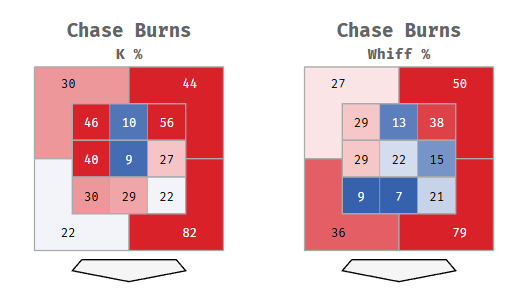
Attacking the top of the zone has been his been a key to unlocking the best version of himself. The high fastball, with 18 inches of induced vertical break, looks great to batters out of the hand but they often swing under it, or pop it up.
Via Baseball Savant
You can see how Burns has used the top of the zone with his fastball to get swing and miss, but it also sets up his slider. Raising the eye level of a batter with 100 mph fastball only to break off a slider that starts in the zone and dart away from righties causes fits. The bottom right corner of the image above shows how effective his slider can be to force batters to chase.
Burns slider is holding batters to a .211 average while producing a 43.1% whiff rate and .304 xwOBA. He’s not afraid to throw it to lefties and backfoot them like you see with Profar in the video above. He has allowed three homers off the pitch, but more on that later.
This approach, mixed in with a changeup against lefties, has led to a 2.44 FIP, 14.94 K/9, and 3.41 BB/9 through his first eight starts. The 5.24 ERA is a bit inflated and his 3.11 xERA tells a truer story. His second start, against Boston, was disastrous. Five earned runs and he only recorded one out. Since then, four starts of three or less runs and one start of five runs.
The Troubles
Of course, Burns has not been perfect. There have already been some growing pains, like his outing in Boston, and I’m sure more will come. As is the case with many flame throwers, when contact is made it is going to be loud. We have seen that at times with his fastball.
Batters are currently posting a 90.3 mph average exit velocity off his four-seamer. Part of that is just physics – fast moving object will leave another fast moving object (the bat)….fast. Before you ask, no I am not a physics teacher although that extremely in-depth explanation might make you think otherwise.
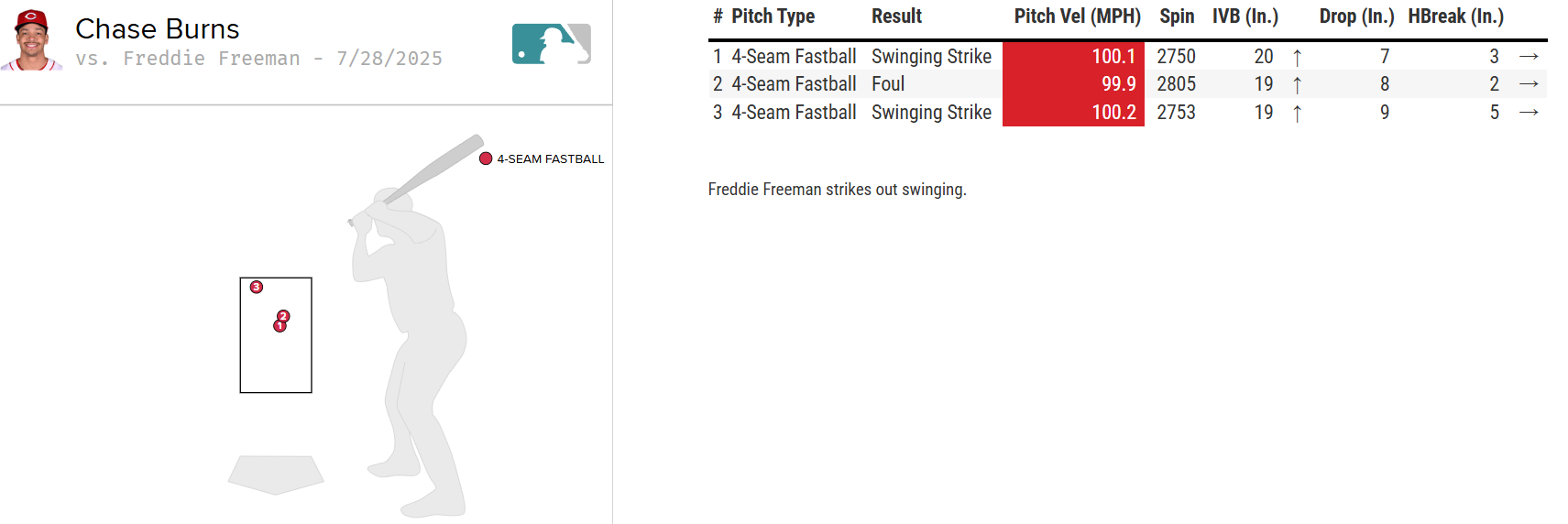
At times, Burns tends to catch the middle of the plate too often. His wicked fastball has bailed him out at times, but you are flirting with danger when you welcome swings middle-middle. We saw this in late July in an at-bat against Freddie Freeman.
Via Baseball Savant
Burns went 100.1 mph right down the middle with his first pitch before returning to that location with 99.9 mph. He finished Freeman with an elevated fastball at 100.2 mph, three pitches, three fastball, three strikes.
Although it worked out, you cannot attack hitters like Freddie Freeman with this approach and come out clean very often. Three of his four home runs he has allowed have been hanging breaking balls that catch too much of the plate.
Luckily, his stuff will bail him out at times but does not serve as a recipe for success. He’ll likely be prone to the long ball, especially early in his career, similar to what we saw from Hunter Greene. Working on his other offerings, or developing more, outside of his fastball/slider will help unlock his full potential.
Burns changeup doesn’t have great movement but has been effective. He’s located it well in the bottom of the zone against lefties but even if that pitch continues to improve I think he needs something more.
We saw Hunter Greene add a splitter and curveball after being a heavy fastball/slider pitcher as a rookie. If Burns can work on his curveball, or mix in another type of fastball to change the movement on his velocity, he could be more effective on days when he doesn’t have his best stuff.
Final Thoughts
Chase Burns is further along than I would have imagined. Sure, the command could always improve but the fact that we have at least seen him dot his fastball on the edge numerous times gives me excitement for what he can become in the future.
Knowing that the Reds were able to form Hunter Greene into more of a refined pitcher should give you comfort with Burns. I’ll even say Burns is more developed than Greene was in his first few seasons. Truly, the sky is the limit.

Written by