
Nick Kurtz’s Swing Change Has Taken His Game to New Heights
Kurtz has made a small but noticeable change that's helped him optimize his swing for even more consistent production.
 | |
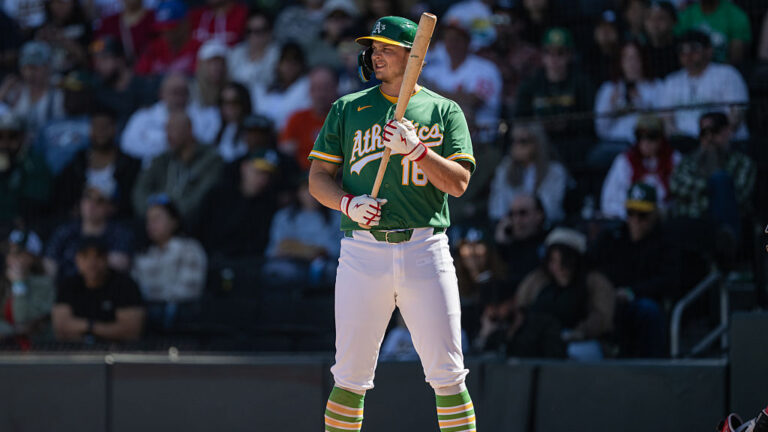
| | 
Over the last decade or so, MLB has seen a multitude of rookie seasons that have gone down in the record books. From Aaron Judge and Pete Alonso both smashing the rookie home run record, to Paul Skenes’ 2024 season, which has an argument to be the best rookie pitching season ever, it’s been a wild time for rookies.
Last season was no different, as we saw yet another truly historic campaign by a rookie. This time, it was Nick Kurtz. Even though he played a grand total of just 33 minor league games prior to his big league debut, Kurtz immediately hit like a seasoned veteran.
In 117 games, Kurtz hit an astounding 36 home runs, and slashed .290/.383/.616 with a 170 wRC+. This was good enough to generate 4.6 fWAR and an American League Rookie of the Year trophy.
With “Big Amish” already putting himself in discussions for the title of the best first baseman in baseball, many people speculated whether Kurtz could get much better or where his true production would lie. So far in 2026, he’s answered that question by taking even bigger strides in his development and putting together one of the most sound offensive profiles in the game.
The reason for this step forward? Kurtz has made a small, but noticeable change that’s helped him optimize his swing for even more consistent production. Kurtz has begun impacting the baseball like never before, and it’s all because of this one adjustment.
Let’s examine this change a little more closely and explain why this minor adjustment has taken him from a breakout rookie superstar to a future perennial All-Star.
Data updated prior to games on May 13.
Breaking Down Kurtz’s Swing Change
by Jay Staph
Before diving into the numbers, we first must evaluate the swing changes Nick Kurtz has made that have allowed his game to take yet another step forward. Although small, these changes have allowed Kurtz to be in a much better position where he’s able to impact the ball harder and more consistently.
The two swings that we’ll be taking a look at are a pair of home runs he’s hit within the last two years. On the left is Kurtz’s 114.6 mph grand slam against Scott Barlow, and the swing on the right is his 115.3 mph home run against Jordan Leasure from earlier this season.
Beginning with the setup, there are a few things that instantly jump out. For starters, Kurtz’s hands are lower and slightly further back. By beginning in this position, Kurtz’s hands are already in the slot that his slight barrel tip used to help him get into, which has simplified his move and made it far more repeatable without the possibility of loading too far.
On top of this, Kurtz’s weight is much more evenly spread than it was during his rookie campaign. In 2025, his weight was distributed on a scale close to 60/40 or 65/35, but it’s now closer to 50/50. By doing this, he’s been able to engage his lower half far more, coiling into his back hip ever so slightly, and using his foundation to build more power than he could before.
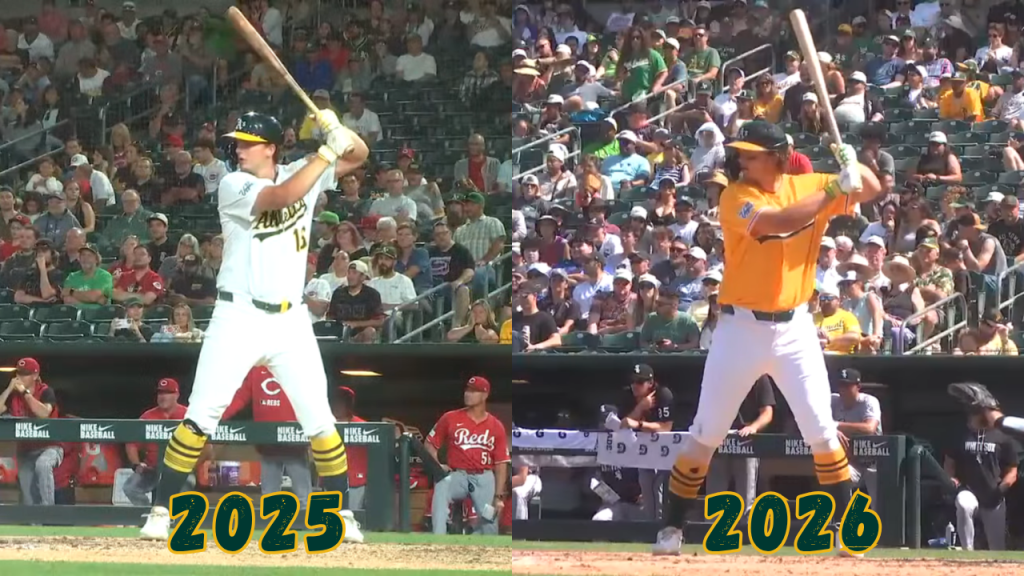
Moving on to his load, the impact of changes to his setup becomes more evident. First off, because of the change in his weight distribution, Kurtz is in a far better position during the middle of his load. He’s staying stacked over the middle of his body, which has helped him avoid overloading on the back half, an issue he ran into a lot last season.
Also, the impact of the change in his bat position on his swing is very clear here. Kurtz’s bat is positioned so it’s far easier to move straight to the baseball than to drag the barrel through the zone. This is something you’ll see even clearer in a few frames, as his move is much simpler than it had been previously.
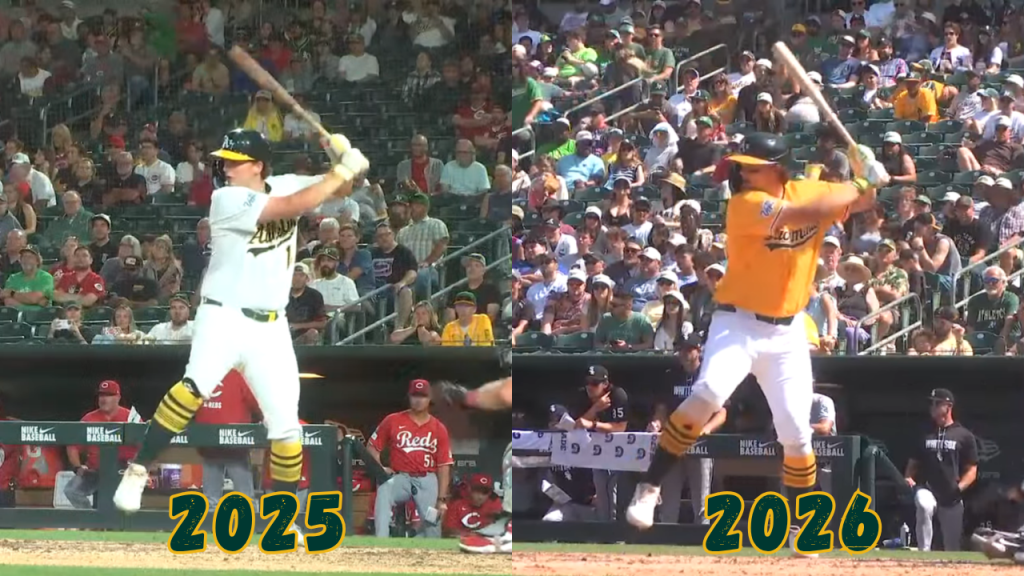
Moving to the beginning of the actual swing itself, the changes we’ve already pointed out are really shining through yet again.
On the left, you can see Kurtz’s first move is down rather than toward the baseball, which is enough to cause more pop-ups and more instances where he’d just miss catching a barrel. Also, you can see how he’s drifting more forward, as his body is moving pretty forcefully toward the pitcher, a move that’s the opposite of optimized.
On the right, the complete opposite is true. Rather than his hands dropping, they remain in the slot, ready to move to the baseball. This way, he carries the barrel straight through the zone, cutting out any extra “barrel drag” that he had last year. Also, he’s not drifting forward nearly as much, but rather allowing the energy he built through coiling to be used.
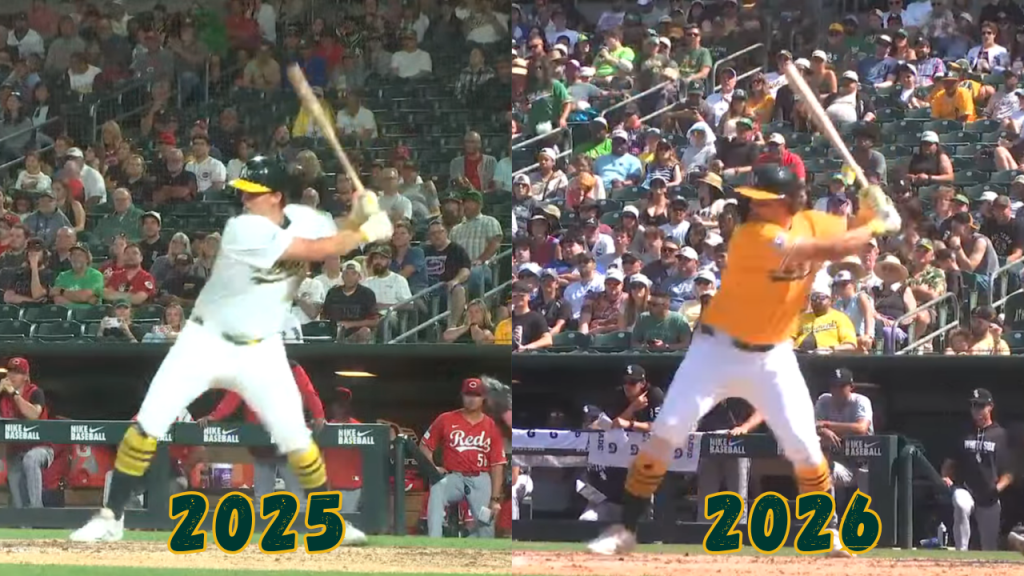
The final frame is the moment Kurtz makes contact with the baseball, and we’re able to get a great look at why he’s been impacting the baseball better than ever with these two frames.
On the left, you can see how Kurtz has a lot less room in between his arms and his torso. This difference is key and a direct byproduct of having to drag his barrel through the zone due to his poor initial hand positioning. Without maintaining space in this part of the swing, Kurtz isn’t able to impact the ball nearly as hard.
Also, despite hitting this ball out of the park, Kurtz got slightly under the baseball, avoiding impacting it with his true potential.
On the right, Kurtz has a lot more space through the swing, and he’s able to impact the ball much harder as a result. He’s able to truly extend through the zone and work through the baseball, rather than getting ever so slightly under it and out in front of the pitch.
It’s also a little easier to see how Kurtz can stay behind the baseball a little bit better by keeping his weight back as opposed to lunging forward. By working behind the ball, Kurtz is able to truly maximize the potential energy he built up during his load, rather than losing it once his front foot lands.
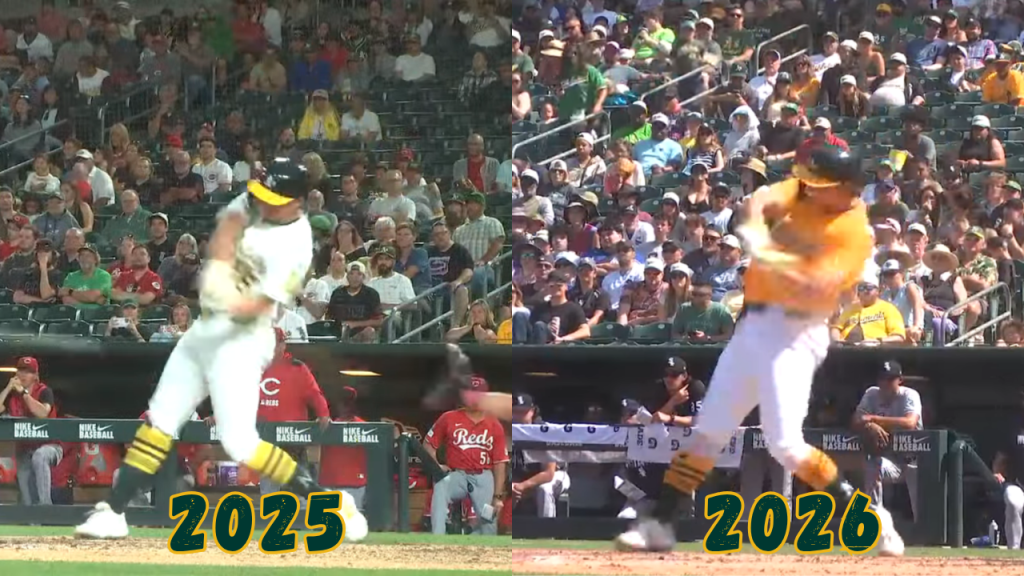
The difference in the quality of contact between these two swings is clear, and the data reflects it. With the swing on the right, Kurtz hit the ball nearly a full mile per hour harder, and it was all because he put himself in a better position to impact the baseball.
This is also why Kurtz has been able to hit the ball over two miles per hour harder on average (94.8 mph in 2026, compared to 92.7 mph in 2025), reach a new max exit velocity that’s almost a full tick higher than his previous career high (115.9 mph), and achive an astounding 8.2% increase in his hard-hit rate (59.3% in 2026 as opposed to 51.1% in 2025).
All of this data comes back to the swing, as Nick Kurtz has truly taken his game to the next level through a few minor adjustments.
What Does the Data Tell Us?
by Shaan Donohue
Nick Kurtz’s swing profile is interesting because it doesn’t just explain one part of his offensive game. It helps explain the entire shape of who he is as a player.
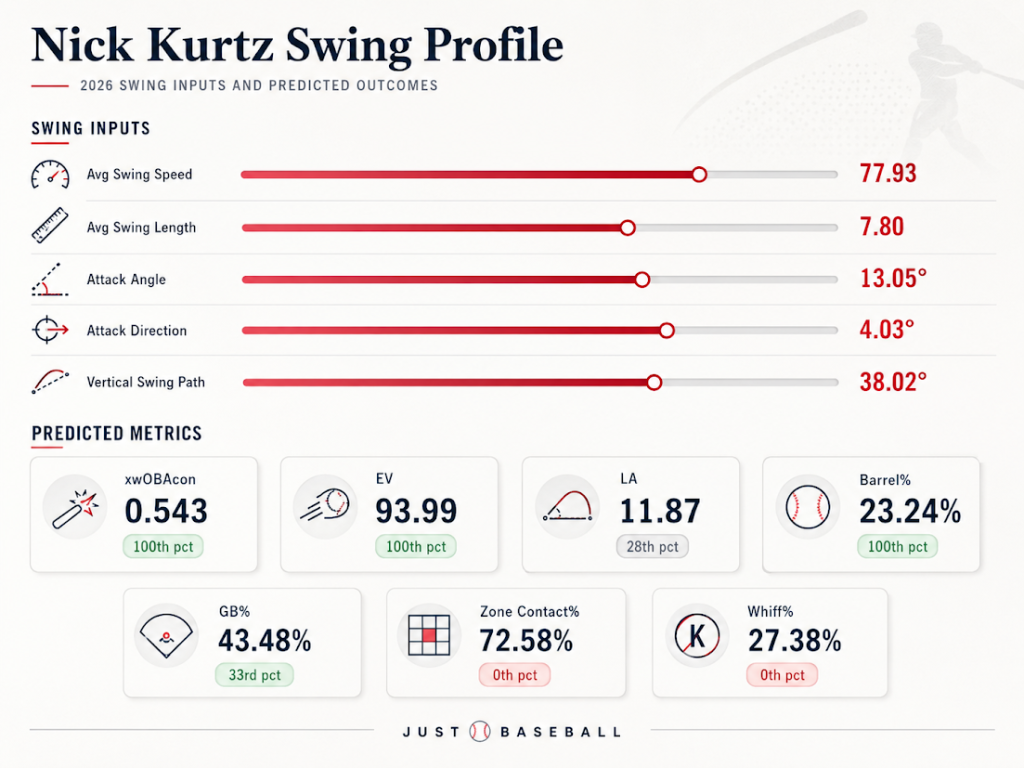
Across both 2025 and 2026, Kurtz has paired a steep attack angle with a vertical swing path. His average attack angle sat at 14 degrees in 2025 and 13 degrees in 2026, while his vertical bat angle checked in at 39 degrees and 38 degrees, respectively. That is a swing built to lift the baseball. When paired with his 99th percentile bat speed, Kurtz can elevate with enough force to do real damage.
The more interesting part of the profile is that Kurtz does not sell out for pull-side loft in the way many hitters with this type of swing path do. A hitter with a steep path and elite bat speed is often expected to pair that with pull-side direction, maximizing air-pull contact where most of the highest-value batted balls live.
Kurtz’s swing direction has remained more opposite-field oriented, sitting at 2 degrees in 2025 and 4 degrees in 2026. That helps explain why his power plays to all fields rather than existing only as a pull-side damage profile.
There is a tradeoff. Kurtz has not been a particularly strong air-pull hitter, with only 12.1% of his batted balls falling into that category. In most cases, that would be a concern for a left-handed slugger with this much loft in the swing.
Kurtz’s bat speed changes the equation. Because he impacts the ball so violently, he does not need to be perfectly optimized for pulled fly balls to produce elite damage. His swing gives him loft, his direction gives him field coverage, and his bat speed gives him margin for error.
The downside of that same swing path shows up in the swing-and-miss data. A steep path combined with a violent move through the zone naturally creates whiff risk, and Kurtz’s 4th percentile whiff rate reflects that concern. From a data perspective, this is not a swing that is ever likely to produce elite contact rates. The path is too vertical, and the move is too aggressive.
What makes the profile work is that Kurtz offsets the whiff with elite swing decisions. This has been a carrying trait for him dating back to his amateur career, and it has translated to the major league level.
Through 2026, Kurtz owns a 90th percentile chase rate and a 100th percentile walk rate. That plate discipline gives him the foundation to survive the swing-and-miss that comes with his power-oriented path.
Kurtz’s swing is not without flaws, but the flaws are part of the same package that makes him dangerous. The steep path creates loft. The bat speed turns that loft into impact. The opposite-field direction allows the power to play across the field. The swing decisions give him enough selectivity to withstand the whiff.
Kurtz may always carry swing-and-miss risk, but the underlying swing traits point toward a sustainable offensive profile built on damage, discipline, and all-fields power.
How Sustainable Is This Pace?
by Jay Staph
After seeing how the changes in Kurtz’s swing have impacted his production, we’re left with one final question to answer: How sustainable is this pace?
The answer is very sustainable, as these changes will allow Kurtz to continue producing elite power numbers despite the volatility that comes with his tendency to whiff. Kurtz hasn’t even played two full big league seasons yet, but he’s already shown tools that can be considered an “Albert Pujols starter kit.”
I mentioned earlier, when breaking down his swing, that Kurtz is impacting the baseball harder than ever before, but I didn’t even touch on the most encouraging aspect of this data. His numbers have taken a dramatic leap forward against secondaries, which is incredibly important if he’s going to keep playing at this pace.
For example, Kurtz went from having a 44.1% hard-hit rate against sliders to posting a hard-hit rate just shy of 70%, which is a ridiculous jump to make. Although it’s a much smaller sample, he’s also posted hard-hit rates near or above 80% against both sweepers and curveballs.
Kurtz’s swing improvements haven’t just allowed him to hit the ball harder than ever, but they’ve likely also given him more time to recognize spin without being so stuck on his back side. From that point on, it’s all about making contact with the baseball, and when he does, few in the league hit it harder.
While whiff rates will always be a concern for him, he certainly makes up for it with his ability to impact the baseball and the way he hits the ball in the air to all fields. This will always make him an extra-base hit threat when he makes contact, as he possesses the ability to do real damage constantly.
At the time of writing, Kurtz has played 157 big league games, and the results have been video game-esque. With 41 homers, 107 RBI, a slash-line of .283/.392/.569, a wRC+ of 161, and an fWAR barely shy of 6.0, we’re looking at dangerous production year-in and year-out.
2026 is Kurtz’s age-23 season, and he’s already likely the game’s best first baseman with real similarities to a young Albert Pujols. This is a generational power hitter, and if he continues to optimize his swing, the sky is the limit on how much better he can get.
Become a Member of Just Baseball
Subscribe and upgrade to go ad-free!
* Save 25% by subscribing annually.