
St. Louis Cardinals 2026 MLB Draft Analysis: Day 2, Part 1
Day 1 gave Cardinals fans plenty to cheer about. Which diamonds in the rough did St. Louis uncover on Day 2?
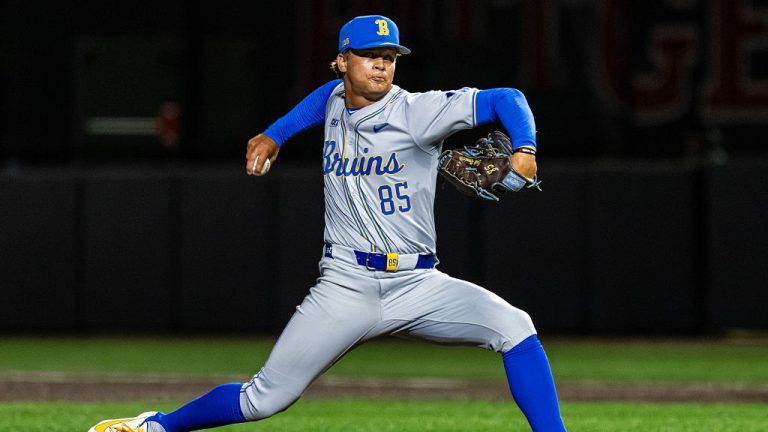
Welcome back to my analysis of the St. Louis Cardinals’ 2026 MLB Draft! Earlier this week, I covered the Cardinals’ Day 1 draft picks. We will be splitting Day 2 into two separate parts, and today I’ll be covering the team’s selections in rounds five through 10.
146. Cal Randall, RHP | University of California, Los Angeles
From a pure stuff perspective, a compelling case can be made that Cal Randall has the best four-seam fastball in the class.
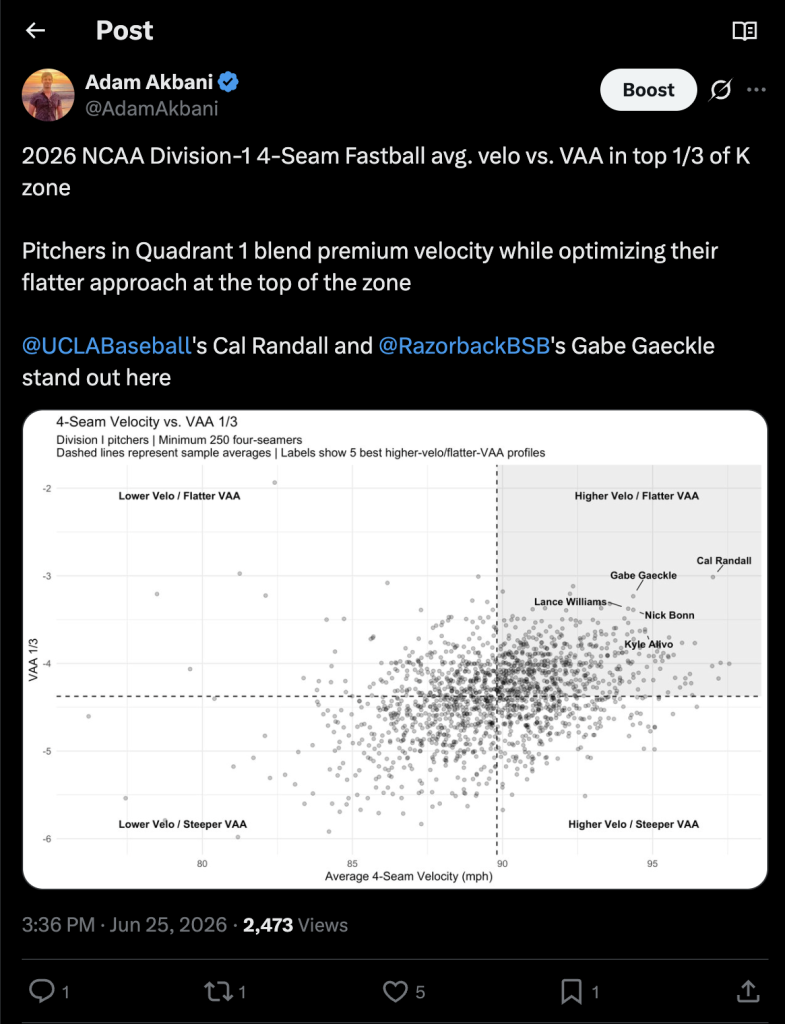
Randall sits 97-98 mph, has reached 101, and generates about 19 inches of induced vertical break from a 5.2-foot release point. That absurd combination makes for one of the flattest approach angles in all of Division I at -4° VAA.
He throws it for strikes a respectable 62.3% of the time, and even if the pitch comprised 88% of his total usage, it was so effective that he got away with it in college.
That being said, I’m curious to see just how much the Cardinals curtail his four-seam usage to challenge him with his secondaries. The team ripped off the band-aid, cutting usage at once by 8-10% with guys like Liam Doyle and Tanner Franklin, but doing the same with Randall would assuredly set him up for immediate failure. A sort of “weaning off” plan over the course of a season makes more sense here.
His high-80s changeup has a similar movement profile to the fastball, which gives it some copycat deception while pumping the brakes.
As was mentioned, Randall is probably a reliever long term. His command is fringy, as you’d hope he’d hit the zone over 65% with a pitch he leans on almost exclusively. However, though at a very small sample size, he did throw his breaking balls for strikes.
This is an upside bet on an elite trait. Randall’s fastball is good enough to get him to the majors, but he’ll also need one of his breakers or offspeed to catch up to the scathing heater.
175. Owen Henne, SS | Seton Hill University
Not only is Owen Henne the most mysterious selection the Cardinals made, but he has the case for being one of the more obscure names of any player who heard his name called this past weekend. However, one glance at his profile and the strides he’s taken, particularly over the past handful of weeks, and I was hooked.
At Seton Hill, Henne hit .399/.488/.572 in 172 plate appearances, with his bat-to-ball skills carrying his offensive profile over his power tool that was vastly improved throughout 2026. His college zone-contact rate was 96.3%, pairing it with a respectable 23.9% chase rate, a 105.2 mph EV90, and a 10.6% barrel rate.
His time in the MLB Draft League only served to boost his draft stock. He hit .302/.486/.528 across 74 plate appearances while posting a 92.5% zone-contact rate while cutting his chase rate to 17.7%. The latter mark ranked in the 93rd percentile.
Most importantly, Henne established a new career-high maximum exit velocity at 109.2 mph, doing so with a wooden bat as opposed to a metal one, and produced a 46.5% hard-hit rate. Even at a smaller sample size, he showed he could improve his swing decisions and hit the ball harder without sacrificing the contact ability that made him successful in the first place.
A caveat to Henne’s game is his inability to loft; his sweet-spot percentage was just 27.9% in the Draft League, while his air-pull rate was only 7%, so there is room for him to optimize his batted balls in the air to left field more frequently.
Regardless, at 6-foot-3 and 190 pounds, there is a reasonable chance that more power arrives naturally as he fills out, which would effectively mitigate the need to be efficient with his batted-ball events.
The difficult part is evaluating his defense and athleticism because of where he played. His lateral movements are solid at best, so it’s not unreasonable to rule out a move off of the six. If he stays at shortstop, the offensive profile has massive intrigue. Even if he slides over to third base, he profiles as an above-average defender at the hot corner.
I can’t wait to see Henne make his professional debut. The contact and improving plate discipline give him a real chance to hit, while his projectable frame and improved power outputs leave room for even more impact potential as he matures.
Add in the possibility that he sticks at shortstop, and it’s easy to understand why the Cardinals were fascinated by his profile.
204. Derek Schaefer, RHP | Arizona State University
The former Sun Devil will enter the Cardinals’ system on the verge of having a complete starter’s arsenal. He already has two solid offerings and is a changeup away from having a more complete bag of offerings to overwhelm hitters with.
His fastball sits 94-95 mph, reaches 99, and showcases about 17 inches of induced vertical break from a 5.8-foot release point. It’s a strong pitch, but his mid-80s power sweeper may be even better. It generates roughly 12 inches of glove-side movement and gives him a legitimate bat-missing breaking ball due to how much horizontal offset it gets when paired with the heater.
His cutter and changeup are less developed. The high-80s cutter gives him another hard look and bridges the four-seamer and sweeper, while the mid-80s changeup offers a potential weapon against opposite-handed hitters. Neither is dependable enough yet from a strike-throwing perspective to make the arsenal feel complete, and the development of the cambio will be key, as he doesn’t currently change speeds enough.
All told, there’s a solid foundation here with a viable heater and breaker. If he can throw more strikes with the offspeed, it’ll help him handle a higher bulk of innings as he ascends the minor-league ladder.
234. Luke Harrison, LHP | University of Texas at Austin
Representing a relic of the John Mozeliak era of pitching draftees, Harrison is a command/control demon who won’t overpower hitters with his arsenal, but he presents an entirely new challenge for batters by hitting his catcher’s target pitch after pitch.
His four-seam fastball sits 91-92 mph and touches 96, but he primarily works off a high-80s cutter that functions as his main heater. That pitch gives hitters a different look, offering velocity across eight inches of horizontal offset.
On the extreme glove-side end is a low-80s power sweeper with about 13 inches of eastward movement. It helps complete a trifecta of offerings spanning across 17 inches horizontally. He also commands these offerings well, with no offering having a strike percentage below the 63rd percentile.
Harrison will make his living by frustrating hitters; changing movement planes, locating his pitches, and keeping hitters constantly guessing. It doesn’t give him much margin for error, but southpaws with a good strike-throwing ability can be useful in several roles. He could start, work multiple innings, or eventually settle into a lefty/lefty matchup role.
The Cardinals are getting a guy who already understands what his arsenal is supposed to do. His success will come down to how consistently he executes. Any additional velocity he taps into would be icing on the cake.
264. Jayden Lobliner, C | University of California, San Diego
The UC San Diego product was named the 2026 WCC Defensive Player of the Year, and given how he graded out as a 31% above-average framer compared to the typical Division I catcher, it’s not hard to see why. He is a stalwart behind the plate.
The bigger questions come on the offensive side. Lobliner posted a respectable 120 wRC+, supported by an 84.5% zone-contact rate, a 105 mph EV90, and a 108 mph maximum exit velocity. Those numbers are playable for someone at a premium position but are not impressive for a player in his age-22 season. His 33.9% chase rate is the biggest concern, however, suggesting he expands the zone too often.
Ultimately, Lobliner’s glove should give him a chance to stick at every level. The Cardinals have consistently valued catchers who can shepherd a pitching staff and hold their own defensively, and given their recent success developing quality catching prospects, it is hard to argue with the logic behind this pick.
If he can tighten up his swing decisions and produce enough offensively, he could develop into a useful organizational catcher with a realistic path to a backup role.
294. Nick Bonn, RHP | California Polytechnic State University, San Luis Obispo
The Cal Poly right-hander made national headlines when he became the first Mustang to touch triple digits in program history.
Is it shocking to hear that Nick Bonn’s fastball is his claim to fame? If you’ve been paying attention, it shouldn’t be. Bonn will routinely sit 94-95 mph, has touched 100, and will generate around 18 inches of induced vertical break from a low 5.2-foot release point, all the telltale signs of a flat approach angle.
His low-80s sweeper gives him about 10 inches of glove-side movement and serves as his primary breaker.
The changeup is the wild card. It sits in the mid-80s and has a solid movement profile, but he does not throw it for strikes, allowing hitters to narrow their focus to the fastball and sweeper. This is a large part of why he was a reliever at Cal Poly.
That two-pitch combination may still work in relief as a professional, especially if the velocity ticks up as he adds meat to his wiry 6-foot-1, 150-pound frame. A better changeup would give him more options against opposite-handed hitters and would give him a better chance to develop into a starter.
Nick has two clear pitches to work with, but the defining factor in his development will be how he can command his offspeed offering. If he can’t, there’s still upside as a fastball-sweeper bullpen piece.
Reactions
Day 2, Part 1 Grade: B+/A-
The early part of Day 2 saw the Cardinals make some expected selections based on their recent pitching draft history, but they also deviated course, landing on some surprising names.
Cal Randall and Nick Bonn are fastball demons, but Luke Harrison gave me nightmares of the Cardinals selecting command/control arms under the Mozeliak regime.
Still, one can dream on Harrison’s strike-throwing ability, and having one of these guys in a draft isn’t the end of the world. Derek Schaefer was a fun selection because he has a great heater-slider combination, but if his offspeed ever comes around, that’s another high-octane starter the Cardinals will have in their system.
On the hitting side, Owen Henne represents one of my favorite selections in all of Day 2, simply because I can dream on a projectible frame growing into more power, all while crossing my fingers that he’ll stay at shortstop. It’s a lot to ask of a Division II guy drafted in the sixth round, but I’ll be watching him closely this fall and in 2027.
Jayden Lobliner represents the automatic, next-guy-up profile who can provide depth at the most important defensive position that every organization has on its draft shopping list. However, given that it’s the Cardinals picking him — an organization that excels at developing backstops — I can’t help but be intrigued. He’s an elite defender, and it’s not as if he has zero offensive intrigue, so I can definitely see the vision here.
This was another fun chunk of the draft, and while selecting Harrison wouldn’t have been my personal pick (thus, why I docked the team a letter grade), it’s not at all a terrible strategy for someone who has an outside chance to outplay his current arsenal.
It’s hard to nitpick at anything that they did this weekend, but for this portion, that’s my only gripe.
Become a Member of Just Baseball
Subscribe and upgrade to go ad-free!
* Save 25% by subscribing annually.

Written by
Adam Akbani is a writer and analyst from St. Louis, MO. He attended Washington University in St. Louis, double majoring in Economics & Strategy and Political…