
2026 MLB Draft: Names To Know After The Fall
A deep dive into 15 lesser-known prospects who deserve a closer look ahead of the 2026 season, when they could shoot up draft boards.
 | |
| | 
The fall has come and gone, and as we enter a “dead period” within the scouting community, that’s our cue to keep going.
With the rollout of our Top 50 lists in the rearview mirror, it’s time to start getting into the nitty-gritty of this class. There are a few glaring omissions present, which will happen with every list that enters the fray.
With that said, while we always want to know who missed, why don’t we focus on the names that have been hidden and lack sufficient exposure to the public?
That’s what we are here to do today. We’ve evaluated plenty of prospects for future renditions of our boards, and we’ll highlight fifteen players within both demographics that we expect to leave their mark on the scouting community this cycle. Their performances during the fall season have left us with plenty of expectations, and they are deserving of the praise. Let’s dive in, shall we?
1B/OF Cody Boshell, Bishop John J. Snyder HS (FL)
Built like an Appalachian Lumberjack, Boshell’s bat is one of the most potent on the amateur scene. While there’s a chance he’s just a first baseman at the next level, the metrics that Boshell posted this summer were obscene.
Boshell has a swing designed to do significant damage. It’s violent bat speed with a lofted bat path through the zone, built for launching the baseball in the air.
Boshell generates plenty of extension at impact, rotates intensely, and routinely crushes pitches in the zone. To date, Boshell pulls the ball in the air among the best of them, something that will be highly valuable come draft day.
However, he’s more than your prototypical slugger. Boshell has run minimal whiff and chase rates to date, displaying solid plate discipline with the ability to rack up walks. The Tennessee commit has a potent offensive profile.
His swing can get out of sorts at times, though that will tighten up with further development. The hands are noisy and take a path less traveled to the baseball, which does hurt his timing slightly, plus the swing can get long as a result.
He is a good athlete for his size and has had reps in the outfield, giving him some leeway defensively to avoid putting too much pressure on the bat to perform.
He’s an average runner with quality arm strength, although his route-running can sometimes be adventurous. He fits best at first base if he proves to be unable to handle a corner outfield spot.
Given the performances he put up on the circuit, Boshell has a “high follow” label on our board, and the same can be said within multiple scouting circles. – Tyler Jennings
RHP Aaron Dierks, West Springfield HS (VA)
A power arm out of the Mid-Atlantic, Dierks saw his velocity creep up the scale throughout the summer, but his performances at the Border Battle and WWBA Championship cemented his status in the industry.
He’s built like a brute at six-foot-three, 215 pounds. He has wide shoulders, good strength, and projection, lending to a sturdy frame.
There’s deception to his delivery, as he’ll pitch across his body with a ton of moving parts coming at the hitter. It’s impressive arm speed from his high release, as well.
Boasting a supinator profile, Dierks gets considerable cut and carry on his heater, playing best to his gloveside and playing off the cross-body action. He misses plenty of bats within the zone, plus he’s shown the ability to locate to both sides of the plate.
At his peak, he’s gotten up to 95-96 MPH, though he’ll routinely sit in the low-90s.
His breaking balls have substantial potential, as well. His slider has crept into the mid-80s with tight spin and bullet shape, tightening into a cutter when thrown harder.
His mid-70s curveball has a bigger shape, though it snaps violently to the dirt with two-plane tilt. He has feel to land both breakers for strikes and pitch backwards when he loses fastball command. There’s feel for a power cambio in the upper-80s, as well.
Dierk’s feel for pitching, strike-throwing, and advanced stuff will put him high on many draft boards. The South Carolina commit will have scouts flocking to his outings in the spring. – TJ
SS/3B Dylan Fairchild, Detroit Catholic Central HS (MI)
A cold-weather bat from the state of Michigan, Fairchild utilized a loud showing at Jupiter to get the “pop-up” label slapped on him. An athletic and projectable infielder, the Cincinnati commit boasts a clean swing from the right side of the dish.
Very few rival his ability to pull the baseball in the air in this class. Fairchild’s operation is quiet and smooth, repeating his mechanics well and consistently getting the barrel to the baseball.
His hips clear out quickly, which enables him to generate quality leverage at impact and carry a heavy barrel through the zone. He gets the ball in the air often, frequently hammering the pull side fence with ease. As he physically matures, so will his impact on that side of the park.
The hit tool isn’t too shabby, either. Fairchild tends to stay within the zone and rarely chases, racking up a good amount of walks as a result. The main issue to fix resides in the hands, which move quite a bit during his load. This has affected his ability to catch up to higher velocities, though minimizing his hands should help him as he climbs the ladder.
Defensively, he’s quiet and composed at the “six”, displaying a solid internal clock with good arm strength across the diamond.
There’s some bounce to his step, plus his exchanges are quick out of the glove. He has the look of a reliable defender, though he may move to third base as his frame fills out. – TJ
OF Tyler Head, North Carolina State
One of the more lithe and projectable athletes from the 2024 prep class, Head made an immediate impact for the Wolfpack in 2025. Now in his draft-eligible campaign, Head enters the winter with plenty of helium attached to his name.
His dynamic center field defense is the eyecatcher of his profile. Head is unafraid to put his body on the line for the highlight reel play, something he did routinely during the spring. He covers plenty of ground with excellent route-running, gobbling up flyballs in the gaps. It’s stout arm strength, as well. Everything points to a potentially plus or better glove at a premium position.
Many believe his offensive impact can close the gap to his defensive prowess in due time.
He’s known more for his table-setting qualities than his power, as he’s a fantastic bat-to-ball artist with minimal swing-and-miss and an excellent eye. He drew nearly twice as many walks as he did strikeouts in 2025.
He’ll utilize the whole field to his advantage, all while flashing pull-side power. As he fills out his frame, the power is expected to tick up.
It’s a ton of projection with a premium glove that ranks among the best in the entire class. Admittedly, it’s not too dissimilar to what Eli Serrano III was in 2024, albeit Head has a better glove and less power than Serrano. He’ll have plenty of fans within the Carolinas. – TJ
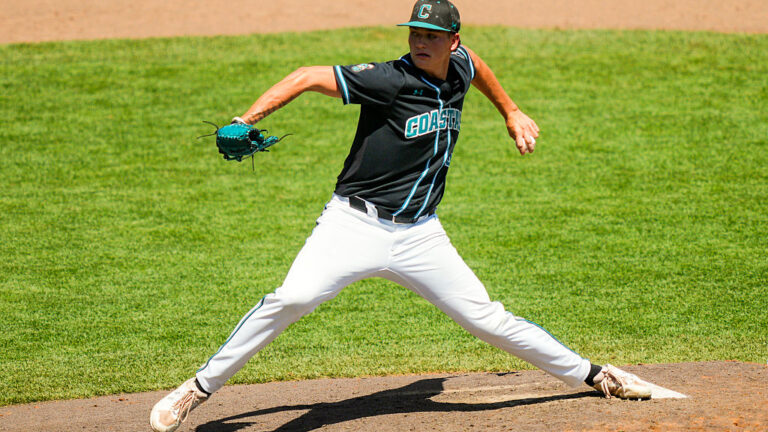
LHP Hayden Johnson, Coastal Carolina
An integral bullpen piece during their College World Series run, Johnson is expected to make the jump into the rotation in 2026 behind Cameron Flukey. With a deceptive delivery and a formidable one-two punch, Johnson has the potential to be a significant draft riser during the spring.
Pitching from the first base side of the rubber, Johnson can be a devilish at-bat, especially for left-handed bats. He’ll hammer the strike zone with the heater, which has crept up in velocity this fall at 92-94 MPH.
It’ll play up from its current state thanks to impressive life on the top rail, as it generates hefty IVB numbers with flatter VAA traits.
The pitch performed as one of the better heaters in college baseball last spring, missing bats at a 31% clip and garnering chases at a 35%. Both are rather impressive marks.
To go one step further, Johnson’s whiff rate in the zone on the heater was 26%, which ranked the highest among 2026-eligible southpaws. That is insanely good.
Johnson’s low-80s curveball has a chance to be a true hammer. Coming out of the same tunnel as the heater, it dives for the dirt with quality snap and some late sweeping action.
It’s been up to 84 MPH this fall, as well. There’s a need to expand the arsenal in a starting role, though scouts have said that Johnson is adding a cutter and change-up to his repertoire in preparation for his expanded role.
The expectation is that Johnson will slot in as the Saturday arm for the Chanticleers this spring, and assuming that assistant coach Matt Williams can work his magic, Johnson is in line for a Day 1 selection. – TJ
SS Elliot Lascelles, Upper Canada College (ON)
The lone Canadian to crack this list, Lascelles has seen his impact grow over the past calendar year. He’s been well-known as a bat-to-ball artist, but an uptick in strength and athleticism has seen his stock climb in recent months.
Lascelles tends to keep his swing compact and simple. He operates with a minimal leg kick trigger and an inward rotation of his front hip before opening up and impacting the baseball.
He’s a pest for opposing pitchers, smothering anything left in the zone and adjusting to offerings just outside of it. He’ll slap the baseball to all fields and utilize his plus speed to grab extra bases, plus he’ll provide value with an aggressive nature once aboard. It’s a true table-setter profile.
While Lascelles’ power won’t be the focal point of his profile, he’s gotten into more juice this year. He’s found some more bat speed and juice that plays best to the pull side gap, though Lascelles won’t be a slugger at the next level. Growing into more impact will elevate his profile further, though.
Lascelles has the fluidity and athleticism to handle shortstop, flashing solid footwork and rangy actions to both sides. With that said, scouts want to see the arm strength improve to solidify his spot at the position. If it doesn’t improve, most believe he’ll shift to second base.
A commitment to Yale may complicate things for Lascelles come draft day, but he’s made enough of a case to have a team invest in his tools. If he can further boost his stock this spring, he has a chance to be taken within the top 100 picks. – TJ
SS Taj Marchand, James Island Charter HS (SC)
Marchand wasn’t invited to a ton of big events this summer, but he left his mark on the scouting community despite that. He was a standout performer at every stop on the summer calendar, and while there’s two-way viability here, many foresee a future shortstop with budding offensive tools.
While Marchand’s swing is a bit unconventional, and the profile has its warts, the metrics have stood out. The pure contact skills are sublime.
Marchand smothers anything left in the zone, plus his adjustability out of the zone caught everyone’s attention, posting a 29% whiff rate on those offerings. He tends to let pitches travel through the zone, shooting the ball the other way.
Marchand does chase at a super high clip, exceeding 35%, but having that kind of contact prowess certainly helps him despite that red flag.
Marchand creates a ton of stretch and elasticity between his hands and front foot, which enables him to have quick hands, solid rotation, and bat speed. He does get in trouble with drifting over his front hip/foot, and one should expect the swing to go through some drastic changes to generate more leverage and power. It’s a promising offensive profile.
Boasting solid arm strength and mobility, many believe Marchand can stick at the “six.” He stays composed and consistent with his actions, flashing good footwork and range, as well as a great internal clock. He has the tools to stick on the left side of the dirt.
The Mississippi recruit can also pitch, reaching 92 MPH on the mound with a budding breaking ball, but the bat has been too good to ignore. He has a case to elevate his profile into the first 100 picks come July. – TJ
SS Jace Mataczynski, Hudson HS (WI)
Jace Mataczynski, like many cold-weather prospects, exploded onto the scene in a hurry and has remained in the crosshairs of the scouting community ever since.
The Auburn commit from Wisconsin displays premium athleticism and twitch in a 6’3″, 185-pound frame, evident in both his offensive and defensive profiles.
At the plate, it’s a right-handed swing that could still stand to add a touch more refinement. He starts in a wide base with a higher handset, close to his ear.
From there, it’s a drift back into his load before a small jabbing step into his swing. Mataczynski’s wide base helps him get into his legs well, and there’s plenty of present bat speed. I’d envision some of the mechanical rawness working itself out via his impressive athleticism.
Defensively, he has a good chance to stick at short. He’s a fluid mover with smooth actions and a decisive first step. His hands are soft, and there’s a rapid arm there, too (he’s been clocked up to 98 mph in the infield).
This is the type of talent and twitch that can end up looking like a draft steal. If Mataczynski’s offensive game continues to trend in the right direction, he’ll check most of the boxes you’re looking for in a projection-reliant shortstop profile. – JD Cameron
RHP Dawson Montesa, West Virginia
Originally a shortstop when he enrolled at Adelphi University, Montesa was converted to the mound and never looked back. After being named a First Team All-American at the DII level, Montesa has taken his talents to Morgantown, where he’ll slot into the Mountainers’ rotation this spring.
Montesa’s delivery is athletic and fluid down the bump, flashing little effort and solid arm speed from a three-quarters arm slot.
There’s enough projection to suggest that Montesa can sit in the mid-90s soon, but for now, he’s pitching in the 91-95 MPH bucket, reaching back for 96 MPH. He generates solid backspin and carry on the top shelf of the zone, where he finds most of his success.
During his stint in the NECBL, Montesa missed bats at a 36% clip in the zone, including a ridiculous 63% mark in the upper third. The makings of a solid heater are there.
Montesa’s primary secondary is a big curveball in the upper-70s, which tunnels off the heater well. It features sharp bite and quality depth, while flashing some tilt in the process.
It’s more of an 11/5 shape than a true 12/6 breaker. There’s feel for a tumbling mid-80s change, plus Montesa has worked on incorporating a firmer slider into his arsenal.
While he’s not faced much DI competition to date, he showed promise in the fall against Kentucky and Wake Forest. Given the athletic traits, fastball upside, and projection, Montesa’s stock could blossom in the spring, assuming quality results are provided. – TJ
2B/SS Anthony Potestio, UC San Diego
Potestio has been one of the best collegiate bats on the West Coast the past two seasons, boasting a career .321 average and an OPS of .891 during his time at UC San Diego. Pairing exquisite bat-to-ball skills and a stable approach at the dish, it may be the best hit tool in this part of the country.
While Potestio can get passive at times, there’s not much to be harsh about at the plate. He loves to lace the ball to every quadrant of the ballpark, plus he keeps whiff and chase rates to a minimum.
Potestio posted a 90% in-zone contact rate during the spring and an 85% rate during the Cape season. That success on the Cape culminated in an All-Star appearance, and that gives him a nice feather in the cap when it comes to evaluations.
The swing path is more linear, though he’s shown the ability to generate solid backspin and lift the baseball. He boasts a high AirPull%, and as he fills out his frame, he’ll find himself depositing more baseballs beyond the fence.
With that said, his power is likely no more than 40-grade. He has the makings of a potential table-setter, though he could make a living in the back-half of the lineup and provide stability, as well.
On the defensive front, Potestio has manned shortstop for the Tritons, though he did see time in the outfield this summer. He showed well in right field, and he can play there in a pinch with good route-running and instincts, but his future is up the middle.
It’s solid range with feel to throw from different angles, and he’ll likely stick at the “six” until a better glove pushes him to second base.
Overall, Potestio has quietly put together one of the better track records in this class, especially at the mid-major level. A top-five round selection is very much in the cards for him come July. – TJ
RHP Logan Schultz, Marcus HS (TX)
Born with a nub on his non-throwing hand, Schultz has adapted to his condition and found ways to impress scouts. In fact, the Texas State commit’s appearance in Jupiter gave scouts an eye-opening look at an arm that possesses quality stuff, projection, and athleticism.
Starting with a low handset, there’s deception and ease of motion that stand out on film. Utilizing an inward rotation of his hips, he keeps the ball hidden through the hand break, and hitters barely see the ball before it comes out of his hand.
This allows his arsenal to play up, and it’s already a good one.
Schultz has been up to 93 MPH, routinely sitting in the low-90s with legitimate arm speed from a three-quarters arm slot. He spins the heater rather well, flashing good zip through the zone with some carry when elevating the offering. Given the projection and athleticism, it’s easy to envision mid-90s in the future.
His breaking balls have upside, too. He’s got a low-80s slider that flashes good tilt and bite late, while there’s a bigger curveball in the upper-70s with more depth present.
Both offerings play at their best when located away from right-handed hitters, plus he’s shown the ability to land both for strikes.
Given the fastball upside, athleticism, and projection, Schultz provides value and has a chance to be taken on Day 2 of the draft. It’s more of a “follow” tag at this stage, but he’s earned some suitors. – TJ
RHP Zane Shaw, Lawrence Free State HS (KS)
Another late-season pop-up arm, Shaw may possess one of the better heaters in the Midwest.
Possessing a stronger build than some of his peers, Shaw attacks the zone regularly with a one-two punch that has gotten better as time has progressed.
He’ll attack hitters with some crossfire angle to the plate, flashing decent arm speed from an over-the-top arm slot that allows him to get behind the baseball well. As a result, Shaw generates plenty of backspin and slight cutting action to his fastball.
Shaw likes to elevate the heater and will miss bats on the upper rail of the strike zone. The vertical carry on the pitch likes to live near the 20-inch mark, an impressive bucket to live in as an amateur. Shaw has reached back for 94-95 MPH when he needs it, though he’ll consistently live in the 89-92 MPH range and blow heaters by hitters.
There’s a low-80s slider with some gyro movement that he’ll land for strikes when his command of the heater wanes.
It’s a pitch that can get soft at times, but given the advancements made in development, the pitch will certainly benefit as he climbs the ladder. His upper-70s change-up is a distant third offering at the present time.
Shaw doesn’t put a ton of effort into his delivery, plus he hammers the strike zone on a consistent basis.
With that said, he doesn’t possess quality projection, but he’s likely a few mechanical tweaks away from unlocking more velocity. He’s another player with a “follow” tag on him, but if he can get the heater to above-average, it’s an enticing Day 2 pick-up. – TJ
SS Santos Wade, Providence Academy (GA)
Even in a talent-rich hub that Georgia offers for amateur baseball, Santos Wade certainly doesn’t get enough national love and recognition for the game he offers. He’s coming off a loud and excellent 2025 circuit run, tallying over 20 extra-base hits and a .350 average.
The Providence Christian infielder brings a tooled-up, dynamic offensive profile. It’s a calm, spread-out setup paired with outstanding bat speed and the ability to drive the baseball to all fields.
Wade generates tension with separation and impressive lower-half strength into the ball, helping him create impactful contact. Santos possesses great barrel control and has recently toned down his leg kick, allowing him a more consistent rhythm and allowing him to handle velocity with damage.
Santos often gets the nod at shortstop defensively and plays it well. Given his athletic 6-foot-1 frame, he displays good range to both sides with the ability to really pick it. His arm strength is fine for the position currently, though it’ll be worth monitoring whether he sticks at the 6-hole or pivots to another position on the dirt.
A current USF commit, Wade looks like a potential day-one plug-and-play if he reaches campus. But if his momentum continues this spring, expect him to garner legitimate day-two draft consideration for 2026. – Peyton Sower
LHP Colin White, Harrison HS (GA)
While White did not attend many big events this summer, his abbreviated showing in Jupiter helped cement his status as a “high follow” in this class. His arsenal is built around power, and you can make a case that it contends against some of the more well-known southpaws in the country.
Built like a bull, White has plenty of strength throughout his body. He’ll pitch with an inward rotation of his front side, staying compact throughout his delivery, though there’s effort at release that has hampered his overall strike-throwing.
This is something that will need to be worked upon in the spring.
With that said, the fastball explodes out of his hand. He held 93-96 MPH during his outing in Florida, and it has the makings of a bat-misser.
It’s big life through the zone with late tailing action, and while he can struggle to command the offering, he can set up his secondaries with the heater.
This leads to an absolute hammer in the low-80s coming out of a similar tunnel. It possesses huge spin rates (2,800 RPMs+), two-plane tilt, and big snap. There’s feel to land the pitch for strikes, though it plays at its best when buried below the zone. It’s got “plus” written all over it.
It’s more of a relief look presently, though the stuff will certainly earn him some money this cycle. It wouldn’t be a shock to see White receive a multi-million-dollar signing bonus, assuming he forgoes his commitment to Florida. If he doesn’t, he’ll be a draft-eligible sophomore. – TJ
SS Will Yow, St. Anne’s-Belfield HS (VA)
Yow is arguably the fastest runner in the entire class, and while comparisons to Kellon Lindsey and Jordan Yost will be prevalent, it’s a testament to the tools in his profile. His big showing in Jupiter helped cement his status among scouting circles.
An athletic and lanky prospect, Yow can create a good bit of stretch in the box, though his swing stays tight and compact. It’s solid bat speed and leverage at impact, though Yow will generate most of his extra bases via his legs.
With that said, he’ll deposit a couple of balls beyond the pull side fence. It’s quick hands with twitchy hips, as well. He can find himself fishing for pitches out of the zone more often than scouts would like, but the speed and contact make up for it right now.
The speed itself is top-of-the-scale good. As a right-handed hitter, Yow has produced sub-4.00 home-to-first times, an elite mark to have at this stage of his career. He has an excellent burst out of the box with a long, athletic gait and instantly puts pressure on the defense to get him out. Anything in the gaps will be turned into extra bases with ease.
That speed does translate to the field, where he’s got the bounce and range to handle the “six” long term. His arm strength does leave some warts when moving to his right, though it’s nothing egregious. If he happens to move off the position, a move to second base, or even center field, would be in the cards.
Yow’s brand of baseball will garner plenty of eyes wherever he plays. He’ll have lofty expectations to meet in the spring, given what he’s already shown, but he’s just scratching the surface of what he’s capable of. The Virginia commit is a “baby gazelle” of sorts, and the idea of him flying up draft boards this spring is not far-fetched. – TJ