
The Brewers Have a Kyle Harrison Problem
Kyle Harrison has not been the same pitcher since he returned from the injured list, raising significant concerns as the postseason approaches.
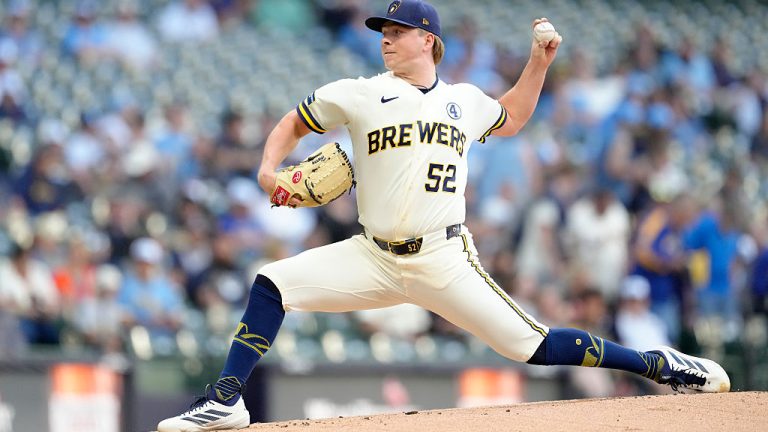
Through the first half of the season, it appeared as if the Milwaukee Brewers had one of the most lethal one-two punches in Major League Baseball blossoming in front of our very eyes.
Jacob Misiorowski was, and still is, doing things never before seen on a mound, flashing unprecedented velocity in pursuit of his first Cy Young Award. Kyle Harrison, while not as flashy, was doing his best to match him in the early parts of the season.
Then came a dreaded IL stint that has seemingly derailed Harrison’s 2026 campaign and has made him look like an entirely different pitcher than the one Brewers fans were watching earlier in the season.
Up until the Brewers traveled to Las Vegas to take on the Athletics in the bandbox that is Las Vegas Ballpark in early June, Harrison was posting numbers that rivaled some of the best in the sport. His 1.57 ERA across his first 11 starts (57.1 innings) was third in baseball behind Shohei Ohtani and Cristopher Sánchez (min. 50 IP).
He ranked fourth in the sport in K-BB% (24.9%), and his unicorn fastball from the left side was seemingly impossible to hit.
His ERA took a hit in Las Vegas, when he surrendered eight earned runs in just 2.1 innings, but few pitchers were going to succeed in that ballpark. He bounced back in a big way after that, and even with the blowup outing inflating his numbers, he still carried a respectable 3.01 ERA and 3.10 FIP across his first 17 starts before hitting the injured list on July 9.
Harrison spent just under a month on the injured list and made his return to the mound on August 5. However, he just hasn’t been the same pitcher ever since his return.
His first start since coming off the injured list actually went quite well, going five scoreless innings while allowing just one hit and striking out 10 against Pittsburgh on August 5. Since that outing, across his most recent five starts, Harrison is 1-4 with a 6.95 ERA and a FIP in the mid-8.00s.
He’s gone just 22 innings in those five outings and has allowed 10 home runs (yes, 10) while walking 12 and striking out just 23. After once looking like the Brewers’ shoo-in Game 2 postseason starter, Harrison is now staring down the barrel of a demotion to the bullpen in order to simply get right and find himself before October hits.
Concerns Across the Board
There is no sugarcoating it: there are red flags across the board in Harrison’s recent performance that point to needing a reset.
The table below highlights his performance pre- and post-IL stint, and the numbers speak for themselves.
| Pre-IL Stint | Post-IL Stint | |
| ERA | 3.01 | 5.67 |
| FIP | 3.10 | 6.19 |
| K% | 29.6% | 25.4% |
| BB% | 5.9% | 10% |
| HR/9 | 1.08 | 3.33 |
| OBA | .221 | .325 |
| WHIP | 1.08 | 1.89 |
There are a number of things going awry for Harrison. For starters, his strike rate has dropped from 66.6% pre-injury to 63.4% since returning. Whether it’s a mechanical issue, a result of fatigue, or simply not having a good feel for his stuff, his strike-throwing ability simply has not been the same, and it’s resulted in his walk rate nearly doubling since returning to the mound.
The problem extends beyond just hitting the strike zone, though. Recently, the command of Harrison’s pitches has seen a noticeable step back as well, and that’s reflected in the substantial uptick in hard contact against him.
Harrison’s hard-hit rate has increased by nearly five percent, his barrel rate has gone from an impressive 6.6% before the IL stint to a whopping 13.1% since his return, and his expected wOBA (xwOBA) has increased by nearly 100 points, going from .276 to .361.
Part of what made Harrison so good earlier in the year was his ability to locate his outlier fastball, specifically at the top of the zone, which would set up his slurve perfectly. Not only has that level of command not been there, but the quality of his stuff has also seen a noticeable step back.
A Step Back in Stuff
The diminished performance of Harrison’s four-seam fastball is at the heart of his struggles. Interestingly, earlier in the year, the Brewers raised Harrison’s arm angle from 27 degrees in 2025 to 32.1 degrees prior to his injury. That change has really allowed his fastball to get much more ride and lean into the outlier characteristics.
Across his most recent six starts, however, Harrison’s arm angle has dropped nearly two degrees, down to 30.4 degrees, which has had a direct impact on his fastball performance.
The arm-side run on his four-seam has dipped from roughly 14 inches in August to a season-low 11 inches in his most recent outing. Likewise, the induced vertical break (IVB) of his fastball has hovered around 14.5 inches in his last six starts compared to his mark earlier in the year, when it sat at around 15 inches in April and May.
What’s more, the velocity on the pitch has also taken a hit. After averaging 95 mph before the IL stint and closer to 95.5 mph in May and into June/July, that mark has dropped all the way to 93.6 mph across his last five starts.
Combine the dip in velocity, IVB, and horizontal break, and it’s a recipe for disaster. Opponents are batting nearly .400 while slugging .768 against his four-seam fastball in his most recent five starts, to go with a hard-hit rate of 48.9%. For reference, across his first 17 starts of the season, Harrison was holding opponents to a .220 batting average and a .399 slugging percentage with his four-seamer.
In that same span, Harrison was generating a whiff 31.1% of the time with his heater. Since returning, that number has bottomed out to just 20.2%, largely due to the aforementioned drop in outlier characteristics that we were seeing from the pitch earlier in the year.
Harrison’s slurve has also not been as sharp as it once was. Although the results against it haven’t been as damaging, the pitch has lost an inch of glove-side movement as well as an inch of vertical drop.
All of this was perfectly exemplified in Harrison’s most recent outing against the Cincinnati Reds, where he allowed six runs (four earned) and nine hits across 3.2 innings.
The feel on his fastball was completely non-existent in that game. It had a season-low 33.3% in-zone rate, forcing him to essentially abandon the pitch as a result and lean on the slurve even more (season-high 45.2% usage).
While his slurve is an impressive pitch and a lethal offering when working in tandem with his heater, Harrison is not at his best when he leans on it to that degree.
It’s somewhat of a snowball effect that is compounding with each start, and it’s looking like something that may not be fixed in time for the postseason to give Pat Murphy enough confidence to turn the ball over to him in a postseason start.
Final Thoughts
After Harrison’s most recent outing, Murphy suggested changes could be coming in regard to his role on the staff. “Maybe he won’t start, maybe he’ll end up being in the middle of the game or something like that,” Murphy told the media.
At this point, that type of decision feels inevitable. With Logan Henderson’s ascension to becoming the Brewers’ bona fide No. 2 starter, it allows Murphy to experiment with what is best for the team and Harrison in the short term with the postseason approaching.
While Miz and Henderson are doing their parts at the top of the rotation, it doesn’t help that the rest of the group has failed to carry its weight.
Dustin May and Shane Drohan, who sport ERAs north of 6.00 since August 1, haven’t exactly thrived in their rotation spots, and Harrison is staring down the barrel of a desperate late-season role change in order to recapture his old form.
All of a sudden, the Brewers need somebody to step up in the rotation outside of the top two names. While that duo may be as strong as any in the game right now, there are real concerns about who the Brewers’ options are for a Game 3 in a postseason series.
There’s still hope that it can be Harrison, but changes, in some form or fashion, will need to be made for him to earn that level of trust back. With just 15 games left in the regular season, the time is now for the Brewers’ pitching lab to work its magic and help Harrison earn back his postseason rotation spot.
Become a Member of Just Baseball
Subscribe and upgrade to go ad-free!
* Save 25% by subscribing annually.

Written by
Joey Peterson is a graduate of the University of Wisconsin-Madison and an editor for Just Baseball. Joey covers the Milwaukee Brewers, along with general MLB topics…