
Teruaki Sato Looks MLB-Bound in Superstar Form
A 2026 surge has established Teruaki Sato as the best player in Japan, and the NPB superstar looks bound for MLB.
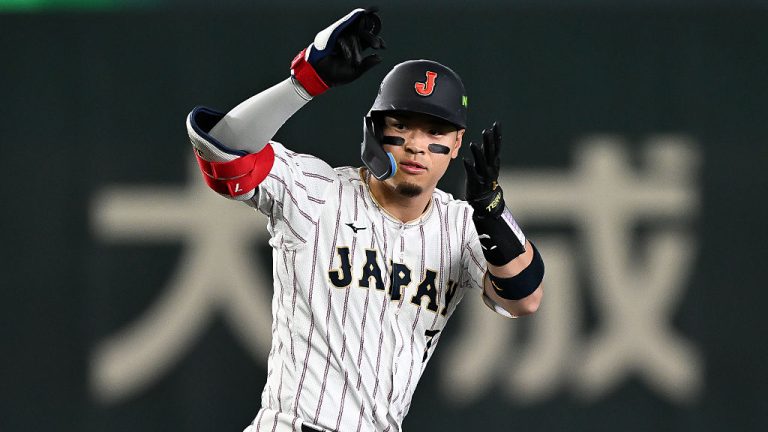
Samurai Japan’s starting lineup for the 2026 World Baseball Classic quarterfinal against Venezuela was stacked with stars, including Shohei Ohtani, Seiya Suzuki, Masataka Yoshida, Kazuma Okamoto, and Munetaka Murakami. All of them were either established major league hitters or, in the case of Okamoto and Murakami, fresh off signing big contracts via the posting system.
But right in the middle of it all, batting in the two-hole, was Teruaki Sato, the lone Nippon Professional Baseball player in the top six of the order.
The Hanshin Tigers slugger, affectionately nicknamed by fans in Japan as “Sato Teru,” was named the 2025 Central League MVP, but still had to earn his way into Japan’s lineup, with manager Hirokazu Ibata initially favoring veteran on-base machine Kensuke Kondoh.
Once Sato got his chance, however, he made the most of it. He hit .300/.417/.600 across five tournament games, highlighted by a 109 mph RBI double off Ranger Suarez. But his underlying data is what really spoke volumes. Sato stood out in several Statcast metrics, particularly with his elite bat speed and exit velocities.
Offensive Prowess
The 27-year-old generated multiple swings over 80 mph and batted balls over 100 mph during the WBC, and he had already recorded a max bat speed of 87.8 mph in an exhibition game against the Chicago Cubs before the 2025 Tokyo Series, which puts him in elite territory alongside monsters like Oneil Cruz and Giancarlo Stanton.
He even took Blake Snell deep in a left-on-left matchup, something no left-handed MLB hitter managed against Snell during the 2025 regular season.
Even beyond those small-sample numbers, Sato’s NPB track record and his prodigious start to the 2026 season tell the same story.
Across parts of six professional seasons, the Nishinomiya native has averaged 33 doubles and 27 home runs per season while posting an .839 OPS and 147 wRC+. That raw power output is even more impressive considering the context that Sato has spent most of his career in NPB’s dead-ball era while playing his home games at the pitcher-friendly confines of historic Koshien Stadium.
Sato entered pro ball as one of the top prospects in Japan after starring as an amateur for Japanese national teams and Kindai University. He drew first-round nominations from four teams in the 2020 NPB Draft before the Tigers won the lottery for his negotiation rights.
In hindsight, that draft class has become one of the strongest in modern NPB history, producing stars like Shugo Maki, Shunpeita Yamashita, Hiromi Itoh, Takahisa Hayakawa, Hiroto Takahashi, Shoki Murakami, and several others. Even among that loaded group, Sato is still looking like the premier talent.
His rookie season in 2021 captured both the immense upside and volatility that defined his early career. He opened the year homering at a historic pace, becoming the first rookie since Hall of Famer Shigeo Nagashima in 1958 to record a three-homer game. But later that same season, he set an NPB record by going 54 consecutive plate appearances without a hit and finished with a brutal 38% strikeout rate.
Still, even through the swing-and-miss, Sato’s raw power was impossible to ignore. He hit at least 20 home runs in each of his first three seasons while gradually cleaning up his approach. From 2022 to 2024, he trimmed his strikeout rate to 25%, walked at a solid 9% clip, and trained at Driveline in the offseason, laying the foundation for the superstar production that followed.
During that time, he made several brief minor league assignments to work through prolonged slumps, underscoring the lower-end volatility in his profile.
But in 2025, he finally put it all together, winning Central League MVP after slashing .277/.345/.579 with 40 home runs, 102 RBI, and 7.0 WAR across 139 games. Hall of Fame hitter and former Yokohama DeNA BayStars manager Alex Ramirez, who had long been a believer in Sato’s potential, summed it up simply: “He’s a Major League-caliber player. A true slugger.”
It took Sato 10 games to hit his first home run of 2026, but once he got going, he quickly became an unstoppable all-around offensive force. As of May 11, he is slashing .377/.461/.762 with 14 doubles, three triples, 10 homers, and 30 RBI through 36 games, leading the CL in all Triple Crown categories. He’s striking out at a 24.0% clip while walking 14.3% of the time, the highest rate of his career.
His Bondsian 279 OPS+ has put him in a stratosphere of his own, with teammate Shota Morishita the only other qualified hitter above 200. At 2.4 WAR, Sato is also on pace for a ridiculous 10.1 WAR season, which would place him among the greatest campaigns in modern NPB history, alongside other historic years like Yuki Yanagita’s 2015, Tetsuto Yamada’s 2015, Hayato Sakamoto’s 2016, and Munetaka Murakami’s 2022.
According to Trackman data available on NPB+, Sato ranks in the upper echelon of the league in several key indicators, including hard-hit rate (62%), barrel rate (21%), average bat speed (73.3 mph), average exit velocity (95.8 mph), and max exit velocity (116.3 mph).
His 17-degree average launch angle and 58% fly-ball rate also reflect a swing built for loft. But Sato is not just a dead-pull slugger, as he owns an NPB-best .376 ISO despite ranking only in the 80th percentile in pull-air rate, underscoring his ability to drive the ball to all fields.
Note: NPB+ seemingly does not filter out the bottom 10% of swings for bat speed, while MLB Statcast does.
Defensive Limitations
Defensively, Sato’s long-term outlook is harder to pin down. He played catcher and third base in high school and the outfield as a freshman in college before transitioning back to third, then split time between both spots after entering NPB. Early in his Tigers career, he spent most of his time in right field, fitting then-manager Akihiro Yano’s preference for keeping both Sato and Yusuke Ohyama flexible between multiple spots on the diamond.
That changed when Akinobu Okada took over in 2023, as the team became more rigid with its defensive alignments and Sato settled in as an everyday third baseman. Under Kyuji Fujikawa in 2025, he saw some time in the outfield again but still spent the majority of the season at the hot corner. So far in 2026, he has played every game at third.
In recent years, Sato has been serviceable at the hot corner and made clear strides from 2024 to 2025, with both his Ultimate Zone Rating and Defensive Runs Saved improving dramatically. He even won the CL Golden Glove Award and Sports Info Solutions Fielding Bible Award at the position.
That said, third base is a relatively weak fielding position across NPB, featuring several players who may be better suited for first base. Even with the progress made, Sato’s fielding remains a question, as he continues to grade out negatively by most metrics and currently sits at -5 DRS in 2026.
Sato is athletic, has a good arm, and moves well enough to make some highlight-caliber plays, but is also wildly inconsistent. From 2023 to 2024, he committed an NPB-worst 43 errors at third, many of which were on throws. That was even worse than Munetaka Murakami’s 37 during that span, and MLB teams clearly did not evaluate him as a capable third baseman upon his posting. Sato cut that number down to just six errors in 2025, but has already made five in 2026.
In a smaller sample in right field, the defensive metrics have been kinder to him, and his arm strength is on full display there. From 2021 to 2022, he recorded nine assists across 215 outfield appearances.
Closing Thoughts
If Sato enters the posting system this offseason, which is his intent but far from a guarantee after Hanshin rejected Hiroto Saiki’s posting request last winter, his market would be fascinating from both a baseball and financial standpoint.
At the time of potential free agency, Sato would be older than Murakami but younger than Okamoto, putting him closer in age to players like Seiya Suzuki and Yoshitomo Tsutsugo when they made the move across the pond. The difference is that Suzuki and Tsutsugo were both drafted out of high school, while Sato came out of college, leaving him with a shorter NPB track record.
From a tools standpoint, Sato’s raw power may be as close to Murakami’s as anyone out of Japan, and his in-zone contact rates are sturdier than his. The glaring weakness, however, is his chase rate. It has been stagnant since his sophomore season and still sits in the bottom third of NPB hitters, well below the plate discipline standards displayed by the likes of Murakami, Okamoto, Suzuki, Yoshida, or even Tsutsugo.
That said, Sato does immense damage on pitches in his wheelhouse, and he swings the bat at a much higher overall rate than any of those players. The result is a profile built around elite power and above-average aggressiveness coupled with swing-and-miss concerns, perhaps closer in hitter archetype to someone like Cal Raleigh or Byron Buxton.
Whether the superstar ultimately gets posted this winter or has to wait longer, his 2026 surge has made one thing increasingly obvious: Sato is now the best player in Japan.
Become a Member of Just Baseball
Subscribe and upgrade to go ad-free!
* Save 25% by subscribing annually.

Written by
Yuri Karasawa is a Japanese-American based in Tokyo, Japan. He founded “Yakyu Cosmopolitan” in 2021 and contributes to JapanBall and World Baseball Network. He has been…