
The Cincinnati Reds’ Outfield Is Still a Massive Problem
There were concerns about the Reds' outfield heading into the season, and the early results have not been encouraging.
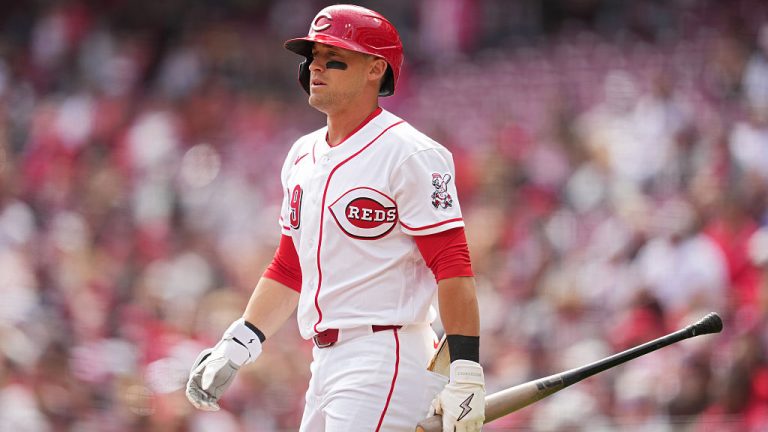
Each winter, media, fans, and podcasters alike put together offseason wish lists and discuss every possible need for each team. In the Cincinnati Reds space, the common need everyone agreed on was outfield. It’s a need that has been present for some time but not seriously addressed from the front office.
The Reds added JJ Bleday and Dane Myers relatively early in the offseason and called it a day. Spring training performances briefly masked the issue, but once the real games started, the problems, once again, showed up.
TJ Friedl, Spencer Steer, Will Benson, Myers, and Noelvi Marte made up the Opening Day group. Two former infielders, a short-side platoon bat, a guy who is still trying to put it together in year five, and Friedl, who is proven to be a major-league-caliber outfielder. Well, at least in the past.
Fast forward to the middle of April, and the problems that Reds fans feared with this group are coming to fruition.
TJ Friedl’s Struggles
Since being recalled in the middle of the 2022 season, Friedl has been a mainstay in the Reds’ lineup.
He’s a proven bat that provided a steady, yet unspectacular, baseline with good bat-to-ball skills and passable defense in center. That’s a perfectly fine profile and a player who most teams would be happy to have as their third outfielder, but the Reds have asked him to be much more.
To say Friedl has started slow would be an understatement. He’s slashing .153/.286/.153, good for a 36 wRC+, all while striking out 26% of the time — 10% higher than his career norm. While I’m typically quick to chalk up slow starts to small sample size, what we are seeing from Friedl looks closer to true regression.
Before we dive in, it is important to know what makes someone like Friedl succeed.
He does not win with making hard contact or shooting the ball into the gap. Instead, it is all about contact, putting the ball in play, and hoping the combination of speed and luck lead to enough singles. Walking at an above-average clip helps, too.
Players with this profile have a small margin for error, and once one of their tools slows down, the production can change quickly.
We have seen Friedl’s batted-ball data take a slip that his skillset cannot afford. His average exit velocity has dropped from 87 mph to 84 mph, which is a mark few successful players can sustain. In the past, Friedl was able to lift and pull the ball enough to sneak out 13 to 15 home runs, but we have yet to see that transpire this season.
Friedl’s ground-ball rate, which will eventually level off, is currently at 60.5%, matching a three-year trend of hitting the ball on the ground more often.
Another trend in the wrong direction has been his pull-air percentage. In 2024, Friedl’s mark was at 27%, but it dropped to 20.9% last season. This year, that number sits at only 2.4%. A sample size will make that number less ugly, but again, its a trend in the wrong direction.
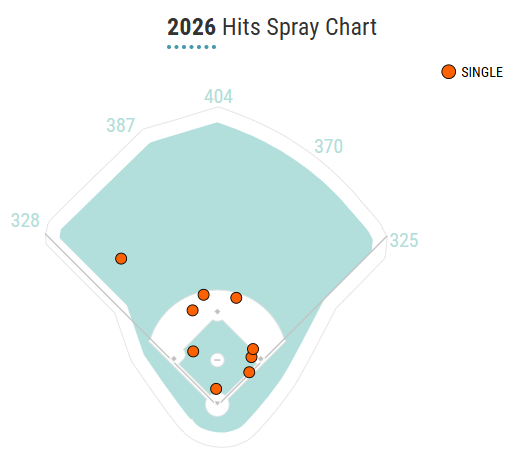
The spray chart above tells the story of Friedl’s start to the 2026 season. Keep in mind, this is who the Reds have anointed as their leadoff hitter. Not quite ideal for a player whose best ability is perhaps laying down bunt hits, the hardest route to get to first.
His defense has declined, and his arm is not strong enough for center. Manager Terry Francona has started to play him in left field more often with Myers covering center when facing a lefty. The decline defensively, although still passable, coincides with his decline in speed.
Friedl has lost two feet per second in the past two seasons, going from a plus runner to below average. A decline in speed makes his contact approach less useful when you cannot beat out as many infield singles. Combine that with a ground-ball rate over 50%, and, well, you have a problem.
Concern in the Corners
When the Reds signed Eugenio Suarez, it pushed Spencer Steer back to left field. It’s a position he had played once third base was not a viable option, but not a position he handled very well.
For a team that talks about defense and one that acquired Ke’Bryan Hayes for his glove, they certainly don’t mind neglecting defensive ability in the outfield.
Since moving to the outfield in 2023, Steer has -8 outs above average. Stats aside, you see the struggles he has with his jumps and tracking in the outfield. His bat usually was good enough to stomach the mistakes, but a .176/.218/.353 slash and 51 wRC+ is hard to stomach.
Steer was great in 2023 but has never reached that level again. There’s certainly value to his 20 home runs and 150 games played per season, but he’s trending toward a third straight year as a sub-100 wRC+ with poor defense. At some point, he is what he is — not good enough to start for a playoff caliber team.
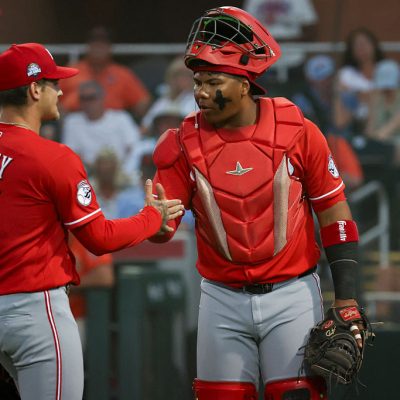
Right field was supposed to be Noelvi Marte’s opportunity to fully breakout. Instead, he’s been demoted to Triple-A Louisville. Honestly, it’s a move that should have happened sooner. Marte’s at-bats were ugly to the point of needing a reset. Poor swing decisions, guessing at the plate, and making no impact is not a recipe for success.
The book is not written on Marte, but I think adjusting expectations is necessary. He has not shown what made him a top prospect over a long enough period of time to expect him to eventually get to that level. Spurts of success surrounded by unplayable stretches doesn’t offer the type of consistency needed to be an everyday player.
Lastly, Will Benson. Oh, the Will Benson discussion yet again. Year four of trying to figure out what level of player Benson truly is. His 2023 production, which had expected stats telling a different story, cannot seem to be forgotten.
The truth is, we all know what type of player Benson is, and it’s simply a matter of accepting it or not. He’s a tooled-out athlete with a lot of pop and not nearly enough contact. Add in below-average defense and a platoon restriction, and you have what every organization has: a raw player with flashes that keep you coming back.
Sure, Benson’s usage can be debated, but at some point the what if game needs to end. He is the type of player rebuilding teams should welcome and playoff caliber teams, especially those without many above-average outfielders, should upgrade.
Is There Help on the Way?
Once struggles start to set in, fans immediately point to the minors to solve the problem. “This player is doing this, and that player is doing that — call them up!”
Those skills translating from Triple-A to the majors is never a clean swap, but the Reds do have a couple of options worth giving a shot.
The first is Rece Hinds, who was recalled to replace Noelvi Marte. Hinds, a 2019 second-round selection, has seven home runs across 39 major-league games with a whopping 38.9% strikeout rate. His profile and tools are similar enough to Benson.
However, Hinds has made strides the past two seasons in Triple-A. He has cleaned up his chase numbers, resulting in a lower strikeout rate, all while maintaining his power. He’s a good athlete with a plus arm and ability to play center but is better suited for a corner.
Will it work out? Who knows, but I think we can all agree it is worth finding out. The Reds need more juice in their lineup, and Hinds certainly has the power to provide it. He’s a more polished hitter now than we saw in years past but could struggle against breaking balls.
Another option who could be recalled is JJ Bleday. After narrowly missing the team out of camp, Bleday has slashed .302/.413/.509 with two home runs and a 153 wRC+ in Triple-A Louisville. Bleday has been an up-and-down player throughout his career, but his 2024 season with the A’s is the best major-league production any Reds outfielder has had in the past two seasons.
Although Bleday is a former top-five pick, I’d warn people about dreaming too much on his upside. He puts together competitive at-bats and his line drive approach will be refreshing to some, but I do think his limitations hold him back from being an answer to the Reds’ problems.
Could he be better than other options? Sure, but I would not be so quick to assume replacing Steer with Bleday will lead to better results over the span of a season. Adding Bleday would insert a lefty bat, which the Reds are lacking. If Frield continues to struggle, then Elly, a switch-hitter, would be the only lefty bat in the lineup.
Hector Rodriguez and Blake Dunn are also on the 40-man roster but do have a more difficult path to the active roster. Rodriguez is a fun prospect but is not quite ready to make the leap, and Dunn is more of a short-side platoon option, like Myers, than a potentially everyday player.
Final Thoughts
The Reds’ outfield issues could have been addressed over the past two off seasons, although I’d argue they should have been addressed with drafting and player development. Cincinnati has failed to develop first-rounders Austin Hendrick (2020) or Jay Allen (2021), amongst others. The players they have traded for — Marte, Steer, Benson — have also not reached expectations.
If you are not willing to make trades for more established players or sign bona fide starting-caliber outfielders, then you must develop them. How many outfielders have the Reds developed in the past 10 seasons? I’m not talking about one good year here or there. I mean sustained, quality outfielders? Not many.
Cincinnati’s current situation is a product of trusting their internal evaluations too much and hoping limited players perform above reasonable expectations. It’s not a plan, it’s a prayer, and there’s a chance it costs them in the long run.
All stats were taken prior to play on April 14.
Become a Member of Just Baseball
Subscribe and upgrade to go ad-free!
* Save 25% by subscribing annually.

Written by