
2026 MLB Draft Deep Dive: Liam Peterson
Florida's Liam Peterson has the chance to be one of the first college arms off the board this July.
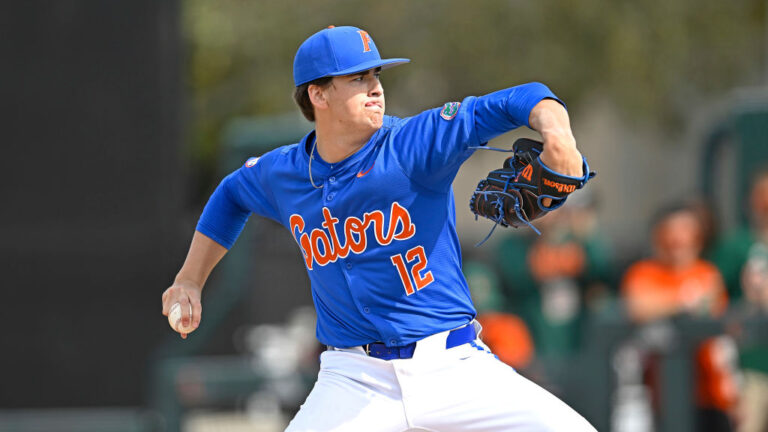
Among the group of high-end college pitchers in this year’s draft class is Florida’s Liam Peterson — one of the more intriguing, but arguably the most polarizing pitching prospect in the 2026 MLB draft class.
Peterson has been a buzzy name in this class dating back to 2023. He was a standout two-way player at Calvary Christian High School in Clearwater, Florida where he won the Florida Class 3A Player of the Year award on his way to a state championship alongside another top college pitching prospect in this class, Arkansas’s Hunter Dietz.
Peterson was considered a top-100 draft prospect as a senior at Calvary Christian but chose to forego the draft as he ended up on campus in Gainesville in the fall of 2023. Since then, his name has been circled as one that could potentially be the top pitcher to come from this 2026 class.
Coming into the season, Peterson was grouped with both Jackson Flora and Cam Flukey in the top tier of college pitchers in the class. However, an up-and-down platform year has evaluators and analysts wondering whether Peterson will be a top-10 pick or land somewhere outside of the first round.
Halfway into the season, either of these scenarios could still happen for the Gator’s right-hander.
Player Profile: Liam Peterson
- Age on draft day: 21.1
- Position: RHP
- HT: 6’5″
- WT: 225
- School / hometown: Florida / Palm Harbor, FL
Peterson has been building the engine since his freshman year with Florida. He made 16 starts as a freshman, 15 of which came out of the weekend rotation, as he was a part of that 2024 Florida team that made it to Omaha despite a mediocre regular season.
In his sophomore season a year ago, Peterson solidified himself as the ace of Florida’s staff as he moved into the Friday night role. In 69.1 innings across 16 games, he posted a 4.28 ERA and a 4.66 FIP while striking out 31.5% of the hitters he faced and walking 10.5%.
Peterson opened this season as the ace once again, but through eight starts, he was recently moved into the Saturday role, giving way to Florida’s Aidan King, who has simply been better than Peterson thus far.
Peterson’s overall numbers have improved from 2025 to 2026, but he has been a bit more unreliable on a start-to-start basis due to his spotty command and often inability to work deep into games. In 45 innings through nine starts thus far, Peterson owns a 3.60 ERA and a 2.99 FIP while striking out a career-high 34.4% of the batters he has faced, but his walk rate is up to 13.0%.
In Peterson’s first Saturday start and most recent for the Gators as of this article, he proved why he’s still a highly-touted prospect against a deep Georgia Bulldogs lineup. He threw a career-high seven innings against Georgia, surrendering just one earned run on eight hits, no walks, and four strikeouts on 97 pitches.
The no walks allowed was huge considering it was the first start of his career in which he didn’t issue a single walk in an appearance that went at least three innings.
Peterson’s stuff is what makes him such an intriguing draft prospect, but it was the command and pitchability that had otherwise been fringy up until this point that served as the difference makers in this particular outing.
The flashes of legitimate big-league traits shine through at times for Peterson, and those traits could turn him into the best pitcher to come from this draft class if he joins the right big-league farm system.
The Arsenal
The tools for Peterson start with his stuff and the physicality.
At 6-foot-5 and 225 pounds, he already has a big-league starter’s frame, but there is still some more room for him to grow into a really strong body. He’s a good mover at his current size, but his delivery is likely to be tweaked by whatever MLB organization selects him this July.
He appears to get a little rushed at times, falling out of sync which can often lead to the loss of his release point. Despite his longer levers, he doesn’t get too much extension either, which is perhaps something that can be unlocked at the next level.
As for Peterson’s arsenal, it’s a four-pitch mix: a fastball, slider, curveball, and a changeup. Depending on preference, his best offering is up for debate, with the fastball and slider as the premier pitches in the arsenal.
The fastball routinely sits anywhere from 95 to 98 mph throughout a start, and he has reached triple digits with it. It’s a high-ride fastball with some cut due to the nature of his higher arm slot. It has been up over 20 inches of vertical break on occasion and is often approaching that outlier tier of ride and cut on top of the already elite velocity.
It plays best at the top of the zone and it’s nearly unhittable when he’s locating it there with consistency. He does, however, struggle with command of it at times, often missing glove-side and below the zone. There’s a two-seam/sinker shape off his four-seam that he has introduced this spring as well, although it’s still used sparsely.
Peterson does have great feel for both of his secondaries, a trait that really helps to mitigate some of the reliever risk that comes with his profile.
His slider is the go-to secondary, sitting in the mid-80s while creeping up into the high-80s at times. It definitely fits into the category of “wipeout slider,” featuring two-plane break and sometimes more of a depthy, gyro look.
He actually has some solid command of the pitch, consistently locating it down and to the glove-side, and when he does miss with it or it leaks out over the plate, it’s good enough to still get whiffs and weak contact.
Peterson has elevated his curveball this spring, upping the usage on the offering and yielding some pretty good results as well. The command of it is still coming along, but like the slider, it’s not as dependent on his ability to locate it to get strikes.
It’s still used at a low enough rate that hitters aren’t necessarily coming into at-bats looking for it or sitting on it, so it’s a pitch that can steal called strikes when hitters are geared up for the fastball. It’s more of a true 12-6 look as it falls out of the sky in a sense because of Peterson’s higher arm slot. Sitting in the mid to high-70s, there’s plenty of separation in both velocity and movement off the rest of his mix.
Peterson’s changeup sits in the mid to high-80s and is a bit further along in its development than changeups that belong to other pitchers his age. It’s another secondary that he has pretty good feel for as it plays off the fastball well, and he consistently keeps it down, flashing some really good depth.
The physicality and stuff will make it hard for teams to pass on him in the first round of the draft, but there is still a wider range of landing spots for Peterson which comes down to his strike-throwing.
Some draft boards have him comfortably in the top 10 while others have him sliding as far as the supplemental round. It will come down to how confident teams are in their ability to get him to average command, because there’s certainly ace upside in Peterson if the strike-throwing is unlocked.
It’s definitely something to follow as Peterson and the Gators press on deeper into conference play and into the postseason.
Become a Member of Just Baseball
Subscribe and upgrade to go ad-free!
* Save 25% by subscribing annually.

Written by