
Why A Randy Vásquez Breakout Means More For the Padres
After flashing potential late last year, Randy Vásquez seems to be turning his promise into production to start the new campaign.
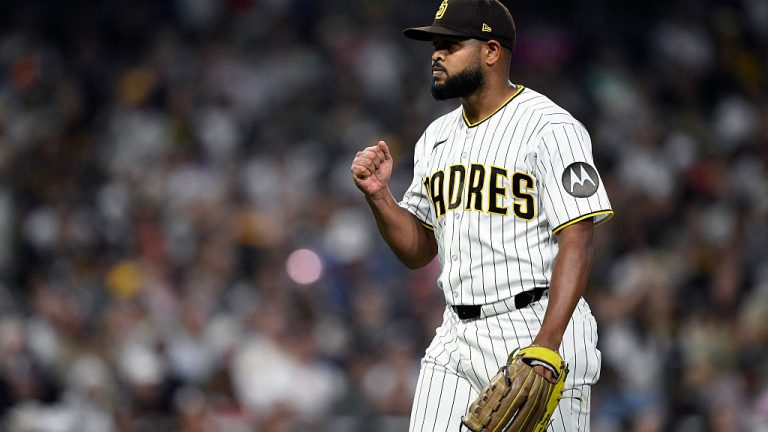
Throughout spring training, there was plenty of buzz surrounding Randy Vásquez. Early in camp, manager Craig Stammen made it clear Vásquez had a secure spot in the rotation and that expectations were high. Through the first stretch of the season, he’s done nothing but meet them.
After flashing potential late last year, Vásquez has turned that promise into production. For a San Diego Padres rotation that entered the season with questions about depth, his emergence has been nothing short of essential.
A September Preview of What Was Coming
The signs were there toward the end of last season.
In September, Vásquez quietly put together a stretch that showed there was something more. Across 22.1 innings pitched, he posted a 3.22 ERA with 19 strikeouts and just three walks, backed by a 3.00 FIP over five starts.
That month served as a preview. Vásquez showed he could navigate lineups multiple times, limit damage, and pitch with confidence. Now, he’s taken that foundation and built on it in a big way.
A Breakout to Start the Season
Through his first three starts this season, Vásquez has been one of the most effective starters in the all of Major League Baseball. He owns a 1.02 ERA and a 1.08 WHIP, combined with 19 strikeouts to four walks.
The spike in strikeouts comes as a surprise. Last season, Vásquez exceeded five strikeouts in a start only three times. This year, he’s already done it twice in just three outings, an indication that his stuff is playing significantly better.
Historically, the start is impressive too. His 1.02 ERA is the lowest by a Padres starter through their first three starts since Joe Musgrove opened the 2021 season with a 0.47 ERA.
Why His Emergence Matters
Coming into the season, the Padres’ rotation carried uncertainty. Musgrove came in as a question mark recovering from surgery and he has already had a setback, and Michael King has injury concerns, too. The backend of Walker Buehler and Germán Márquez offers little upside at the moment, although both veterans are coming off of decent starts.
The Padres desperately needed Vásquez to be a stabilizer in the middle of the rotation, and he has been exactly that through the early goings of the new campaign.
His development has provided a much-needed steady hand. Instead of forcing the bullpen to cover early innings or overworking back-end arms, the Padres now have a reliable presence who can bridge the gap between the top of the rotation and the rest of the staff.
His presence has a cascading effect on the team. It preserves bullpen arms, keeps the team competitive, and raises the overall floor of the staff and team.
What’s Behind the Breakout
Vásquez’s breakout isn’t an accident, the evidence is right in front of us.
One of the most noticeable changes is a slight drop in his arm angle. While subtle (3 degree drop), it has had a significant impact on his pitch movement. The lower slot has created more horizontal action, making all of his pitches harder to square up and giving hitters a different look compared to last season.
There’s also been an uptick in fastball velocity, 93.5 from last season to 94.8 this season. That added speed, combined with improved movement, both induced vertical break (iVB) and induced horizontal break (iHB), has made his fastball a much more effective weapon. It’s not just a setup pitch anymore; it’s generating a real swing-and-miss pitch with a 30.4% whiff rate.
His pitch mix has also been retooled. The cutter, in particular, looks sharper. It’s showing less inverted break, staying on plane longer, and finishing with more glove-side movement. That makes it tougher for hitters to track and increases weak contact.
At the same time, Vásquez is leaning more on his four-seam fastball. The increased usage from 21% to 33.5%, paired with its improved characteristics, has changed how he attacks hitters. Now everything is playing off of his four-seam fastball, and the results are positive.
But perhaps the most underrated aspect of his breakout is his ability to pitch through traffic. Vásquez has excelled at limiting damage even when hitters reach base. He consistently outperforms expected metrics because he knows how to make pitches in high-leverage spots.
A big part of that is his ground ball rate. By keeping the ball on the ground, he avoids extra-base damage and double plays become a real weapon. It’s a skill that doesn’t always show up in highlight reels, but it wins games.
Final Thoughts
Randy Vásquez’s breakout isn’t just a nice early-season story; his development could shape the Padres’ season.
If this version of Vásquez holds, it changes how the team can approach big games. It’s no longer a stretch to feel comfortable with him as a third starter in a playoff series.
Coming into the season, I saw Joe Musgrove as the team’s X-factor. Now, that distinction clearly belongs to Vásquez.
For a team with postseason aspirations, that kind of internal growth is invaluable. And for Vásquez, it’s the clearest sign yet that his September glimpse wasn’t a fluke, it was a preview of what was to come.
Become a Member of Just Baseball
Subscribe and upgrade to go ad-free!
* Save 25% by subscribing annually.

Written by
Ethan is an aspiring sports analyst who has a passion for all sports. He was a collegiate baseball player and is a recent San Diego State…