
MacKenzie Gore Can Become a True Ace for the Rangers in 2026
Gore's elite stuff can help him reach new heights for Texas.
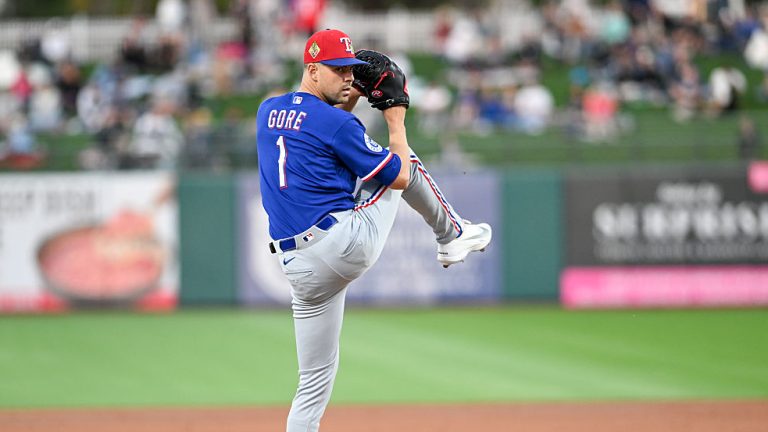
This is the third article in a series about pitchers who can outperform their projections in 2026. The first two entries focused on Cam Schlittler and Connelly Early.
Projection systems are designed to reward consistency. Pitchers who have demonstrated stable performance over multiple seasons tend to settle into defined ranges of expected production. For players who have already shown flashes of high-end ability without fully sustaining it, those systems can sometimes undersell the possibility of a true leap forward.
The Texas Rangers’ MacKenzie Gore fits squarely into that category.
Gore is no longer a projectable arm in the traditional sense. He has already established himself as a productive major league starter, with multiple seasons of solid underlying performance.
Yet, there remains a persistent sense that more is available. A sense that his current level of output does not fully reflect the quality of his raw arsenal.
The source of that intrigue is straightforward: elite stuff.
Gore’s fastball is a legitimate bat-missing weapon, capable of generating whiffs at the top of the zone while still limiting quality contact. It is the foundation of his approach, setting the tone for how hitters are forced to operate against him.
A curveball with significant depth gives him a second pitch that can miss bats in a completely different way, letting him attack hitters on a separate plane and disrupting timing.
Against right-handed hitters, that combination forms the core of his arsenal. The fastball establishes velocity and vertical pressure, while the curveball provides depth beneath it. His changeup is mixed in to introduce a third velocity band, giving him another way to keep hitters off balance without needing to rely on it as a primary weapon.
A key addition to that mix is his cutter. Thrown with enough velocity to stay within his fastball band, the pitch works in on the hands of right-handed hitters and provides just enough horizontal movement to miss barrels.
Like many modern cutters, its value is less about overwhelming hitters on its own and more about how it connects the rest of his pitch mix, serving as a bridge between his primary weapons.
Against left-handed hitters, Gore’s approach shifts slightly. He leans more heavily on the fastball and slider combination, using the fastball to establish the zone and the slider to move away from barrels.
The slider does not necessarily grade as an elite pitch in isolation, but it plays effectively within the context of his arsenal, particularly when paired with a fastball that demands attention.
The curveball is mixed in more selectively, serving as an additional change-of-pace option to keep hitters from settling into a predictable pattern.
MacKenzie Gore Pitch Mix and Pitch-Level Pitch+ Grades
| Pitch Type | Usage | Pitch+ |
|---|---|---|
| Four-seam | 1435 | 114.6 |
| Curveball | 686 | 120.2 |
| Slider | 340 | 98.8 |
| Changeup | 301 | 104.6 |
| Cutter | 130 | 123.8 |
Pitch+ is a unified pitch quality model designed by Just Baseball’s Shaan Donohue to evaluate how pitch shape and location contribute to swing-and-miss ability, contact-quality suppression, and overall run prevention. The model integrates modern ball-tracking inputs with outcome-based location modeling to provide a single, normalized rating of pitch effectiveness.
Taken together, this is the profile of a pitcher with the ingredients of a frontline arm: multiple bat-missing pitches, coverage against opponents of either handedness, and a fastball that can anchor the entire arsenal.
However, Gore has not consistently translated that toolkit into the level of dominance that typically defines top-tier starters. That gap between underlying ability and realized performance is where the opportunity lies.
For much of his career, Gore has existed in the space between projection and realization. The talent has always been evident, but the conditions surrounding that talent have not always been conducive to maximizing it.
Gore was a central piece of the Juan Soto trade, arriving in Washington as a 23-year-old with the expectation that he would anchor the next competitive window. He debuted in 2022 and spent the next three seasons developing at the major league level, showing flashes of dominance without fully sustaining it across a complete season.
Part of that inconsistency can be attributed to his own development, but the environment around him also played a meaningful role.
During Gore’s time with the Nationals, the organization was still in transition, and its pitching infrastructure and defensive support lagged behind that of more established contenders.
In 2025, Washington fielded one of the weaker defensive units in baseball. Jacob Young provided strong value in center field, but he was largely the exception. The rest of the roster struggled to convert balls in play into outs. The team saw limited range from its infield and corner outfielders and below-average production from behind the plate.
For a pitcher like Gore, whose arsenal generates both swings and contact, that context matters. Even marginal defensive deficiencies can compound over the course of a season, turning manageable contact into extended innings and elevated run prevention numbers.
The result can be a wide gap between underlying ability and observed outcomes.

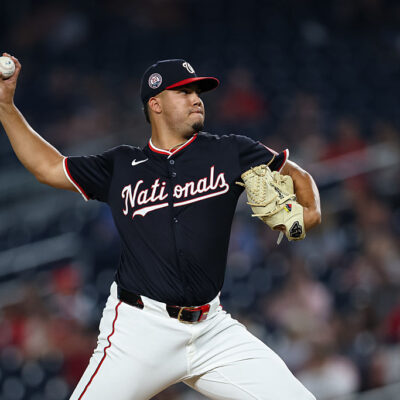
That context shifts meaningfully with his move to the Texas Rangers. Texas offers a more stable and supportive environment on multiple fronts. Defensively, the roster is better equipped to convert contact into outs, reducing the burden on Gore to be perfect within the strike zone.
The run environment also tilts in his favor. Globe Life Field played as one of the most pitcher-friendly parks in baseball in 2025, suppressing offensive output and limiting damage on balls in play.
Those factors alone raise the floor of Gore’s performance. They do not change the quality of his pitches, but they do influence how that quality translates into results.
Just as important is the organizational context. Under leadership that includes former major league pitcher Chris Young, Texas has demonstrated an ability to develop and optimize pitching talent. That kind of infrastructure can be particularly impactful for a pitcher like Gore, whose ceiling is tied not to adding new pitches, but to refining execution, sequencing, and consistency over time.
Gore’s arsenal has long suggested the potential of a frontline starter. What has been missing is a context that consistently allows that talent to surface over a full season.
In Texas, that barrier is lowered. With stronger defensive support, a more favorable run environment, and a more established pitching development structure, the conditions are in place for his underlying ability to translate more cleanly into production.
If Gore’s talent fully translates, the impact on the Texas Rangers extends well beyond incremental improvement in the rotation. It would reshape the ceiling of the roster.
Texas is only two seasons removed from a World Series run that was driven largely by offensive firepower, but the identity of this current team is increasingly anchored on pitching. A front three of Jacob deGrom, Nathan Eovaldi, and Gore has the potential to rival any rotation in the league.
Gore’s role within that group is what makes the situation particularly compelling. For the first time in his career, he is not being asked to carry a staff. After spending his early seasons positioned as a de facto ace, he now slots in as a clear third option.
That shift reduces pressure while preserving upside. His ceiling remains that of a top-tier starter, but the expectations surrounding him are more measured, allowing his performance to play up within the context of the rotation.
That dynamic creates a level of depth that few teams can match. A pitcher with top-of-the-rotation potential occupying the third spot in a playoff series is a structural advantage, particularly in October when matchups tighten and marginal differences in starting pitching often dictate outcomes.
Texas has also taken steps to stabilize the roster around that rotation. The addition of Brandon Nimmo brings a high-floor offensive presence, while a healthy season from Corey Seager and continued development from Wyatt Langford will provide needed middle-of-the-order impact.
After an underwhelming offensive showing in 2025, even modest improvement on that side of the ball meaningfully raises the team’s overall outlook when paired with a strengthened pitching staff.
Within that context, Gore becomes a potential swing piece. If he performs in line with prior seasons, the rotation remains strong. If he reaches the level his arsenal suggests, the entire structure elevates. A fully realized version of Gore alongside deGrom and Eovaldi gives Texas a legitimate case for the most formidable three-man playoff rotation in the American League.
That is where individual development intersects with team outcome. The postseason is often the stage where talent is both validated and amplified.
For Gore, a deep October run would not only solidify his standing within the league but also shift his perception from a high-upside arm to an established frontline starter. He has long been known for the quality of his stuff. Translating that into postseason impact would bring a different level of recognition — and position him for a significant payday as he approaches free agency following the 2027 season.
Become a Member of Just Baseball
Subscribe and upgrade to go ad-free!
* Save 25% by subscribing annually.

Written by