
Rangers Make Aggressive Trade for Nationals’ MacKenzie Gore
The Rangers are a better team than they were on Thursday morning, while the Nationals beefed up their system with five new prospects.
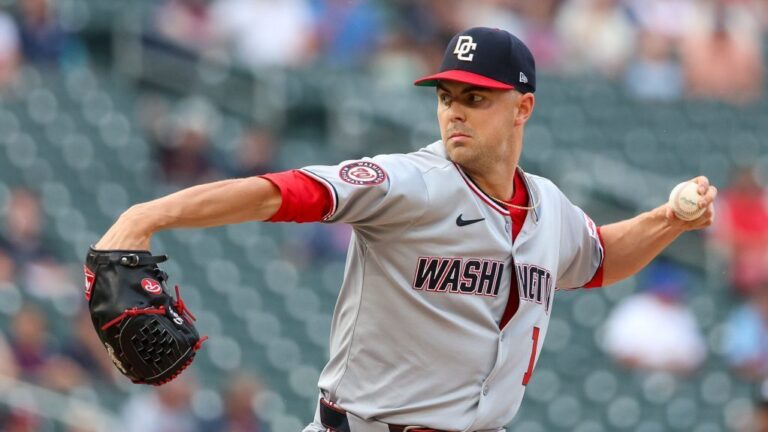
Over the past week or so, we have seen the hot stove really start to heat up. Kyle Tucker, Bo Bichette, Luis Robert Jr., Ranger Suárez and several more have new homes. Freddy Peralta was the first of the big starting pitchers to be dealt, but MacKenzie Gore followed shortly thereafter.
On Thursday afternoon, reports started to surface that the Washington Nationals had traded the lefty Gore to the Texas Rangers for five prospects.
It’s a move that gives the Rangers the type of pitcher that is proven, but still has upside, and solidifies a rotation that thinned out quickly after Jacob deGrom, Nathan Eovaldi, and Jack Leiter. On the other hand, the Nationals added a handful of prospects into a system that needed everything from upside to depth.
I’m sure the Rangers had a number of starting pitching targets, but as more and more were landing elsewhere, Texas worked quickly to grab one of the best available arms and did so without having to give up their top prospect, Sebastian Walcott.
Without a doubt, the Rangers are a better team than they were on Thursday morning. The Nationals are also in a better position, as they needed to be steered onto a clearer path, and they chose to restock their system.
The Rangers’ Side

The Rangers’ top two of deGrom and Eovaldi is up there with the best in baseball. However, each is past 35 years old, comes with an injury history, and will have his contract expire after the 2027 season. The need to get younger was as important as the need to get better for 2026.
Gore, 26, comes with team control for 2026 and 2027. However, with the above names perhaps no longer part of the equation after that, an extension makes all of the sense in the world. Texas will have a couple more contracts coming off the books in addition to Eovaldi and deGrom, making an extension a reasonable financial decision.
So, what does Gore bring? For one, a lefty to the rotation with more upside than Jacob Latz, respectfully speaking. Over the past two seasons, Gore has really started to develop into the type of pitcher the Padres were hoping he would be when they selected him third overall in 2017.
He boasts a five pitch-mix with four registering a whiff rate of 35% in 2025. His fastball sits 95 mph, but it could use some tweaking. That’s a challenge the Rangers will not be scared to tackle. Gore’s stuff is good enough to make him a top two in a rotation, but command has held him back from establishing himself as such.
When I say command, I’m not only talking about his career 3.77 BB/9, but his command within the strike zone. Of all his pitches that landed within the strike zone in 2025, the highest percent landed middle-middle. Luckily, his breaking ball produces enough swing and miss that he’s able to dance around and out of the zone to help get outs.
The Nationals have not been known for their ability to develop pitchers over the past several years. Texas has had more success in that department. To get a player of Gore’s caliber, raw talent, and relative youth gives the Rangers a high-floor, high-ceiling arm to mold and finish developing.
The price was not cheap, but it also did not gut their system.

The Nationals’ Side
I think we all saw the writing on the wall. Washington was supposed to take a step forward in 2025 and instead fell on its face. Manager fired, GM fired, and fans confused about what would be next or what direction the Nationals would take.
It’s a team with a number of young and intriguing players that hasn’t won, hasn’t capitalized on the Soto return, and needed more in its farm system. That’s a difficult position to be in. With a new front office, trading Gore, knowing he would not be extended, made a lot of sense.
What is interesting is the direction they went in with the return. We still know so little about how this front office will operate, but the Gore trade gives us the first true data point. Step one was to go more quantity over quality and get more darts to throw at the board, if you will.
That’s not to say there isn’t quality in the return, because there certainly is. Shortstop/third baseman Gavin Fien was the 12th overall pick in the last draft and grades well across the board. While not a consensus top-100 prospect, Fien has been trending toward that title and could land on the list sooner than later.
Alejandro Rosario, a 24-year-old starter, gives the Nationals something they need: young rotation help. If he can prove he’s healthy coming off Tommy John surgery, he should slot into the Nationals’ rotation in 2026. He’s a former top-100 prospect for us at Just Baseball.
Devin Fitz-Gerald (not a typo) is a shortstop who was selected in the fifth-round in 2024 and posted a .302/.428/.482 slash while in the lower minors this past season. He’s a contact-oriented player who many think can grow into enough power to give him a high ceiling, even if he comes with more projection than production to date. If you ask around, prospect experts expect him to climb lists as soon as this season.
The last two are outfielder Yeremy Cabrera and first baseman Abimelec Ortiz. Cabrera brings plus speed, stealing 43 bags last season, but is a bit raw. Ortiz, who is about to turn 24, offers more power and is coming off a season where he hit 25 home runs and posted a 124 wRC+ across Double and Triple-A.
When I say quantity over quality, I simply mean the Nationals didn’t settle for the best two prospects they could get from a team and cash in. They addressed a need for a starter, found two guys that could eventually fill out the left side of an infield, and took a chance on tools – one with speed and one with power.
Rosario could be on the roster in 2026, and Ortiz offers Washington an option to fill first if they do not sign a veteran first baseman.
Final Thoughts
I think we are looking at a true win-win. The Rangers get an immediate upgrade with a high chance of sticking around through the end of the Seager era while also keeping four of their top six prospects.
The Nationals targeted a deal that would allow them to add a number of prospects, each with legit breakout potential spread across different needs and skill sets, and all trending upward. The new regime now has a deeper farm system and a jump start on the retool.
I think the Nationals trading Gore now instead of next season, when he will have one year of control remaining and amid a messy CBA situation, was the right move. The Rangers kept their top choice to one day pair with Seager, Sebastian Walcott, and held on to most of their top pitching prospects.
Who could possibly be upset?

Written by