
The Blue Jays’ Next Top Pitching Prospect on the Fast Track
Johnny King burst on the scene in 2025, posting gaudy strikeout rates and dazzling with his advanced arsenal of pitches. Here's why 2026 could send the teenage phenom's stock into orbit.
The Toronto Blue Jays‘ farm system has been reaping the rewards of a 2024 draft class that has delivered staggering results nearly from the on set. Their first rounder, Trey Yesavage, blazed through 5 levels in his first pro season, starting his season in Single-A with the Dunedin Blue Jays before finishing it with one of the greatest World Series starts in modern history at Chavez Ravine for Game 5.
Khal Stephen also came out of the gates hot, pitched extremely well, and found himself as a valuable trade chip whom the Blue Jays used to acquire RHP Shane Bieber from the Guardians on deadline day. A move that bolstered a rotation in dire need of upgrades.
Then we have Johnny King, a projectable 6-foot-4 southpaw, whom the Blue Jays selected in the third round, 95th overall, out of Naples High School. The then-18-year-old debuted in the Florida Coast League and utterly dominated competition to the tune of a 1.18 ERA across 24 innings with a video game-like 41.8% strikeout rate before earning a promotion to Dunedin where he continued to impress.
So what makes King different from other pitching prospects, and what sets him apart from other guys who put up gaudy numbers in the lower levels of the minor leagues before coming back down to earth against stiffer competition? Let’s dive in.
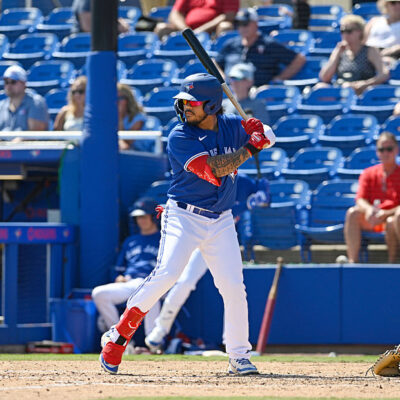

Johnny King’s Stuff
King wields a five-pitch mix consisting of a sinker, slider, curveball, changeup, and four-seam fastball. The four-seamer/curveball in particular were his two most used offerings. King’s fastball averages 93-95 MPH with incredible arm side run and ride thanks in part to this 19″ of iVB it generates on average. The offering had a whiff rate north of 30%, which is in elite territory for a heater.
His curveball is at present moment his most-used secondary pitch. It sits in the 80-82 MPH range and has the shape of a 12-6 curveball because of the steep vertical drop it induces. Hitters at both the complex and Low-A couldn’t do anything with it, as evidenced by the bonkers 50% whiff rate it produced on batters.
King’s slider is a pitch he seldom throws but it has shown promise in the spurts he does use it. He throws it harder than his curve, usually in the 81-84 MPH range, while generating tons of glove side movement. It registers as a 103 stuff+ offering via Thomas Nestico’s (@TJStats) stuff models and generated a near 40% whiff rate. Most encouragingly, King has shown the confidence to throw it to both righties and lefties.
The Results
So now that we know about King’s high octane stuff, the question is will it translate into tangible results? Thus far, the answer is yes. Albeit with the caveat that this is an advanced arm for a teenager and he was essentially bulling complex league and Single-A hitters.
We talked earlier about King’s success in the FCL. He only appeared in 7 games at the level, 5 of which were starts, accumulating a total of 24 innings. Regardless, a 1.13 ERA is a 1.13 ERA, and his 1.53 FIP tells us he earned that ERA and the process backed up the results. So, how did he fare when he made the jump to full-season ball in Single-A?
King made 10 starts with Dunedin, across 37.2 innings. In that time he produced a 3.35 ERA to go along with a 4.24 FIP. Some of that could be attributed to some bad luck, given his HR/FB ratio spiked from 0 to 16%, but most of it is attributed to self-infliction.
The problem King ran into wasn’t that A-ball hitters were able to hit his stuff. On the contrary, actually. They managed just a .201 batting average against him. The problem was his command issues. King walked 17.9% of the hitters he faced, which was the 11th-highest mark of all pitchers with a minimum of 30 innings pitched in the Florida State League.
The funny contrast to that is that at the same time, King struck out 38.1% of the hitters he faced in the FSL, which amongst all pitchers with a minimum threshold of 30 innings pitched in that league, put him second, only behind his future teammate in Yesavage, who punched out 43.3% of the hitters he faced.
What to Expect in 2026
King’s innate ability to miss bats gives him an incredibly high ceiling. When you combine his FCL/Single-A data, hitters only made contact 61.9% of the time when they swung at his pitches. A jaw-dropping fact when you put it into context that the MLB league average for contact is 76.4%.
Still just 19 years of age, King won’t turn 20 until late in July, meaning he has plenty of runway to continue developing as a pitcher. At the forefront of that development, will be harnessing his control and command to further enhance his already nasty repertoire of pitches.
Another key factor to remember, King is 6-foot-4 with a lean frame. Which gives him ample opportunity to continue filling out his frame which in turn could lead to upticks in velocity. Given the fact that he already sits 93-95 with his fastball with fantastic VAA (-2.9) and iVB (19.2), his fastball is already firmly a plus pitch. Any further addition of velocity would push it towards elite territory.
The southpaw is likely slated to begin the 2026 campaign back in Dunedin. Where the Blue Jays brass is sure to keep extremely close tabs on one of it’s most tantalizing arms in the system. Should King excel early, a promotion to High-A Vancouver should be in the cards for him.
From there it’s simply a matter of how King adapts to a new environment. It’ll be his first taste of professional baseball outside of Florida. Not only will he be dealing with more advanced hitters, but he’ll be exposed to a much different environment given how cold and rainy Vancouver gets in April and May.
For Johnny King, the world is his oyster. Blessed with an elite pitcher’s frame, arm talent, and makeup, his ceiling is truly limitless. His biggest and really only true obstacle will be the development of his control. Should he make the leap into simply an average strike thrower, he would instantly become arguably the top left-handed pitching prospect in baseball. The arm talent is simply that good.

Written by
Damon's ultimate passion lies in Baseball. An aspiring sports journalist, Damon has been a die hard Blue Jays fan since essentially birth but prides himself from…