
Why the Orioles Were Willing to Trade a Haul for Shane Baz
While the initial reaction to the Shane Baz trade was that it was an overpay, the Orioles are banking on the upside of a frontline arm.
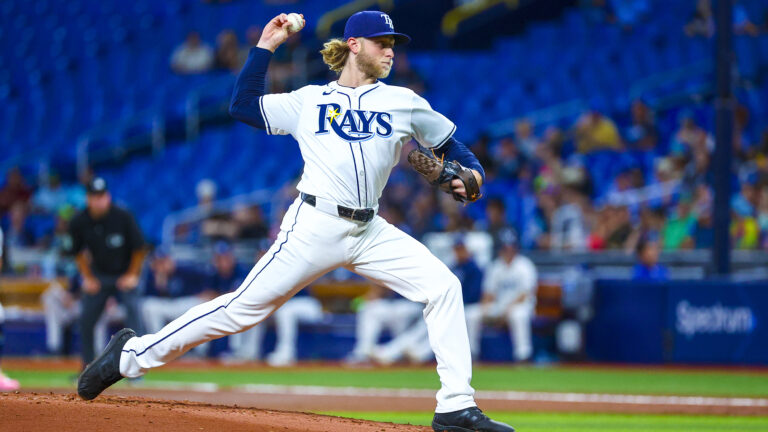
Last week, the Orioles and Rays struck a surprising intra-division trade that sent right-handed pitcher Shane Baz to Baltimore in exchange for a high-volume haul that included four prospects and a Competitive Balance A pick.
There may not be a clear “headliner” in the package the Orioles parted with, but the quantity of the return contributed to some sticker shock.
Catcher Caden Bodine (Orioles #7 Prospect) and outfielder Slater de Brun (Orioles #12 prospect) were both 2025 first round picks by the Orioles while Michael Forret (Orioles #11 prospect) broke out in a big way last season.
Austin Overn is a glove-first outfielder who has a chance to be a fourth outfielder with the Competitive Balance A balance selection to cap things off, which should be somewhere in the 37-40th overall pick range, likely adding around $2.7 million to their bonus pool.
My initial reaction was that it was a steep price to pay for Baz. Evidently, there’s a wide range of opinions on the value of Baz, which ultimately is the biggest variable in what end of the spectrum your opinion may lay on the trade.
Why Are the Orioles So Bullish on Baz?
It’s easy to dream on the 26-year-old right-hander. He was once one of baseball’s most high-regarded pitching prospects, but was held back by an arthroscopic elbow surgery early in 2022 followed by Tommy John surgery later that year, limiting him to just 106 1/3 big league innings from 2022 to 2024.
Despite mixed results in 2025, Baz’s 166 1/3 innings pitched made his season a success in itself. He also flashed the stuff that made him such an exciting prospect. The fastball averaged 97 MPH with a trio of intriguing secondaries.
It may not be a coincidence that his last start of the 2025 season was in Baltimore, where even with a managed workload as he surpassed his career-high in innings, he had all of his offerings on display through four no-hit frames.
Execution will be important, as Baz had the tendency to leave stuff over the heart of the plate, which manifested in a bit of a home run problem.
Especially in the home run friendly environment he pitched in for half of his starts at Steinbrenner Field, where his ERA was more than two runs higher with more than twice the total of homers allowed.
There were undoubtedly more “cheap” homers allowed for Baz at home than on the road given the Yankee Stadium dimensions of Steinbrenner Field paired with wind that often blew out. The jarring difference in HR/FB rate at home (27%) versus on the road (15%) would back that up.
What isn’t a byproduct of Steinbrenner Field’s dimensions is Baz’s huge gap in batted ball angles at home compared to the road. His average launch angle allowed on batted balls 95 MPH and above was twice as high at home (16.3 degrees) than on the road (8 degrees). His ground ball rate was also eight percent higher on the road (51%) than it was at Steinbrenner (43%).
I can’t quite find a rhyme or reason why, maybe it was one of those instances where a guy tries so hard to combat something that he ends up feeding into it. The pitch usage is almost identical, with just slightly more changeups at home and a bit of a propensity to leave them up. All four of Baz’s home runs allowed on changeups in 2025 were at home.
Chicken or egg thing aside, there’s no refuting that it will be better for Baz call a different ballpark home.
Another area that will be important to monitor with Baz in 2026 is his fastball performance.
Averaging 97 MPH last season, it was an effective pitch but at that velocity with above average carry for his arm angle, it’s surprising that Baz did not pick up more gaudy whiff numbers with his fastball last year.
Some of it may be the fact that Baz does not pitch towards the bottom of the zone as much as he should. Hitters–especially righties–could pull their sights up with the focus on covering the middle of the zone and up.
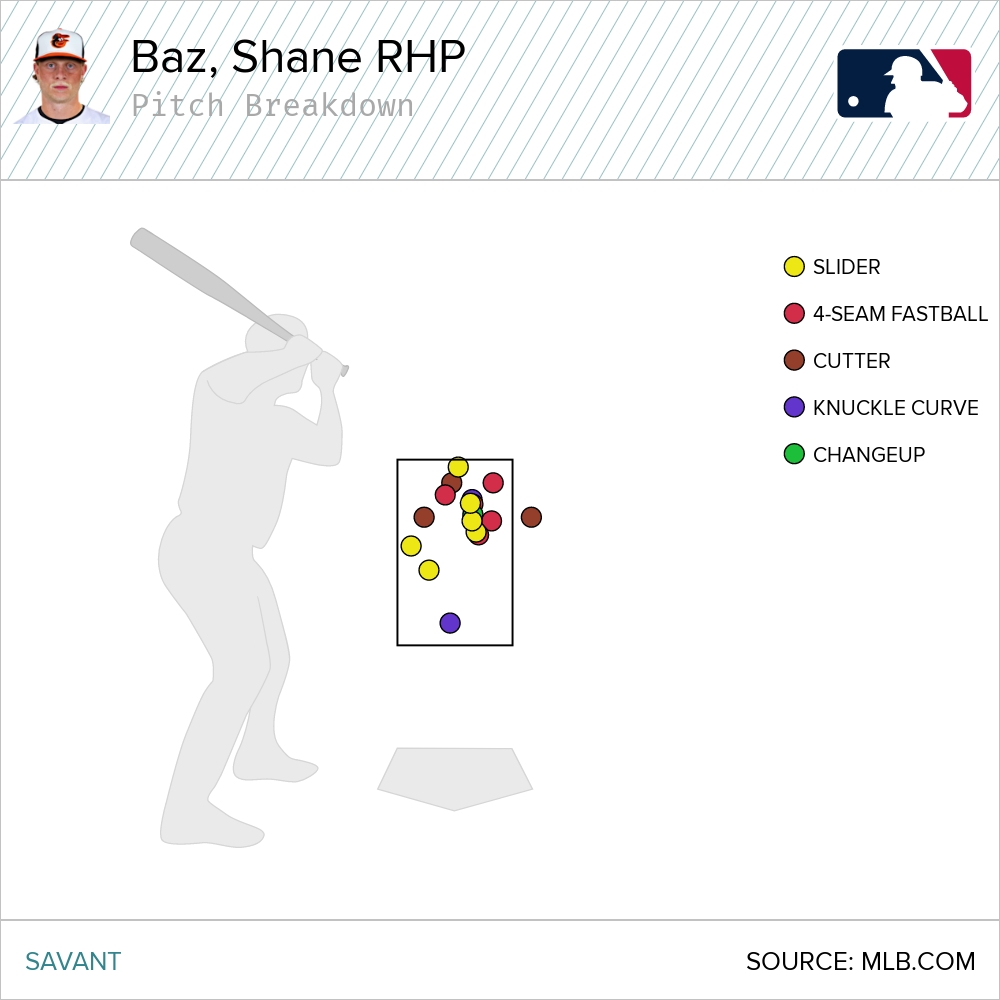
With righties able to eliminate the changeup, they are almost guaranteed to see one of three pitches: the four seamer, curveball or cutter. The four seamer and cutter were frequently used in the upper half of the zone and he rarely works inside to same-handed hitters. Baz occasionally mixed in his slider as well (5% usage), but tended to miss upstairs with it, with all five homers being on pitches in the heart of the plate or above.
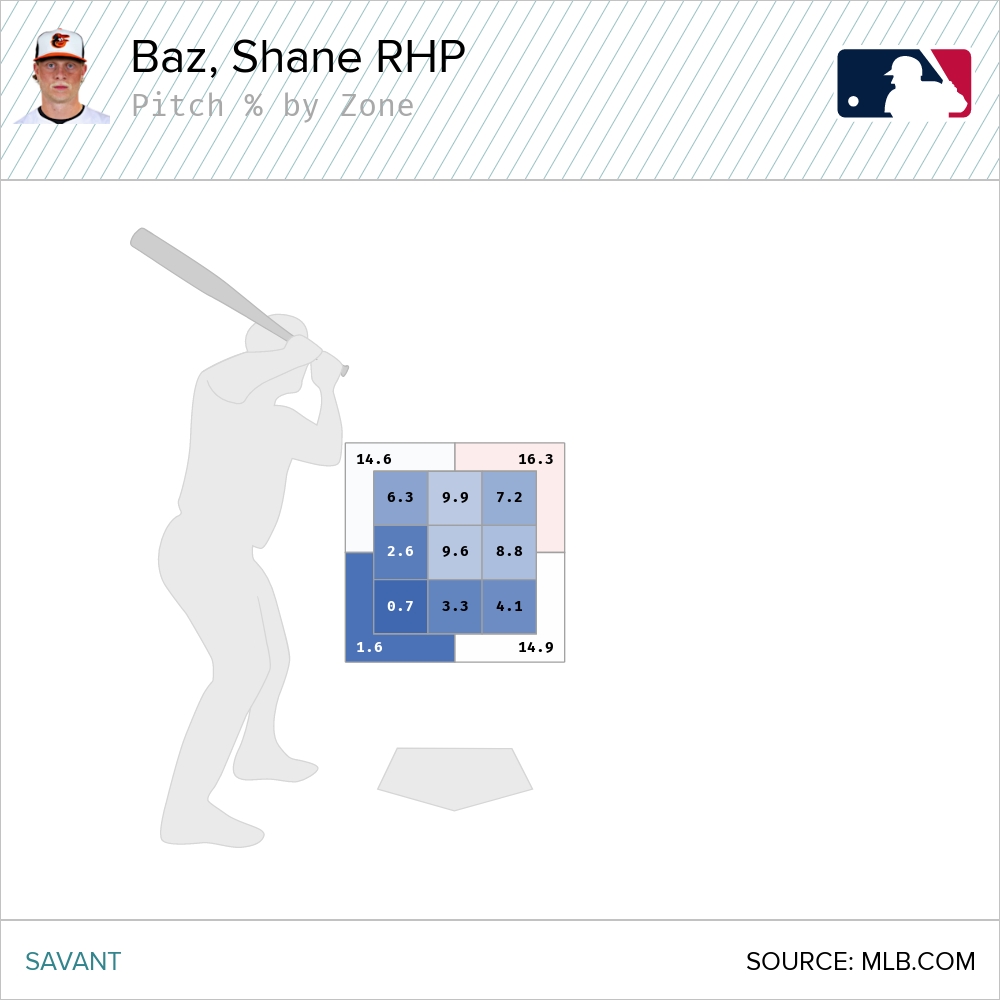
The best explanation I can find for Baz’s elevated fastball not performing better is that it is a focal point for hitters, especially right-handed hitters and when they don’t have to worry as much about being sped up with something hard inside, covering that 90 MPH cutter over the heart of a hanging curveball becomes a bit easier.
Below is the location of every homer a right-handed hitter launched against Baz in 2025.
Lefties should continue to be less of an issue for Baz because of the presence of his changeup.
The elevated fastball tailed by the changeup and cutter cadence seems to keep lefties more off balance and cognizant of all four quadrants. It also helped that Baz was far more willing to throw his fastball to the inner third against lefties in 2025.
| Handedness | K% | Slug% | Hard Hit% |
|---|---|---|---|
| Vs. Lefties | 28.2% | .404 | 32.5% |
| Vs. Righties | 21.7% | .459 | 44.8% |
As ugly as the slider results were in 2025, I still think it is a pitch he should throw more next season. It will be a matter of locating it more frequently to his glove side and to the lower third of the plate.
The biggest X-factor and a pitch I expect Baz to add to is a sinker.
Something to keep righties aware of the inner third will be helpful and would likely aid his cutter and sinker as well.
When a hitter sees something starting over the heart of the plate or just inside of that, they’ll no longer be able to assume that it’s going to stay there or break away from them, they’d also have to be aware of something running in towards their hands.
The proof is in the pudding with Hunter Brown. He added his sinker in 2024 and the results against righties since have been night and day. In 2023, Brown surrendered an OPS of .836 against right-handed hitters, giving up 18 homers.
In 2024 and 2025 combined, righties have posted a .635 OPS as he has introduced a sinker that he throws 37% of the time to same-handed hitters with nearly 70% of those pitches being on the inner half.
Now, it may be a bit ambitious to hope for similar success from Baz with a new sinker, but even if it’s a watered down version, there’s plenty of reason to believe that he would be more effective right on right even just by mixing a sinker in.
There’s also just the general optimism that the more innings Baz throws and the further he is removed from Tommy John surgery and the more innings he throws, the better the breaking ball command can be.
It’s understandable why those most bullish on Baz still see the upside of a guy who can sit near the top of a strong rotation. The addition of a sinker, reworking the slider and locating his breaking balls better could parlay into reaching that massive upside.
But even finding one of the aforementioned three components in 2026 could help Baz take a big step forward, which is why the Orioles were willing to pay the price they did to bring him in…the team that parted with him was willing to admit it as well.
“Love the person, love the human and someone that we feel very, very strongly [that] the best is right in front of him,” Neander said to reporters during his media availability following the trade on Friday night. “I think that Baltimore agrees, and that speaks to why the transaction [came in] at the acquisition price that it did.”
Understanding the Orioles Trade Package
Orioles GM Mike Elias has made some trades of note in recent years, with the move for Corbin Burnes most noteworthy, as well as acquisitions of Trevor Rogers and Zach Eflin.
That said, those trades have not been enough to shake the general perception that the O’s front office tends to clutch onto their prospects.
A potentially blocked Coby Mayo and Heston Kjerstad sitting in no-man’s land after big league struggles serve as reminders of just that. The apprehension does not appear to be in trading prospects in general, but rather those who have the upside to make it regrettable.
The package of prospects sent to Tampa may be the best example of that.
In aggregate, it’s a steep price to pay, but it could be argued that the most appealing aspect of each of the four players moved is their perceived floor rather than ceiling and the Orioles are seemingly confident in their ability to replace that type of prospect.
Of the four players the Orioles selected in the first 40 overall selections of the 2025 Draft, Ike Irish definitively had the highest upside, which is why he checks in at No. 4 in our Orioles top prospect list.
Players that can help their 2026 squad were clearly off-limits as well like Dylan Beavers, Trey Gibson and even Enrique Bradfield Jr.
Breakout teenage prospects Nate George (OF) and Esteban Mejia (RHP) are both far off, but offer intriguing upside that fits the bill of what Elias and Co. tend to clutch onto. Maybe even when there’s a case that they should be more willing to move those types.
If the goal is to prioritize higher impact prospects, it becomes increasingly understandable to backfill a package with the quantity that could make it look like an “overpay” in its totality.
There’s two prongs to the aforementioned Neander quote.
One is that the Orioles are taking a shot that is justifiable given the belief that Baz will only get better. But the other is that while an intra-division trade is tough to execute, when you have an organization that is as hell-bent on maximizing assets as there any in MLB, the Rays simply could not say no.
The more time I spend thinking about the wrinkles to the deal, the more clear it becomes that these two teams were synced perfectly for a deal. The Rays–who are seemingly in a perpetual 40 man crunch–have at least 10 prospects worth noting who will be Rule 5 eligible in 2026.
For that reason, the Rays tend to target recently-drafted prospects when possible. At the same time, teams are not always eager to part prospects they just drafted…especially in the first round.
The Orioles farm system depth makes a quantity over quality package more palatable as well, further bolstering their minor league talent with a successful trade deadline last season.
The Rays farm system is both talented and deep in its own respect, but it could be argued that the organization sorely needed a prospect like Caden Bodine. His elite receiving and plus bat to ball skills make him a high probability big league back stop even if the impact may be limited.
Bodine immediately becomes the top catcher prospect in the Rays system with the only other prospect of note behind the dish being a bat-first Dominic Keegan. Below are the scouting grades on Bodine from the Orioles end of season farm system update.
| HIT | Plate Disc. | GAME POWER | RUN | FIELD | FV |
| 50/60 | 40/50 | 30/35 | 40/40 | 50/60 | 45+ |
It will be a question of whether Bodine can impact the baseball enough to properly leverage his well above average feel to hit from both sides of the plate and there’s some gains he could stand to make in the catch and throw department.
Regardless, Bodine is an high-probability big league piece, even if the ceiling is limited.
18-year-old outfield prospect Slater de Brun is of course further off, but his speed, hand-eye and defensive projection should give him a decent chance of filling an MLB role even outside of his peak outcomes.
| HIT | Plate Disc. | GAME POWER | RUN | FIELD | FV |
| 40/55 | 45/55 | 30/35 | 70/70 | 45/55 | 45 |
De Brun also received a 45 future value grade out of the draft because I found myself again more intrigued by the perceived floor than what the ceiling could ultimately be.
At 5-foot-9, 190 pounds with a frame that doesn’t necessarily point towards room for a ton more strength and a swing that is more slash and dash, de Brun will likely need to maximize his hit tool and defensive outcomes to be an above average regular.
That said, he has a skill set that should give him a relatively strong chance of landing as a bench outfielder, headlined by his blazing speed.
22-year-old outfielder Austin Overn represents what a below-median outcome could look like for de Brun. His double plus speed and defensive prowess in center field gives him a decent shot to fill a big league bench role, but struggles with velocity and fringy pop limit him to a fourth outfielder’s ceiling.
Ironically, the lone pitching prospect in the deal may provide the widest range of potential outcomes. 21-year-old right-hander Michael Forret broke out in a big way in 2025.
He creates some unique shapes relative to what hitters would generally expect from a pitcher with his arm angle, with a deep bag of pitches that performed well at mostly High-A and three starts at Double-A.
| FASTBALL | SLIDER | Sweeper | Changeup | Splitter | COMMAND | FV |
| 50/55 | 60/60 | 50/50 | 50/55 | 50/50 | 50/50 | 45+ |
Opponents hit just .157/.224/.213 against Forret in 2025 with nearly identical splits against both lefties and righties thanks to his deep bag of pitches.
The stuff may not be elite, but he could very well have five average or better offerings and saw his velocity increase as he was further removed from a back issue that kept him out for a little over a month in May.
Between the deep bag of intriguing offerings and possibility for more velocity, it is not completely unreasonable to believe that a the Rays could help Forret maximize his upside into the form of a middle-rotation arm.
Given his present stuff and feel to pitch, Forret should at least land as a back end arm, assuming he successfully increases his workload in 2026 and beyond.
The Competitive Balance A selection is particularly intriguing for the Rays as well because it almost guarantees that the Rays will have the largest bonus pool of any team in the 2026 Draft.
Already owning the No. 2 overall selection and a Competitive Balance B pick, the addition of a pick that should land anywhere from 34th to 37th overall and roughly $2.7 million in value will give the Rays the ability to acquire a ton of talent in what should be a deeper class than 2025.
The Rays are hoping that one of the five pieces coming back ultimately become an above average regular, but it’s not necessarily essential to make this a successful deal for them given the decent likelihood that a couple players fill big league roles and the enviable draft capital they now have for 2026.
For the Orioles, Baz will undoubtedly need to take a step forward in 2026 to make this trade a success. The other part I cannot completely wrap my head around is the idea that Grayson Rodriguez is so far gone that it is worth trading four years of him in exchange for one year of Taylor Ward.
Admittedly, we do not know what has gone on behind closed doors and Baz just threw nearly 170 innings while Rodriguez hasn’t pitched in a regular season game in 16 months.
The thing is, Baz similarly struggled to stay on the mound with two elbow procedures that limited him to just 158 2/3 innings over a three year span.
Though it was my initial reaction, it’s probably unfair to use the Rodriguez trade as precedent to judge the Baz trade as Baz was the only one throwing in 2025, but the fact that Rodriguez has four years to get right and the Orioles opted to just move on just to pay a steep price for another right-hander with injury history might just be more of an indictment on the Orioles feelings towards their once top prospect.
With three years of control and another year removed from Tommy John surgery, the Orioles have time for Baz to continue to improve and even if he’s only 10-15% better than he was in 2025 next season, Baz objectively improves that rotation as long as he is healthy. But you can’t rule out even larger gains than that with his skill set.

Written by
Aram Leighton is the Co-Founder and Executive Editor for Just Baseball. A Syracuse University grad, Aram is one of the hosts of the Just Baseball Show…