
Which Second-Half Stars Will Fully Break Out in 2026?
We saw some new faces stand out in the second half of the 2025 season, but which ones are on the cusp of a full breakout in 2026?
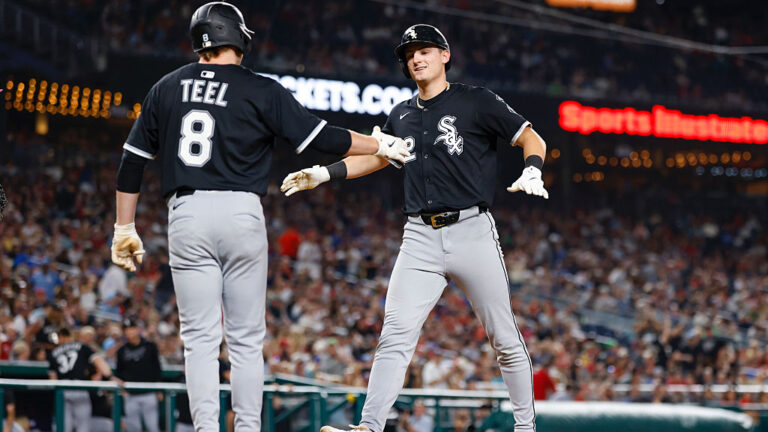
One of the most fun aspects of each Major League Baseball season is the breakout performances we see from players across the league. Whether it’s a role player who finally becomes a key piece of a playoff team, or simply a prospect performing well in his first crack at the big leagues, these storylines are always a blast to keep an eye on.
This season, some of the most exciting breakouts came in the second half of the season, where we saw many hitters begin to really make a name for themselves. The majority of them were on the younger side, which makes this year’s breakouts even more exciting, as the talent pool in the sport continues to grow quickly.
One of the main questions surrounding these breakouts, though, is whether or not they are sustainable, or if they’re just one-year wonders. Heading into the offseason, this will be very important for teams to determine as they begin to shape their rosters for the 2026 campaign.
With many of these players being in their first taste of major league action, the important key will be whether or not they can replicate these breakouts as big league arms begin to adapt to them. This is an issue we’ve often seen plague some former top prospects like Aristides Aquino, among others.
Let’s take a deeper dive into six of these second-half stars and see if any of them will be able to fully break out in the 2026 season.
Daylen Lile — Washington Nationals
After spending a few seasons as a top prospect in the Nationals’ organization, Daylen Lile finally got a chance to prove himself at the big league level this year. In this short stint, he didn’t disappoint either, as he finished in the top five in National League Rookie of the Year voting.
The most important takeaways came from the Lile’s second half, as he dominated in the 58 games he played during this span. Lile slashed .333/380/.576 with seven homers and a 162 wRC+. He was one of only 10 players to post a wRC+ above 160 in the second half of the season as well, joining a group that included Nick Kurtz, Juan Soto, Aaron Judge, Shohei Ohtani, and others.
The question for the Nationals is whether or not Lile’s success can be sustainable heading into 2026, as his contact-speed profile seems to be pretty safe overall. His contact and whiff rates both ranked above the 80th percentile, pointing towards Lile succeeding at his specialties.
Lile also ranked in baseball’s 100th percentile in line drive rate, a super encouraging sign for a contact-first hitter. With his sprint speed ranking near the top of the sport as well, this will give him the ability to stretch singles into extra-base hits.
The only main concern around Lile’s game is how effective the contact-first approach can be. He didn’t reach an exit velocity over 110 once this season, and his average exit velocity sat under 89 MPH. For most players, this is an alarming sign, but with Lile’s contact rates being so elite, this approach can work.
Notably, Athletics rookie star Jacob Wilson, one of the best contact hitters in the league, followed a similar path this year. His max exit velocity and average exit velocity actually finished lower than Lile’s this year. However, prioritizing contact, Wilson managed to be one of the best pure hitters in the league.
Given Lile’s overwhelming success with his contact-first approach, I have a lot of faith that his breakout will continue into 2026. If he can take even a smaller step forward in finding consistent barrels, he could easily become one of the best pure hitters in the sport.
Spencer Horwitz — Pittsburgh Pirates
2025 was yet another disappointing season for the Pittsburgh Pirates’ offense. They finished near the bottom of the league in nearly every offensive category, leaving them with very few positives on this side of the ball. However, their main offseason acquisition, Spencer Horwitz, was one of the few bright spots on this roster.
Horwitz slashed .305/.396/.520 with nine homers and a 154 wRC+ in the second half. He was also worth nearly 2.0 fWAR in this same span. After Horwitz missed a large portion of the first half of the season, seeing him take this step forward in the second half was a huge positive sign for the Pirates.
It seems likely that Horwitz’s breakout will continue into 2026, as he really started to get comfortable at the plate after reacclimating to big league pitching. With a full spring training under his belt at the beginning of 2026, he may not have the same adjustment period that he had this season.
Similarly to Lile, Horwitz’s offensive game is largely determined by his contact-first approach, followed by good plate discipline, although he does possess the ability to hit for power at times. He ranked in the 72nd percentile or better in chase rate, strikeout rate, whiff rate, and walk rate, four areas that allow for a pretty solid profile.
This is even more true when considering his contact rate of over 82% last season. Similar to most contact-first hitters, the question will always come back to concerns surrounding his quality of contact. After all, Horwitz posted a barrel rate of only 8.2% last season alongside an average exit velocity under 87.5 MPH.
However, this doesn’t appear to cause much of an issue for Horwitz. His playstyle allows him to slot in as a very solid top-of-the-order bat, reaching base for the more impactful power bats that follow. Also, he would’ve hit over 20 homers in a full season if you follow his pace from the second half of the season.
Due to his second-half excellence and solid contact rates, I have a ton of faith in Horwitz sustaining his breakout into next season. If he can enter the season healthy, we may see him set the tone early, establishing himself as one of the league’s biggest breakout players shortly after Opening Day.
Ben Rice — New York Yankees
This season, many storylines surrounded the New York Yankees. From yet another dominant offensive season by Judge to their eventual disappointing loss in the playoffs, this was a rollercoaster year in New York. One of the most underrated aspects of this season, though, was the quiet breakout of first baseman Ben Rice.
Rice’s most impressive production came in the second half, as he was one of their offense’s driving forces down the stretch. The left-handed hitter slashed .281/.352/.542 with 12 homers and a 147 wRC+ in this span. For the 26-year-old, this stretch erased any doubt that Rice’s breakout season was legitimate.
Rice was simply one of the most underrated hitters in the sport during the 2025 season, and his underlying metrics support this idea across the board. If you check his Baseball Savant page, you’ll see nothing but red offensively, as he ranked in the 90th percentile or higher in most offensive categories.
One of the key details I’d like to examine is the idea that Rice has yet to even reach his full potential offensively. For example, Rice underperformed his expected stats by a significant margin. This was arguably most noticeable in his wOBA, where his actual metric of .358 sat nearly 40 points lower than his xwOBA.
Another one of the most important takeaways from Rice’s 2025 season was his excellent quality of contact. He posted an unreal barrel rate of over 15% alongside some of the best exit velocity numbers across the sport. Considering that Rice did all of this in just his first full season, this is super encouraging.
Rice also has the luxury of playing half of his games in Yankee Stadium, a ballpark that’s notoriously lefty-friendly. Although Rice only hit 26 home runs during the 2025 campaign, there’s plenty of room for this number to grow when taking his home ballpark and quality of contact into consideration.
Overall, Rice doesn’t just seem like a safe bet to continue his breakout 2025 campaign, but he actually seems like a safe bet to take his game to another level. If he continues at this pace, he’ll fly up the first base rankings in no time.
Kyle Teel — Chicago White Sox
One of the biggest blockbuster moves last offseason was the trade that sent Garrett Crochet to the Boston Red Sox, a huge move for both sides. While Crochet finished second in Cy Young voting, White Sox fans had multiple former first-round picks to be excited about. One of them, catcher Kyle Teel, looked fantastic in the second half.
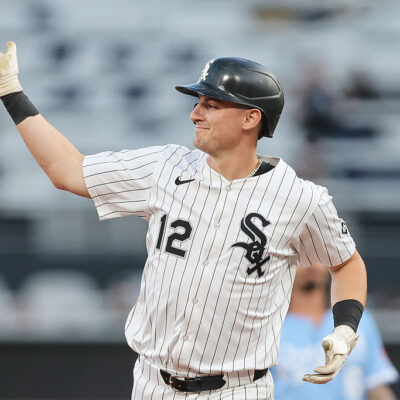
Teel suited up for 53 games in the second half of the season, where he slashed .288/.376/.457 with eight homers and a 136 wRC+. He was also worth 1.6 fWAR, a pace that would make him worth nearly 5.0 fWAR across a full season.
The most impressive feature of Teel’s offensive game was his plate discipline. During his excellent second half, Teel recorded a walk rate of 11% while keeping his strikeout numbers relatively under control. Also, he maintained a chase rate under 24% across both halves of the season, a number that would’ve placed him near the top of the league.
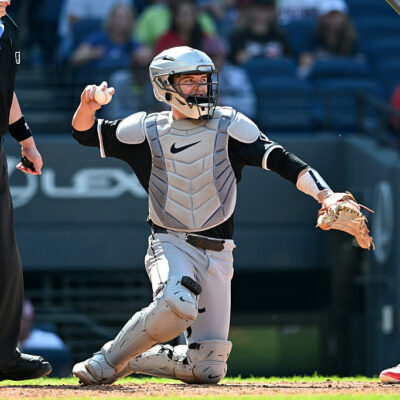
While Teel’s numbers look very solid on the surface, he does have a few pretty substantial drawbacks offensively. First off, he struggled to see spin well. He registered a strikeout rate of nearly 40% against sliders, while posting a similar mark against curveballs. Against breaking balls as a whole, Teel whiffed over 40% of the time.
Teel also recorded some relatively low average exit velocity numbers. His average exit velocity just barely surpassed 88 MPH, which is definitely something to keep an eye on. Another concerning part of his offensive profile is his contact rate, which finished the year barely over 70%.
This season was full of both positive and negative takeaways for Teel. Despite this, he showed the grounds for a solid incoming 2026 season. His performance against breaking balls will be something to keep an eye on, but with more reps against big league pitching, he should be just fine.
Colson Montgomery — Chicago White Sox
After a rough minor league season in 2024, Colson Montgomery‘s future success was more uncertain than ever before. However, he finally got his crack at the big leagues in 2025, and he was one of the most impressive rookies in baseball during this stint.
Montgomery played the majority of his solid big league games in the second half of the season, and his performance put him among some elite company. He slashed .238/.301/.555 with a 132 wRC+ and 21 homers. In fact, his wRC+ was just one point below Bryce Harper and Fernando Tatis Jr.’s mark during this same stint.
To put it simply, Montgomery’s power was otherworldly during his short time in the big leagues. His 21 homers were fifth among qualified hitters during the second half of the season, ahead of superstars such as Judge, Soto, and Kurtz. His barrel rate of 14.5% was another reflection of his elite power.
However, Montgomery’s power being so elite was one of the few things that propped up his overall numbers during this span. He’s struggled mightily with keeping his strikeouts in order and finding other ways on base. In fact, over 34% of his total big league hits were home runs.
This is concerning, to say the least. If Montgomery’s power ever dips, his strikeouts may balloon out of control, creating an all-or-nothing power approach. Player archetypes like this often result in either elite power hitters or players who significantly struggle to make regular contact.
If Montgomery can channel his elite quality of contact metrics into more than just home runs, he’s a slam-dunk pick to fully breakout next season. He does come with some more risk than the majority of others here, though, as his power-first approach could significantly hurt him.
Jakob Marsee — Miami Marlins
Back at the beginning of the 2023 season, the San Diego Padres pulled off a blockbuster trade that brought Luis Arraez out west. While this trade ultimately bolstered the Padres’ lineup, one of the biggest breakout performers of the 2025 season, Jakob Marsee, was sent to the Marlins.
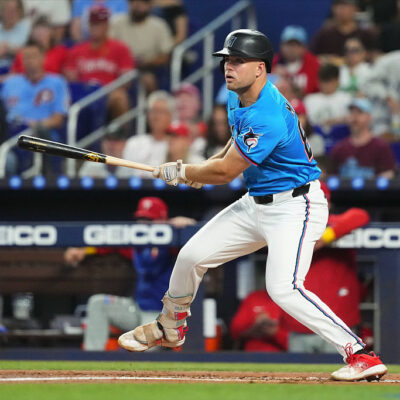
Marsee played 55 games during his first taste of big league action, with all of them coming in the second half of the season. In this span, he hit .292/.363/.478 with five homers and a 133 wRC+. He was also one of just 31 players to generate 2.0 fWAR or more in this same time frame.
Across the board, Marsee was a very solid hitter. He posted an elite chase rate, launch angle sweet spot rate, and a very respectable .347 xwOBA. Thanks to his well-rounded profile, he even garnered some love in the Rookie of the Year race, finishing 8th in the final vote.
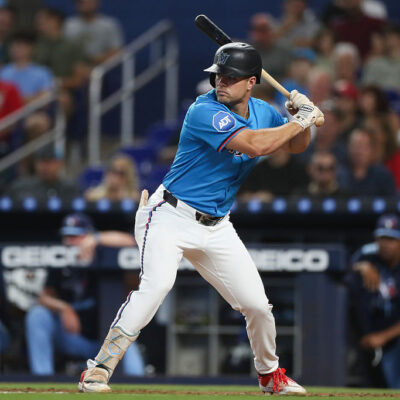
When taking a closer look at Marsee’s numbers, he’s an easy player to get excited for due to the fact that his struggles were relatively minor. His two real weaknesses came in his ability to hit fastballs and put up consistent exit velocities, with both of these being things that he can easily adjust to next season.
Marsee saw four-seamers 34.2% of the time during this 55-game stint, and he posted an xwOBA of .335 against them in addition to a strikeout rate over 26%. While this isn’t a large weakness of his, it’ll definitely be something to monitor due to how regularly he saw heaters.
The same can be said for his quality of contact, which could use some small tweaks. His average exit velocity failed to reach 89 MPH, which is less than stellar. However, he did post a hard-hit rate of over 41%, which makes me feel a little bit better about his quality of contact.
If you’re looking for a safe breakout pick for next season, Marsee seems like the perfect fit. With his well-rounded offensive profile, if he can simply improve his performance against four-seam fastballs, he could take a massive leap in the right direction during the 2026 season.

Written by
Jay Staph, a huge baseball fan and stat nerd, founded and ran his own baseball writing website, BSBWrites, at just 16-years-old. With focal points around prospects,…