
Hurston Waldrep Riding New Pitch Mix to Major Success
Atlanta Braves rookie Hurston Waldrep shares how evolving his pitch mix has allowed him to begin to find big league success.
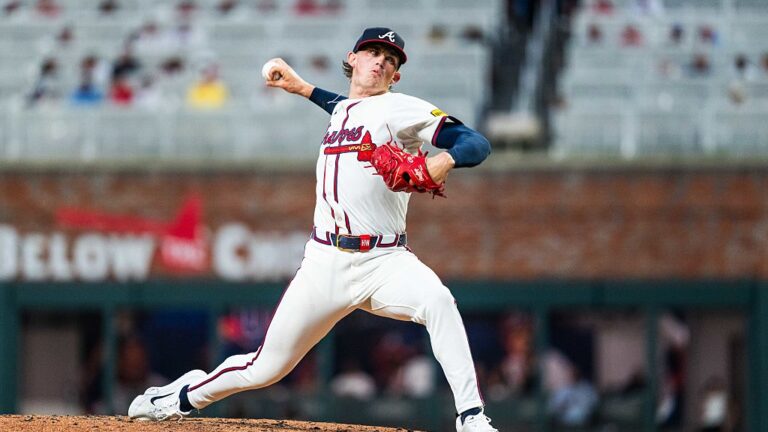
The Atlanta Braves targeted Hurston Waldrep in the first round of the 2023 draft as a potentially fast-moving college arm whose fastball, splitter combo could have him helping the big league team quickly.
That’s exactly what they got with the right-hander, calling him up to make his MLB debut less than a year from hearing his name called and after only 10 starts at Double-A starts and two at Triple-A.
Though his fastball was not garnering much whiff, he was keeping the ball in the yard with his splitter was playing like an easy plus pitch and a slider that did enough as a third offering. One great pitch can help a pitcher manage the pitcher-friendly Southern League, but he looked one-dimensional in his two MLB starts.
Waldrep allowed 13 earned runs in seven innings with 10 of his 11 whiffs coming on the splitter. He hit the IL right after the second start with elbow inflammation, returning to the mound for Triple-A Gwinnett about six weeks later.
He was not much better at Triple-A, continuing to struggle with his below average fastball shape and command, walking 23 and struck out 32 in 34 innings to finish the season. It was more of the same for Waldrep to start the 2025 season, pitching to a 5.64 ERA in 15 Triple-A starts, with opponents hitting over .300 against his four seamer through the end of June.
For a while, the Braves and Waldrep were keen on getting the four-seamer and slider to a point where they could complement the splitter effectively.
“Their focus has always kind of been, hone in on what you’re really good at and have a simplified approach to the game which we really tried to buy into to develop the four seam and the slider,” Waldrep said.
A natural supinator, Waldrep struggles to stay behind his four-seamer. The tendency to slightly get out to the side of the ball as he throws it caused it to flatten out, which is why hitters had little issue getting on plane with it.
What’s amazing about pitching is the same release tendency that restricts his four-seamer could make it easier to introduce other pitches and that’s exactly what Waldrep did in the middle of his age-23 season this year.
Waldrep introduced a cutter and sinker, both of which he learned in a matter of days and was instantly comfortable with.
“Having the sinker and the cutter, it’s almost kind of made the four seam better. To disguise it a little bit,” Waldrep said. “I’ve really loved both those pitches, but the cutter has been the favorite add so far.”
Since the start of July (four Triple-A starts and five MLB starts), Waldrep cut his four-seam fastball usage to roughly 10%, a third of the figure from his 15 starts prior. In that span, the sinker and cutter have accounted for 30% of his pitches, with opponents posting a combined .628 OPS against the offerings with a 63% ground ball rate.
With the reintroduction of the curveball and the slider a bit tighter, all of the sudden, Waldrep has a unique plot of pitches and the hitters he has faced over the last two months would likely agree.
In the aforementioned nine start span, Waldrep is sporting a 0.85 ERA in 53 innings while opponents have slashed .190/.263/.254.
The only thing more impressive than the results of late is the fact that Waldrep was able to add his two new pitches in a matter of a few days.
“People don’t realize those two pitches are actually very similar,” Waldrep said. “The way that I throw, adding both of those pitches is relatively pretty easy. I throw them out of the exact same slot with the exact same release point queue. It’s just a different grip.”
With the cutter grip in particular, it’s hardly even that different from his four-seamer…just enough to make all of the difference. Waldrep mentioned a “Mariano Rivera style grip” which is an ever so slight adjustment from the four seam grip.
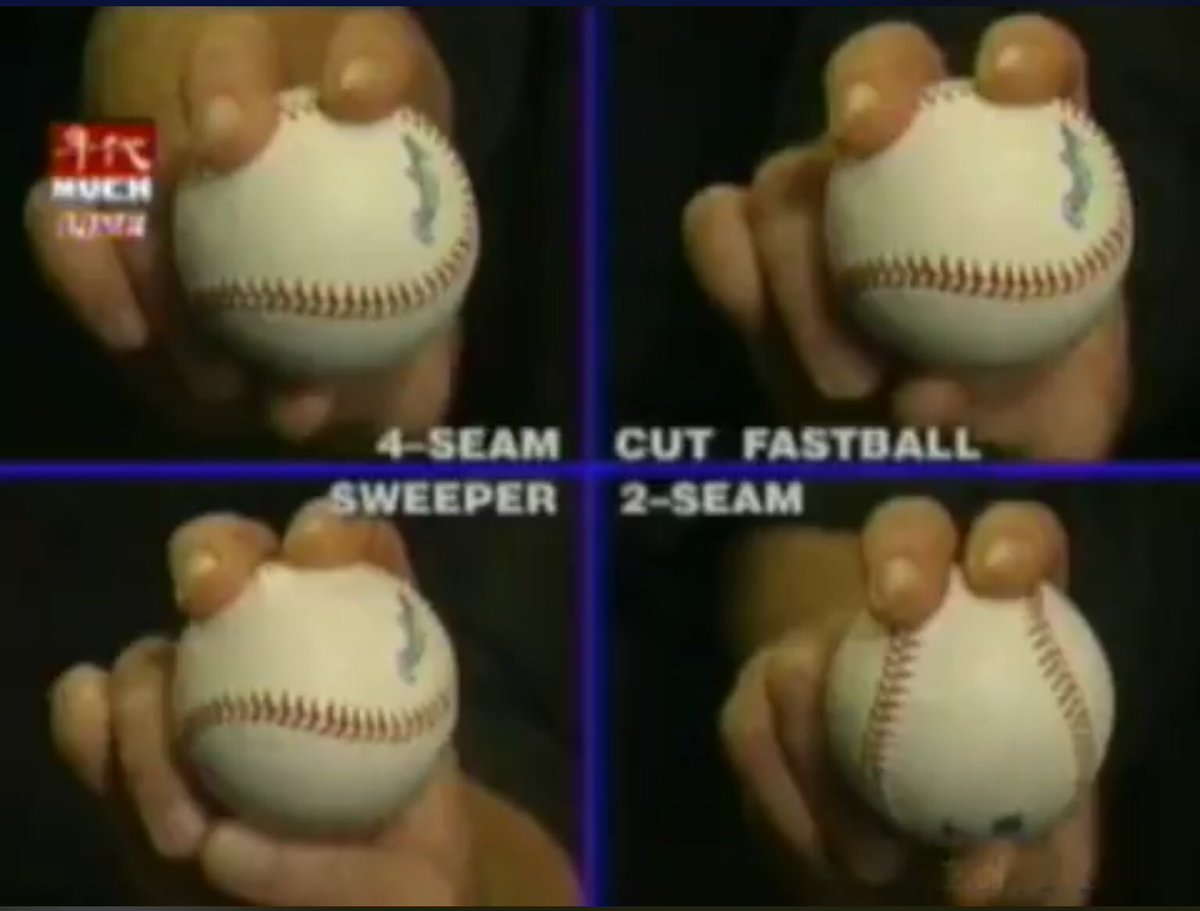
Essentially, the same release qualities that hindered Waldrep’s four seam fastball became an asset to his cutter and sinker. As a supinator, it’s much easier for Waldrep to let the cutter grip do the work, knowing his natural throw will create the desired movement.
The same can be said with the sinker. While other pitchers need to manipulate the ball some by turning their hand over, supinators like Waldrep can generate arm side movement through seam shifted effects. He essentially grips it like a two-seamer and lets physics do its thing.
”I never visualized myself in the big leagues as a sinker cutter guy,” the Braves right-hander said. “I always visualized myself in the big leagues as upper nineties with a good splitter, but you have to adapt and you have to adjust to the game.”
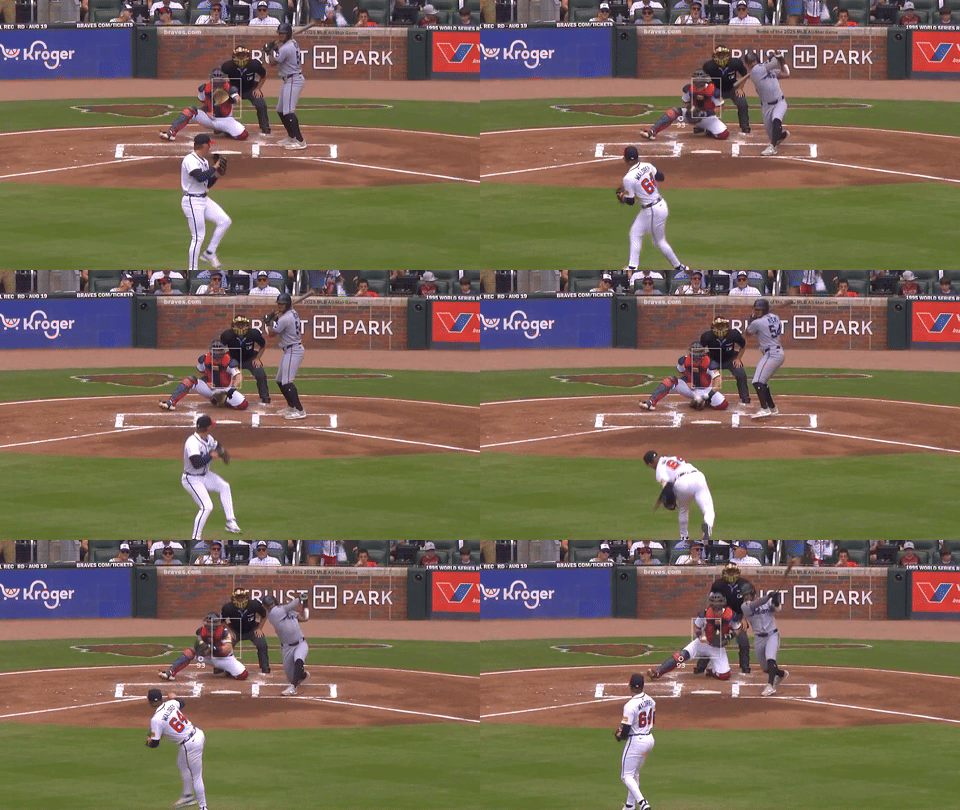
That said, he’s still a splitter guy too and the diversification of his arsenal has only made his best pitch even more effective.
In his five big league starts since being called back up, Waldrep has allowed just three extra base hits in 30 innings pitched. The splitter has been as dominant as ever for him with hitters having more on their mind, holding opponents to 4-for-40 with 22 strikeouts since rejoining the Braves.
Waldrep called back to his sophomore year of college at Southern Mississippi where he decided to try out a splitter in the middle of the season after watching Kevin Gausman. The split was a quick study for Waldrep as well.
“I threw it in the bullpen and then threw it in the game the next week, had two strikeouts on it and ever since then, it’s been a high-usage pitch.”
According to Waldrep, the pitch has evolved over the years, from a split change grip, to a true splitter, back to what he called “a little bit of split change” to now a true splitter again.
Though the pitch mix looks different from what Waldrep did in college, the 23-year-old’s revamped arsenal has helped him get back to something he did well as an amateur: getting ground balls.
“Being able to attack early, knowing that my damage is gonna be ground balls. I have a really good infield behind me, so it’s like, yeah, let that happen,” Waldrep said.
“That was kind of easier to buy in to than trying to throw a four steam at the top, especially the way that the splitter plays down. You want something that plays down and starts on the same tunnel.”
In a frustrating year for the Braves, Waldrep’s progress has turned into a key silver lining as they look ahead to 2026.
“I’m going to continue learning what I’m doing well,” Waldrep said. “It’s really just taking it game to game, lineup to lineup.

Written by
Aram Leighton is the Co-Founder and Executive Editor for Just Baseball. A Syracuse University grad, Aram is one of the hosts of the Just Baseball Show…