
Why Connelly Early Could Break Out For the Red Sox in 2026
Connelly Early has a clear path to exceeding his projections and becoming a meaningful piece of a contending Red Sox rotation.
 | |
| | 
Projection systems tend to favor clarity. Pitchers with a singular defining trait—elite velocity, a dominant breaking ball, or a clear bat-missing weapon—are easier to model and project forward. Players whose value is distributed more evenly across their arsenal can be more difficult to capture. Connelly Early falls into the latter category.
Public projections place Early in a modest role, forecasting roughly 100–110 innings and production in the back-end starter range. That outcome is understandable when viewed through a traditional lens. He does not feature a single overwhelming pitch that anchors the profile or drives immediate attention. But that absence of a singular dominant offering is precisely what makes his profile more interesting.
Early’s effectiveness is not driven by one pitch—it is driven by the interaction of many. He features three above-average secondary offerings in the curveball, sweeper, and changeup, each bringing a different movement profile and timing disruption. None need to carry the arsenal on their own because they function collectively to expand the hitter’s decision space.
That depth is paired with two distinct fastball shapes that he commands well. While neither the four-seamer nor sinker stands out as an elite pitch in isolation, their value lies in their reliability. Early is able to locate both consistently, allowing him to move between velocity bands and planes without sacrificing control of the at-bat.
Connelly Early Is on the Verge of a Breakout
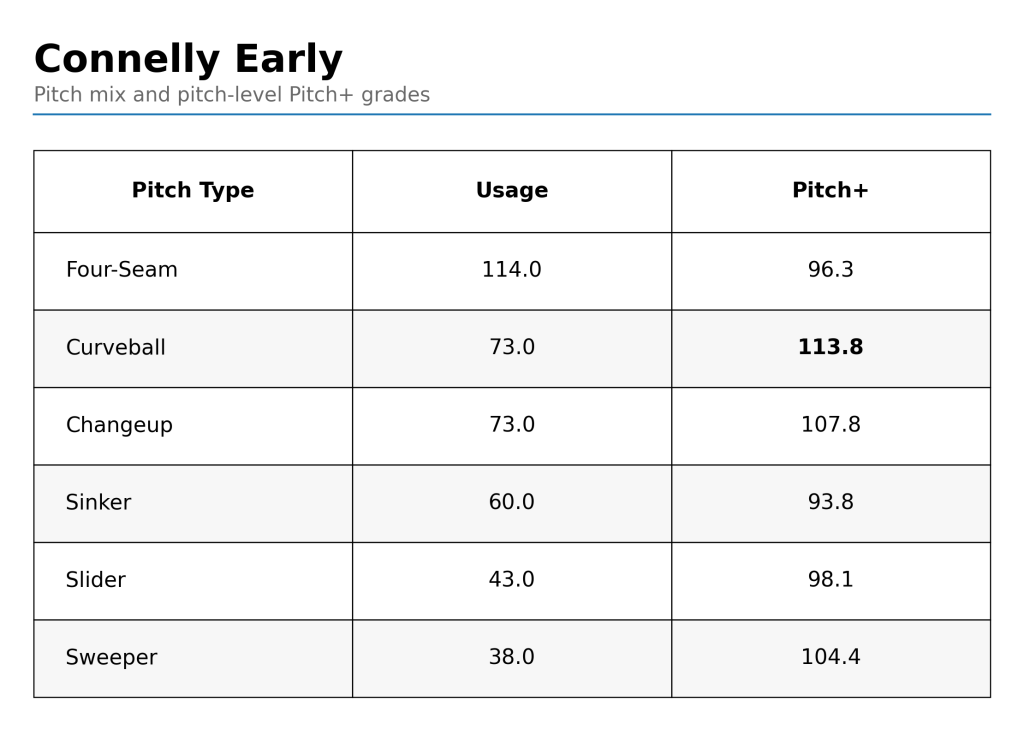
Pitch+ is a unified pitch quality model designed by Just Baseball’s Shaan Donohue to evaluate how pitch shape and location contribute to swing-and-miss ability, contact-quality suppression, and overall run prevention. The model integrates modern ball-tracking inputs with outcome-based location modeling to provide a single, normalized rating of pitch effectiveness.
The result is a pitcher who can present hitters with a wide range of looks while maintaining command of the strike zone. It is easy to view a profile like Early’s and focus on what is missing. Without a clear plus-plus pitch, there is a tendency to assume a lower ceiling or reduced margin for error. In reality, depth itself can be a skill. Pitchers with broader arsenals and multiple viable options are often better equipped to navigate lineups multiple times. They are less dependent on precise execution of a single pitch and more capable of adjusting their approach as hitters adapt. That flexibility becomes particularly valuable over longer outings and across a full season.
Early’s arsenal does more than provide depth—it gives him a framework for how to attack different types of hitters. Against right-handed hitters, he leans heavily on a four-seam, curveball, and changeup mix, using that combination to change both shape and speed while maintaining a consistent visual tunnel. Against left-handed hitters, the approach shifts toward sinkers, sliders, and sweepers, creating a different set of movement profiles that work laterally and attack from a different angle. Rather than asking one version of his arsenal to solve every matchup, Early effectively operates with two tailored approaches, each designed to exploit the tendencies of the hitter he is facing.
That variability also enhances the effectiveness of his fastball. While his four-seamer and sinker may grade closer to average on their own, they play up within the context of his sequencing and command. Early consistently executes his offspeed pitches in ways that force hitters to anticipate movement and velocity changes, and that expectation creates hesitation. It is not uncommon to see hitters take fastballs in the zone—pitches that would typically be attacked—because they are geared for something else. In that sense, his command is not just about throwing strikes, but about controlling the hitter’s decision-making process.
This style of pitching lends itself to sustainability. Because Early can alter his approach based on opponent and situation, he is less vulnerable to being solved over the course of a game or a season. That adaptability provides a pathway to outperforming conservative projections, particularly as his workload increases. At the same time, there is still meaningful uncertainty. Early’s development path has been relatively compressed, with limited time at the highest levels before reaching professional baseball. As he gains experience, there is reason to believe his execution and sequencing will continue to sharpen. For a pitcher whose value is already built on variety and adaptability, even marginal improvements can have an outsized impact.
A Breakout Goes a Long Way
If that progression occurs, the implications extend beyond individual performance. A breakout from Early would materially shift the outlook of the Boston Red Sox rotation. Boston has already made aggressive moves to reinforce its staff, acquiring Garrett Crochet and Sonny Gray in consecutive offseasons. Those additions signal a clear intent to contend, but they also increase the importance of internal, cost-controlled production.
If Early is able to establish himself as a mid-rotation starter, Boston gains a controllable arm capable of providing meaningful innings behind its top-end pitchers. For a team with significant financial commitments, that kind of internal stability is essential. His emergence would also bring clarity to the structure of the staff. Securing a rotation spot could push fellow left-hander Payton Tolle into a bullpen role, where his stuff may play up in shorter outings and give Boston another potential leverage option.
At the same time, Early’s presence would create a surplus of viable starters. With Crochet, Gray, Early, Brayan Bello, Ranger Suárez, and Johan Oviedo all in the mix, Boston would have more rotation-caliber arms than available spots. While that type of logjam often resolves itself over the course of a season, it also creates optionality. A pitcher like Bello, who still has multiple years of team control, could become a logical trade candidate, allowing Boston to address other needs while maintaining rotation depth.
That is ultimately the value of a pitcher like Early. He does not need a singular dominant pitch to outperform expectations. His value is derived from how his arsenal functions as a whole—how it adapts, how it disrupts timing, and how it allows him to navigate lineups in multiple ways. If that translates over a full season, Early has a clear path to exceeding his projections and becoming a meaningful piece of a contending rotation.
Become a Member of Just Baseball
Subscribe and upgrade to go ad-free!
* Save 25% by subscribing annually.
Written by