
Michael King Has Returned to Ace Status
King has returned to his frontline form, keeping the Padres' postseason aspirations alive while setting himself up for a big payday come season's end.
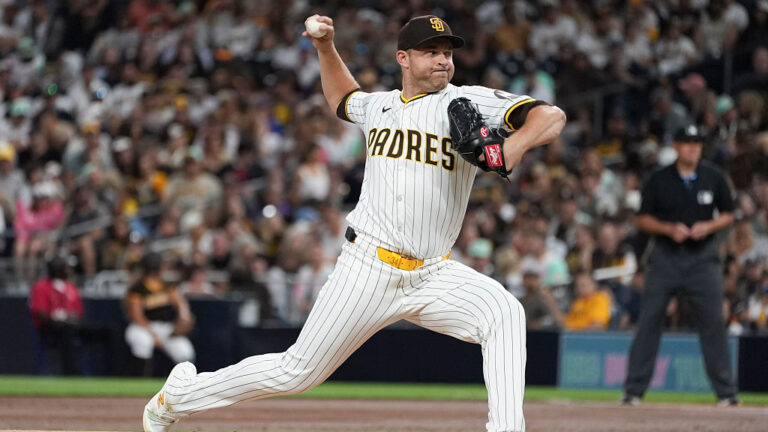
When the San Diego Padres traded for Michael King in the Juan Soto deal, the hope was that he was ready to take the next step as a starting pitcher. That is exactly what King did in his 2024 season, posting a 2.95 ERA with 201 strikeouts across 173.2 innings. His breakout performance earned him a seventh-place finish in NL Cy Young voting.
Following that season, King wasn’t able to recapture his form. He made two trips to the injured list, one for a nerve issue in his shoulder and another for knee inflammation. This limited him to 15 starts, where he owned a 3.44 ERA. Not terrible by any standard, but he was far from his dominant self.
This down year hurt King’s value in free agency, which worked in the Padres’ favor due to their payroll restrictions. King and the Padres agreed to a three-year, $75 million contract with player options after the 2026 and 2027 seasons.
So far this season, King appears to be back. Through 10 starts, he possesses a 2.31 ERA with 59 strikeouts in 58.1 innings. He ranks tenth in ERA among qualified starters and is 15 innings away from surpassing last season’s total.
Let’s dive into what has led to King’s return to ace status and why he has once again become one of the best starters in baseball.
What’s Behind King’s Success?
The most obvious reason for King’s success so far this season has been health. Despite the two IL stints last season, there weren’t major concerns about his velocity or pitch shapes. Now fully healthy, everything in his arsenal is playing up again.
King has made some slight adjustments, most notably a 5.3% increase in his changeup usage. The changeup is now his most-used pitch at 26.7%, barely ahead of his sinker at 26.4%.
Throwing the sinker and changeup over 50% of the time creates an effective tunnel, with the firm sinker and softer changeup looking identical until the last minute, making it tough for hitters to adjust.
These two pitches are largely responsible for King’s overall 50.4% ground-ball rate, a large increase from his 39.1% number from last season. His changeup generates ground balls at a 60.4% clip, and the sinker lives at a healthy 51.4%.
One other key adjustment has been a 3.7% decrease in four-seam usage. He has been using the four-seamer to ambush hitters after showing them his sinker, sweeper, or changeup, all of which have great movement. Hitters spend entire at-bats anticipating movement, only for his four-seamer to stay on plane and freeze them.
With all of his pitches working in unison this season, King has gotten back to limiting hard contact at a near-elite level, ranking in the 86th percentile in hard-hit rate (31.9%) and average exit velocity (86.5 mph). Additionally, he has reimagined his ability to miss bats with a 29% whiff rate and 25.8% strikeout rate.
Overall, on the year, hitters are batting .191 against King, and his .222 expected batting average (xBA) suggests that his early-season success is sustainable.
What Does King’s Success Mean?
For the Padres, King’s resurgence has been essential. With both Nick Pivetta and Joe Musgrove sidelined for extended periods, King has provided the frontline starter presence the rotation desperately needed.
It is hard to imagine the Padres remaining competitive without him anchoring the staff. Randy Vasquez has taken a step forward this season, but beyond him, the rotation consisting of German Marquez, Walker Buehler, Griffin Canning, and Lucas Giolito comes with plenty of question marks.
Especially with the team struggling offensively at times, King has consistently kept the Padres in games and given them a chance to win every fifth day.
For King specifically, this season could set him up for a massive payday. As mentioned earlier, he holds player options after both this season and next season, and if he continues pitching at this level, there is a strong chance he opts out.
Last year’s injury-shortened season hurt his free-agent value, but this rebound has likely restored it. If he maintains this pace, King will almost certainly position himself to be paid like a true frontline starter.
During the most recent free-agent cycle, notable starters like Dylan Cease, Framber Valdez, and Ranger Suarez all landed major deals. If King sustains his current production, his next contract could realistically fall somewhere between the value of Suarez’s and Cease’s deals, potentially trending closer to the upper tier.
Final Thoughts
King has reestablished himself as an ace this season and, in many ways, has become the backbone of the Padres’ rotation. Without him performing at this level, it is difficult to imagine the team staying afloat through the injuries and inconsistency surrounding the staff.
What has made his resurgence so impressive is how complete it has been. King is commanding all four quadrants of the zone, generating weak contact, missing bats, and using a pitch mix in which each offering complements the next.
In the short term, he is buying time for Pivetta and Musgrove’s return while keeping the Padres’ postseason aspirations alive. In the long term, if he continues pitching like this, he will not only re-enter the crowded NL Cy Young conversation but also position himself for the biggest contract of his career.
Become a Member of Just Baseball
Subscribe and upgrade to go ad-free!
* Save 25% by subscribing annually.

Written by
Ethan is an aspiring sports analyst who has a passion for all sports. He was a collegiate baseball player and is a recent San Diego State…