
5 Players With the Most To Gain From the Arizona Fall League
With the Arizona Fall League starting in less than two weeks, here are five names to keep an eye on.
 | |
| | 
Every year, the Arizona Fall League offers a proving ground for a unique mix of prospects: recent draftees testing their skills, breakout candidates looking to cement themselves, and once-touted names aiming to get back on track.
With front offices, scouts, and analysts all locked in, it’s one of the most important stages of the offseason prospect calendar.
This year, a group of five players stands out as having the most to gain. From a toolsy corner outfielder to a power-armed lefty trying to regain form, each has something to prove — and the AFL could go a long way toward shaping how they’re viewed entering 2026.
Brailer Guerrero, OF, Tampa Bay Rays
Scouting Notes
Brailer Guerrero starts with high hands and coils into his back hip before unleashing a power-laden, violent left-handed swing. He flashes plus bat speed that allows him to drive the ball to all fields.
Guerrero’s flatter path is geared for line drives and has contributed to his bloated ground-ball rate (52.9%). The violence in his move also results in a lot of swing-and-miss—his 64% contact rate overall paired with a 29.3% strikeout rate underscores the volatility in his offensive profile.
When Guerrero squares it up, he has enough raw power to split gaps and drive line drives out of the yard, but his current path is likely to limit how much of that raw strength translates into true game power.
He hedges some of these concerns with a patient approach relative to his age, running a 11.3% walk rate in his 2025 sample, which is impressive for a teenager who won’t turn 20 until June of next year.
Defensively, Guerrero projects to a corner outfield spot, meaning the bat will need to carry the profile. His combination of patience, bat speed, and flashes of impact gives evaluators some optimism, but there’s real refinement needed to unlock his ceiling.
Shades of: Emmanuel Rodriguez, OF, Minnesota Twins organization.
Biggest Question
The central question with Guerrero is whether he can make enough contact to make his profile viable.
His approach and bat speed give him a chance to develop into a three-true-outcome corner outfielder, potentially overcoming a lack of natural loft with high exit velocities and patience. But for that to work, he has to rein in the swing-and-miss and prove that his contact skills can hold up against more advanced competition.
The Arizona Fall League will be a critical test; unlike the Florida State League arms he just faced, AFL pitchers will bring sharper secondaries and better command. How Guerrero adjusts to quality sequencing and consistent strike-throwers will go a long way toward determining whether his offensive game can translate to the upper minors.
Fall League Outlook
Guerrero flashed intriguing upside in his first full year off the complex, showing enough bat speed and patience to hint at a real offensive ceiling if the contact improves.
The AFL will be an opportunity for him to prove that his profile can hold up against older, more advanced arms. Strong showings could push him onto the national radar and give him momentum toward the back end of top 100 lists entering 2026.
Hagen Smith, LHP, Chicago White Sox
Scouting Notes
The No. 5 overall pick in the 2024 draft, Hagen Smith showcased dominant stuff during his final campaign at Arkansas and carried it into a strong but brief pro debut.
With an electric fastball–slider combo, Smith was reaching the upper 90s with his heater and showed confidence throwing his wipeout slider to hitters on both sides of the plate.
Fast forward to 2025, however, and Smith’s command and velocity regressed. While his slider remained a swing-and-miss weapon, his inability to consistently locate the fastball drove his 17.6% walk rate (56 walks in 75.2 innings at Double-A). He still proved tough to square up—opponents hit just .164 against him, and he yielded only five home runs—but the overall efficiency and dominance weren’t there.
Smith also spent time on the injured list, and the dip in velocity suggests he may have been pitching through a physical issue. Even so, his raw stuff still stacks up with the best in the minor leagues.
If he can get healthy and recapture his prior form, Smith has the upside to move quickly through the White Sox system and reclaim the frontline potential that made him a top-five draft pick.
Shades of: Lefty Dylan Cease
Biggest Question
The command. Plain and simple. Before his fastball command backed up, Smith was viewed as a consensus top-40 prospect in baseball with a clear path to a 2025 debut.
The regression in his strike-throwing not only limited his effectiveness but also raised questions about whether he can consistently harness his high-octane arsenal.
If the command returns—even to a serviceable level—Smith’s stuff is more than good enough to dominate. If not, the risk of an eventual bullpen role becomes more pronounced.
Fall League Outlook
Smith’s raw stuff should allow him to overwhelm plenty of hitters in the Arizona Fall League, where not every lineup will feature big-league quality bats. The bigger question is whether he can limit the free passes and show signs of refining his command.
He’s likely to work in shorter 2–3 inning bursts, which should let the velocity and slider play up, but evaluators will be watching closely to see polish layered on top of the power. A strong showing could reestablish him as one of the premier left-handed pitching prospects in the game.
Daniel Espino, RHP, Cleveland Guardians
Scouting Notes
Daniel Espino’s return to the mound in September marked one of the most encouraging stories in the prospect world. Once regarded as one of the most electric arms in the minors, Espino had not pitched since 2022 after a run of injuries derailed his development.
At his best, Espino featured true rocket-ship stuff: a fastball that touched triple digits and overwhelmed hitters, paired with two breaking balls that both graded as plus or better. His slider is a biting gyro pitch that disappears under barrels, while his two-plane curveball offers a deeper, more vertical look that complements the heater.
Together, the arsenal once bordered on unhittable, headlined by a fastball that drew near-80 grades from evaluators.
The caveat, of course, is that the baseball world has not seen that version of Espino in quite some time. His brief return this fall was a welcome sign, but it remains to be seen how much of that pre-injury explosiveness he can recover—and how consistently he can deploy it moving forward.
Shades of (at his best): Luis Castillo
Though, after nearly three years away, comping Espino to anyone feels unfair until we see him consistently healthy again.
Biggest Question
What does he even look like at this stage? Espino’s 2025 return consisted of just two-thirds of an inning in the minors, where some poor batted-ball luck clouded the results but he still managed to flash glimpses of his old self.
After nearly three years away from competitive action, the priority isn’t dominance—it’s simply building comfort on the mound again. For Espino, the biggest hurdle is reacclimating to the rhythm of live-game scenarios and proving he can stay on the field long enough to let his immense talent shine through.
Fall League Outlook
Still just 24 years old, Espino has the opportunity in the AFL to begin rebuilding his prospect status. The Guardians have a track record of developing arms seemingly without end, and if Espino can stay healthy, he could pitch his way back into the conversation for a big-league role sooner than later.
More than results, though, the most important development is simply that he’s back on the mound and throwing. A clean bill of health paired with even flashes of his old stuff would mark a major step forward.
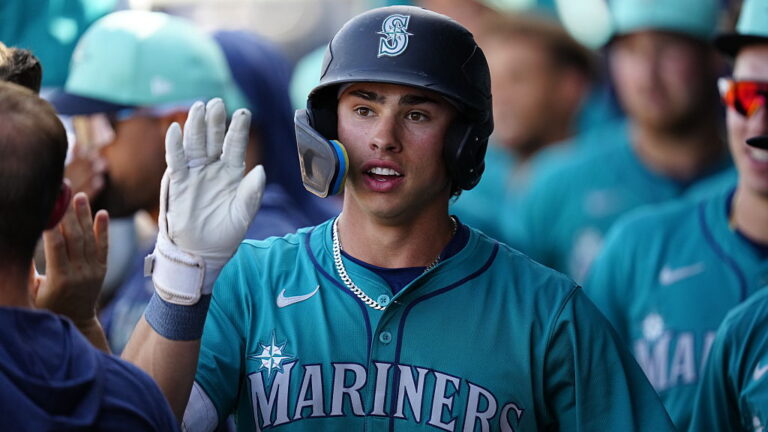
Jonny Farmelo, OF, Seattle Mariners
Scouting Notes
An intriguing blend of speed and power when drafted in the first round in 2023, Jonny Farmelo’s first two seasons of pro ball have been marred by injury.
The left-handed hitter employs a compact yet powerful swing, built off a small leg lift that allows him to sink into his backside before unleashing loft-oriented bat speed. That path has already shown results. In his limited pro debut, Farmelo posted a 36% ground-ball rate and a 20% HR/FB rate, signaling a swing built to lift and drive the ball.
Defensively, it’s been more of an adventure. Farmelo is still regaining his footing in the outfield after tearing his ACL in 2024, but at just 21 years old, there’s still time to recapture his pre-injury athleticism. When healthy, the bat carries real impact potential—he flashes plus raw power and, with his ability to elevate, could grow into a 25-homer threat.
The challenge lies in his contact skills. At High-A, Farmelo posted just a 64.5% contact rate with a 29.5% strikeout rate, a sharp contrast to the advanced approach he showed in Low-A as a 19-year-old when he ran a 16.3% walk rate.
His 2025 stint was marked by more chase and swing aggression, though some of that could be attributed to pressing after missing significant time with injury. The overall package still suggests a potent power bat, and if the athleticism returns alongside improved swing decisions, the upside remains considerable.
Shades of: Kerry Carpenter
Biggest Question
Farmelo’s contact concerns are the single biggest factor holding him back from emerging as a potential top-50 prospect in baseball. His power and loft-oriented swing give him middle-of-the-order upside, but his ability to make consistent contact will dictate how much of that ceiling is reachable.
The Arizona Fall League will present a tougher challenge than what he faced in High-A, with more advanced arms and sharper secondaries. How he handles those looks—especially left-on-left matchups—will be critical.
If the swing-and-miss issues persist, particularly against quality breaking stuff, Farmelo may begin to look more like a platoon option than an everyday cornerstone.
Fall League Outlook
Farmelo is a candidate to generate major helium out of the AFL, much like Josue Briceno did for the Tigers a year ago. The dry desert air rewards hitters with lift and carry, and Farmelo’s ability to elevate with authority should be on full display.
If the bat speed and raw power translate as expected, he could be among the more eye-catching offensive performers in the league. Just as importantly, if he flashes some of his pre-injury athleticism—both on the bases and in the outfield—it could restore confidence in his all-around profile.
Put it all together, and Farmelo has a real chance to push himself into top-50 prospect conversations by the end of the offseason.
PJ Morlando, OF, Miami Marlins
Scouting Notes
After suffering a freak injury doing deadlifts during a rain delay in 2024, PJ Morlando battled through additional setbacks in 2025 but still flashed the upside that made him a first-round pick.
Starting with the bat almost flat on his shoulder, Morlando uses minimal movement to tap into the double-plus raw power that has been his calling card since high school. His swing is flatter and line-drive oriented, giving him the ability to split gaps and even drive balls out of the yard on a line.
Right now, his game power plays below the raw due in part to a 52% ground-ball rate, but even modest improvements in lift could unlock massive production. The swing does leave him vulnerable to spin, reflected in his 27.4% strikeout rate, but he hedges those concerns with a patient approach, running a strong 17.8% walk rate at age 20. That kind of plate discipline at his age is a strong foundation to build on.
Morlando’s defensive home is likely a corner, meaning the bat will have to carry the profile. With his patience and sheer power potential, the pieces are in place for him to push quickly if he can stay healthy and make incremental adjustments to his bat path.
Shades of: Oneil Cruz
Biggest Question
Morlando projects as a three true outcome masher, but at present his inability to elevate puts a definitive cap on that ceiling.
His path is likely going to result in more ground balls than other steeper ones, but even a 5–7% reduction in his ground-ball rate could result in a significant uptick in slug. His slug numbers were pedestrian in his first full season of pro ball, but it is not for lack of raw juice.
Incremental improvements in elevation against better competition would be a massive feather in Morlando’s cap.
Fall League Outlook
Morlando has only played 59 games total in his professional career so in many ways this is still our first look at him. He will see a step up in competition from Low-A, but the ball will fly with his raw power. If he shows improved elevation with that patient approach, he will quickly become a name to watch.
Conclusion
The Arizona Fall League has a way of reshaping narratives in just six weeks. For Brailer Guerrero, it’s about contact; for Hagen Smith, command; for Daniel Espino, health; for Jonny Farmelo, contact versus advanced arms; and for PJ Morlando, elevation. Each has a chance to leave Arizona with their stock meaningfully higher than when they arrived.
This quintet represents five very different developmental paths, but they share one thing in common: the AFL could be the turning point that defines how the industry views them moving forward.
Written by