
2026 MLB Draft Deep Dive: Dee Kennedy
College baseball's newest superstar has taken the country by storm. How will his skillset translate to the professional game?
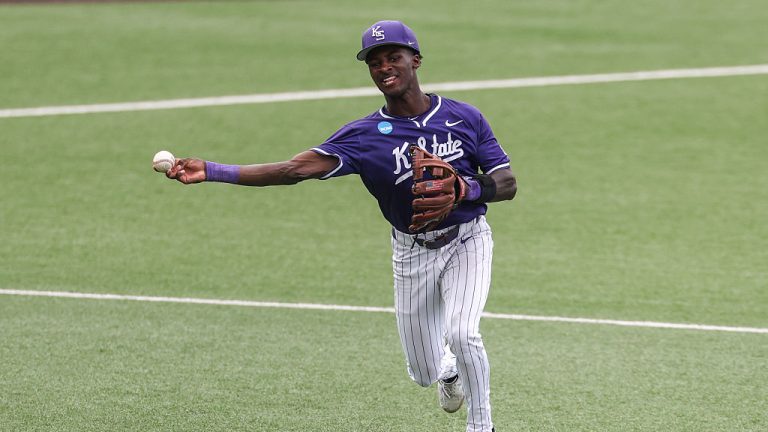
The Kansas State Wildcats’ baseball program has slowly turned heads under head coach Pete Hughes. They’ve clinched two consecutive NCAA Tournament berths and aim for the trifecta this spring.
Leading the charge this spring is their prolific junior shortstop, Dee Kennedy. A native of Fort Worth, Texas, Kennedy began his college career close to home at the University of Texas. He spent a year with the Longhorns before transferring to Kansas State for the 2025 campaign.
Fast forward two seasons, and Kennedy has quickly ascended into college baseball’s upper echelon. He’s become a serious contender for the Golden Spikes Award and is a potential early selection in the 2026 MLB Draft.
Dee is an athletic marvel, consistently boasting some of the loudest toolsets in the nation. He’s finally putting it all together, so it’s worth taking a closer look at his overall game to highlight what makes him so special.
Scouting Report
Dee Kennedy – SS – Kansas State Wildcats
Height/Weight: 5’11”, 185 | Bat/Throw: R/R | ETA: 2029
| HIT | Plate Disc. | GAME POWER | RUN | FIELD | FV |
| 30/40 | 35/55 | 30/50 | 60/55 | 50/60 | 40 |
Season Stats (All data current as of 5/1/2026)
| PA | wRC+ | HR | RBI | SB |
| 209 | 209 | 19 | 65 | 20 |
Offensive Profile
Kennedy’s signature skill at the dish is his ability to pick out pitches to his liking and do damage with them. He chases at just 15.0% of pitches out of the strike zone, while offering at 70.9% of pitches in the zone.
This lethal combination is one of the best in college baseball and is a primary reason for his success this season.
Paired with his elite swing decisions is impressive game power. Kennedy won’t wow you with scathing top-end exit velocities (109.2 MPH max EV), but his elite rotational athleticism allows him to make efficient use of what he does have in the tank. A 105.6 MPH 90th percentile EV proves this, ranking in the 86th percentile in Division 1.
A glaring red flag in Dee’s profile is his overall bat-to-ball ability. He currently runs just a 79.5 Z-Contact% (21st percentile), and while it hasn’t been an issue in college, scouts raise concerns about whether or not he’ll hit enough in pro ball to merit a premium draft selection.
The team drafting Kennedy will inherit the arduous task of flattening his attack angle, allowing him to live more in the 10-25° launch angle range rather than hitting so many balls above 25°.
Those who succeed with higher flyball percentages in the professional ranks usually boast higher-end exit velocities, which Dee lacks. He’ll have more success at the next level if he hits more line drives.
Even so, when Dee does make contact, it’s loud. His LD+FB Pull% ranks in the 98th percentile, showing how an elite feel for the barrel can help conceal fringy bat-to-ball issues and raw power outputs.
Athletic/Defensive Profile
Even if his offensive game has some holes, Dee’s twitchiness on the basepaths and feel for anchoring the six have always given him a fighting chance.
He was one of the fastest players in his high school class, running the 60-yard dash in an eye-watering 6.38 seconds. Kennedy’s speed has especially been apparent this year, where he’s swiped 20 bases in 45 games so far, a skill that should carry over to the next level and into his late 20s. Combined with his power, it’s entirely possible he becomes a 20/20 threat.
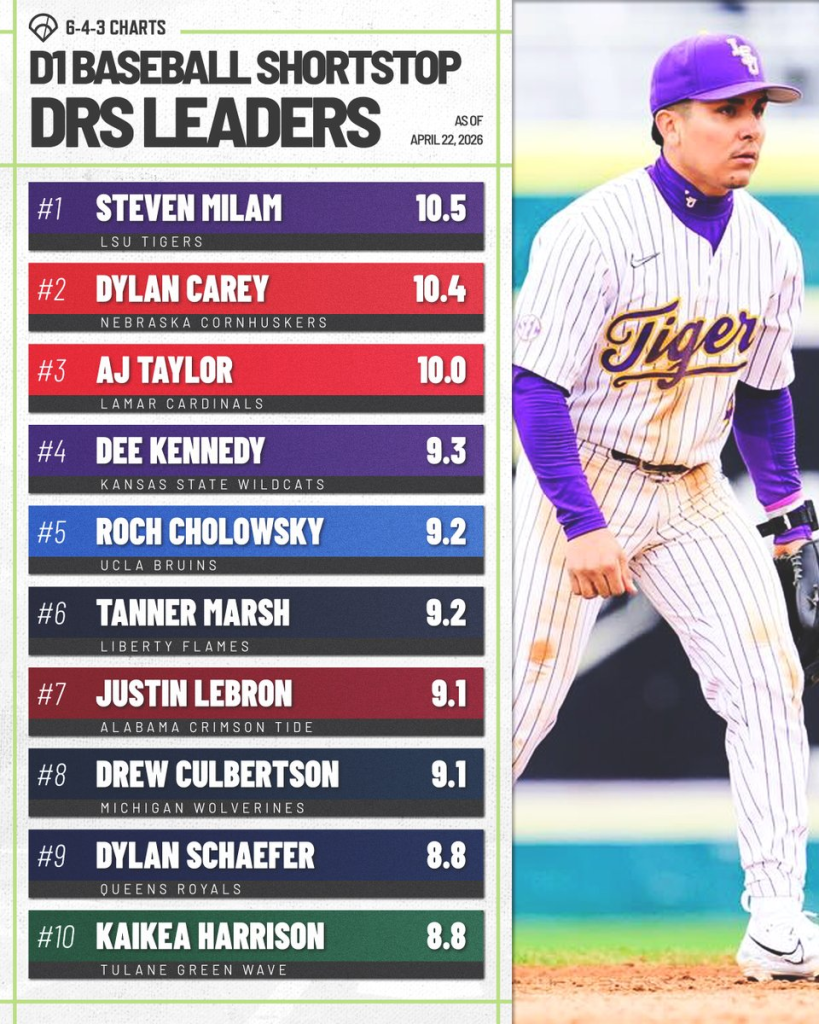
Kennedy’s glove work at shortstop has always been his calling card. He possesses above-average range and a solid arm that should keep him at the position through his 20s. According to 6-4-3 Charts, Dee’s 9.3 DRS ranks fourth amongst all Division 1 shortstops, ahead of Roch Cholowsky and Justin Lebron.
He’s playing third base in this video, but one can still get a sense of the premium instincts, range, and arm strength he offers from the left side of the infield.
Comparisons
When putting him side by side with some of his contemporaries, it’s clear why Kennedy is a 24-karat diamond buried in draft boards.
Top 2026 MLB Draft College Shortstop Prospects
| Player | wRC+ | 90thExitVel (MPH) | MxExitVel (MPH) | OPS vs 94+ MPH | OPS vs Spin | Quality Contact% | Chase% | IZ Contact% | LD+FB Pull% |
| Dee Kennedy | 209 | 105.6 | 109.2 | 1.760 | 1.179 | 28.3 | 15.0 | 79.5 | 67.9 |
| Roch Cholowsky | 180 | 108.1 | 112.1 | 0.748 | 1.079 | 18.6 | 19.0 | 89.1 | 53.1 |
| Justin Lebron | 122 | 106 | 110.5 | 0.651 | 0.943 | 19.7 | 21.0 | 78.5 | 52.4 |
| Eric Becker | 149 | 106.0 | 110.6 | 0.820 | 0.917 | 17.4 | 25.6 | 88.3 | 35.0 |
| Tyler Bell | 196 | 104.3 | 107.7 | 0.627 | 1.033 | 15.9 | 12.5 | 83.2 | 47.1 |
Cholowsky, Lebron, Becker, and Bell each merit first-round selections, with the former two being lottery locks. It’s fascinating to see Kennedy, who came into the season as a projected early-middle-round pick, outclassing his peers in many major categories while holding his own in others.
Justin Lebron and Tyler Bell each have contact rates similar to Dee’s, but their taller, more rectangular frames project for better future power outputs, providing them with more appealing, higher-end outcomes. Kennedy, on the other hand, is just 5-foot-11, and his raw power outputs are likely capped.
Dee’s feel for going pull-side in the air and swing decisions allow him to mash all pitch types better than most in his class, let alone amongst other shortstops. These, along with his elite defense, should bolster his profile early in his professional career while he works on making more contact.
MLB Comparisons
A big leaguer who profiles similarly to Kennedy is New York Yankees shortstop Anthony Volpe; both display elite swing decisions and defense amid average power and below-average contact rates. Dee is less trigger-happy than Volpe on two-strike counts, leading to a higher BB% at the collegiate level, though it’s unlikely this fully carries over in pro ball.
A star version of Kennedy could look something like a compact Geraldo Perdomo, where he’d show much-improved bat-to-ball skills, elite defense and plate discipline, and solid power. This is more of a 99th-percentile outcome, but it’s fun to dream about who Dee could become if he maximizes his potential.
Outlook
It’s difficult to find many other prospects who have bolstered their draft stock more than Kennedy this season. However, despite his surge into the early rounds, scouts will understandably point to his poor bat-to-ball ability as a roadblock from rising too far in the top 100.
Kennedy’s current 50th-percentile outcome is a 40 FV: a platoon-hitting, fifth-infielder on a championship-caliber team averaging 1-1.5 WAR each season throughout his first six years of team control. All things considered, he currently projects as a second-round or competitive balance round-B selection.
Teams placing him higher on their draft boards favor toolsy, athletic, up-the-middle talent with an outside chance to hit, hoping one of them actually does so. Teams that have him lower on their draft boards have a preference for more polished, well-rounded talent with less of a boom-or-bust profile.
Regardless of where he lands in the draft, that team’s hitting development will be challenged with gearing his swing for more contact. He’s either above-average to elite in every other department, so it will be intriguing to see how this plays out over the next few years.
Kennedy ranks as one of the more polarizing players in the 2026 class. The ingredients of a good everyday player, if not better, are all on the table. While he has a major uphill battle to climb, it wouldn’t be surprising to see him evolve into a star.
Become a Member of Just Baseball
Subscribe and upgrade to go ad-free!
* Save 25% by subscribing annually.

Written by
Adam Akbani is a writer and analyst from St. Louis, MO. He attended Washington University in St. Louis, double majoring in Economics & Strategy and Political…