
Milwaukee Brewers Top 15 Prospects
Already boasting one of MLB's best farm systems, the Freddy Peralta trade has put this system over the top to be the best in the game.
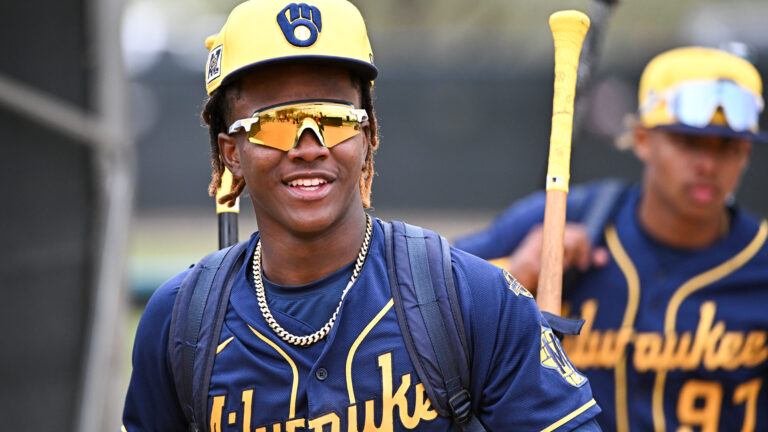
Baseball’s best farm system entering 2026, the Brewers are routinely loaded with talent across each level, headlined by two phenoms in Jesus Made and Luis Peña.
The depth of the system stands out in particular as well, boasting seven top 100 prospects at the start of the 2026 season with a dozen prospects of at least 45+ Future Value, safely the most of 30 teams.
There’s so much talent in the Brewers system that there are several 40 FV prospects who had to be left off the eight names to watch as well. With the high upside of several of the Brewers’ prospects outside of the top 10 as well, it’s safe to say that this system will be one of the game’s best for years to come.
1. Jesus Made – SS – (Double-A)
Height/Weight: 6’1″, 190 | Bat/Throw: S/R | IFA: $950K – 2024 (MIL) | ETA: 2027
| HIT | PLATE DISC. | GAME POWER | RUN | FIELD | FV |
| 45/60 | 45/55 | 45/60 | 55/55 | 35/50 | 60+ |
Made quickly made a name for himself with one of the best DSL showings in recent memory before following that up with a massive 2025 campaign where he climbed three levels, improving as the season progressed, finishing the year at Double-A not long after his 18th birthday.
The switch-hitting shortstop could be baseball’s next No. 1 overall prospect thanks to his ridiculously quick hands and feel for the barrel, paired with elite plate discipline and baseball instincts.
Offense
Starting slightly open and his feet a tad more than shoulder-width apart, Made sinks into his backside in tandem with a rhythmic barrel tip as he pulls his hands down towards his belt; the move is a little more pronounced from the left side.
He will likely need to clean up such a loud move, as it could be difficult to time and also puts him into a slot that is generally harder to launch from and limits his ability to elevate the ball as much as he should.
The fact that he is able to not only do plenty of damage from his launch position and consistently make contact is a testament to his freakish hands and athleticism in the box. He boasts a good feel to hit from both sides of the plate, but the left-handed bat-to-ball is particularly impressive. It’s rare bat speed from both sides of the plate, popping exit velocities north of 110 MPH from each side.
His 90th percentile exit velocity of 105 MPH is well above his peers and his improved ability to elevate in the second half of the season bodes well for his power outlook heading into 2026.
As he cleans up his operation in the box to be less dependent on raw talent and more conducive to repeating his moves and creating leverage, there should be plus game power in the tank.
With his quickness, barrel accuracy and plate discipline, the elusive plus hit and power combination could be attainable for Made.
Defense/Speed
Made has good defensive tools, boasting a plus arm, but his footwork and actions are a work in progress. Similar to how he operates in the box, it is natural athleticism over fundamentals at this point for Made, sometimes struggling with his first step and reading balls off of the bat.
He has a knack for the acrobatic play and is comfortable charging in and throwing on the run. He has a shot to stick at shortstop, but has the fallback of a quality third base or second base. An aggressive base stealer, Made swiped 47 bags on 60 tries in 2025.
Outlook
Made did everything you wanted to see to follow up an all-time DSL performance by settling into Low-A before dominating High-A and earning a Double-A cameo in a season where he was 17 years old at the start.
He started the 2026 season at Double-A with the focus on optimizing his mechanics and approach a bit further to reach closer to his sky-high ceiling.
Made’s plus hit and power potential have him looking like a potential star who could debut as a teenager. There’s a lot of similarities to Ketel Marte.
2. Luis Peña – SS – (High-A)
Height/Weight: 5’11″, 185 | Bat/Throw: R/R | IFA: $800K, 2024 (MIL) | ETA: 2028
| HIT | Plate Disc. | GAME POWER | RUN | FIELD | FV |
| 50/60 | 35/45 | 45/60 | 65/65 | 40/50 | 55+ |
An advanced offensive skillset with plus-plus wheels, Peña has the potential to be a dynamic middle infielder. He feasted on DSL competition in 2024, then hit the weight room hard heading into 2025, adding plenty of functional strength, which helped encourage the Brewers to have him skip the Arizona Complex League in tandem with Jesus Made and Peña did not miss a beat in Low-A.
He faded towards the end of the season at High-A, which should be far from a concern as he enters his age-19 season.
Hitting
Starting upright with his feet a little more than shoulder-width apart, Peña utilizes a medium-sized gather with his front leg as he pulls his hands back. He patterned his moves to be much more cohesive and fluid heading into the 2025 season, helping him engage his more powerful lower half more effectively, aiding an uptick in bat speed and overall impact. His exit velocities leapt from fringy in the DSL to elite for his age in Low-A in a matter of a single offseason.
As he improved his loading pattern, his contact ability has only benefited as well, making a seamless transition to Low-A, where his contact rate was comfortably above 80% through his first 30 games.
His entry point is steeper into the zone, but the bat speed is easily plus, making it more manageable. His average launch angle on hard-hit baseballs is still a bit lower than desired, but should improve as he finds more depth in his swing. Between the feel to hit and bat speed, there’s plus hit and above average power to dream on for what could be an electrifying offensive profile.
Peña tends to be overly aggressive, especially on breaking balls, something that held him back once he reached the High-A level towards the end of his age-18 season. The Brewers made it a point of emphasis for Peña during instructionals and Spring Training heading into the 2026 season and were encouraged by the results.
Defense/Speed
Peña is extremely quick on the base paths, comfortably turning in plus run times, but his lateral movement at shortstop leaves a bit to be desired. The arm is plus, which could accommodate a move to third base.
A menace on the base paths in the early going of his pro career, Peña only needed 55 pro games to reach 50 stolen bases, and it was more of the same between Low-A and High-A, stealing 44 bags on 51 tries.
Outlook
Though he’s still somewhat far off, Peña has a relatively polished game with the tools to potentially be an All-Star. The uptick in power to go with what could be a plus hit tool and plus wheels is a dynamic skill set that does not come around too often.
Even if Peña moves to third base or second base, his offensive ability should still make him a high-impact player who can make his mark in many ways.
Peña added even more strength heading into the 2026 season, with a focus on handling the workload that comes with a full campaign after fading some towards the end of what was by far the longest season of his life in 2025. If the added strength and improvements against spin translate, Peña could very well be one of the top overall prospects in baseball by the end of 2026.
3. Jett Williams – 2B/OF – (Triple-A)
Height/Weight: 5’8″, 180 | Bat/Throw: R/R | 1st Round (14) – 2022 (NYM) | ETA: 2026
| HIT | Plate Disc. | GAME POWER | RUN | FIELD | FV |
| 45/50 | 70/70 | 45/50 | 60/60 | 45/50 | 50+ |
Compact but explosive, Williams is a great athlete with more impact than his frame would suggest. His polish at the plate helped him fly through the minor leagues, reaching Double-A in his age-19 season in 2023, before having most of his 2024 wiped out by wrist surgery.
He returned to mashing at Double-A in 2025 before finishing the year in Triple-A. Williams was acquired alongside Brandon Sproat during the offseason in the deal that sent Freddy Peralta and Tobias Myers to the Mets.
Offense
A relaxed, narrow setup, Williams uses a decent-sized leg kick to gather into his back hip, but controls his lower half well. Despite his smaller frame, Williams is strong with a powerful lower-half, using the ground well to create power.
Between his lower-half control and minimal movement with his hand load, Williams is consistently on time and leverages his small strike zone well. One of the more patient hitters in Minor League Baseball, Williams has chased roughly 15% of pitches as a pro.
Producing average exit velocities, Williams consistently drives the ball in the air consistently with good carry to the pull side, giving him a solid chance to hit for average game power. There’s a decent amount of zone whiff, especially on elevated four-seamers that could create some challenges for Williams, but his approach helps hedge that concern.
Williams has the angles to out-slug his average exit velocities, but there’s some concern that the bat-to-ball may not be proficient enough to consistently get into it, especially with his tendency to expand more against sinkers than any other pitch type.
Defense/Speed
Williams has slowed down some since being drafted, putting on some weight ahead of the 2024 season. It’s more effective ability to get to his top speed than footwork at shortstop, which actually looked improved.
He works low to the ball with good hands and an above-average arm that is capable of making throws from different angles. While he can make the tough throws, he has the tendency to sail a few too many relatively routine throws, especially when he sits back on the ball.
With how quickly Williams has climbed through the minors and the presence of Francisco Lindor at the highest level, the Mets mixed in center field reps where he relies on his natural athleticism to get by, but has the closing speed and arm to get by out there.
With the Brewers’ unique infield situation, Williams is expected to see reps all over the diamond, including third base.
Williams projects best at second base, where he could be an above-average defender as opposed to the average-at-best defense he’d likely provide at shortstop or center field. He should consistently be a factor on the base paths, swiping 34 bags on 43 tries in 2025.
Outlook
2025 was an encouraging bounce-back season for Williams after losing most of 2024 to injury, but there is still a question as to where he will play long term defensively with an offensive profile that will likely be somewhat dependent on him launching 15+ homers from his 5-foot-7 frame.
His versatility is still an asset, which hedges some of the long-term positional concern, even if he is not particularly great at a singular spot.
The Brewers are bullish on their newly-acquired prospect, who could break into the big leagues in somewhat of a super-utility role. The versatility, speed, approach, and sneaky pop give Williams the foundation to be a big leaguer for a long time. The questions of how much power he can get into and how good the defense is at what spot make it difficult to project high-end WAR outputs.
4. Brandon Sproat – RHP – (MLB)
Height/Weight: 6’3″, 210 | Bat/Throw: R/R | 2nd Round (56) – NYM (2023) | ETA: 2025
| FASTBALL | CHANGEUP | CURVEBALL | Sweeper | Slider | COMMAND | FV |
| 50/50 | 60/60 | 50/50 | 50/55 | 40/45 | 40/45 | 50+ |
Drafted by the Mets twice (90th overall in 2022), it was dazzling stuff that made Sproat a first-round candidate as the 2023 draft approached; however, below-average command dropped him to the second round.
Sproat exploded in 2024, looking like one of the more exciting pitching prospects in baseball before his stuff and command regressed in Triple-A at the end of the 2024 season.
It was more of the same through the first half of 2025 before things clicked, earning four big league starts to close the year out, where he held his own. Following the season, Sproat was sent alongside Jett Williams in exchange for Freddy Peralta and Tobias Myers.
Arsenal
At his best, Sproat boasts three above-average offerings, with his changeup being plus. Sproat will utilize both a four-seamer and a two-seamer, with the former sitting a tick higher. Through the first half of 2025, Sproat averaged 96 MPH with his fastball, but that climbed to 97 MPH over his final 15 starts.
Given the roughly dead zone shape of his four seamer, the velocity is important, making the return back to the upper 90s important for his success. The four-seamer is more effective than the sinker, but his command of it is spotty.
The best pitch for Sproat is his changeup in the low 90s, averaging 16 inches of horizontal action and nearly zero inches of induced vertical break, giving it a late heaviness that facilitates high ground ball rates and plenty of whiff/chase at the bottom of the zone.
Sproat’s sweeper looked far improved in 2025, both from a command and shape perspective, giving him a swing and miss pitch for right-handed hitters as his shorter, harder slider lags behind.
Though the results with the pitch were not great in his pro debut, Sproat’s curveball flashes at least average and should be a decent pitch to mix in to both lefties and righties.
Outlook
With his stuff ticking back up in the second half of the 2025 season, Sproat regained much of his prospect shine and looked like a potential rotation piece for the Mets heading into 2026 before they shipped him out to Milwaukee for Freddy Peralta.
Though his control has improved as a pro, his execution can be inconsistent, making it more difficult to put hitters away at times while also leaving himself susceptible to more damage.
Sproat’s ability to get ground balls and mix six offerings gives him a back-end starter’s floor, but the below-average fastball shape and overall execution probably limit his ceiling, with the most likely outcome being a No. 4 starter. There is some optimism that the Brewers could unlock more out of the right-hander, pushing him closer to middle-rotation territory if it all clicks.
5. Luis Lara – OF – (Double-A)
Height/Weight: 5’8″, 170 | Bat/Throw: S/R | IFA: $1.1M, 2022 (MIL) | ETA: 2027
| HIT | Plate Disc. | GAME POWER | RUN | FIELD | FV |
| 55/60 | 55/55 | 30/35 | 60/60 | 60/70 | 50 |
A standout glove with good bat-to-ball skills from both sides of the plate, Lara offers a high-floor skill set that will almost assuredly see him fill a big league role. If he can maintain his strong bat-to-ball and find enough gaps, there’s potential for an everyday centerfielder.
Hitting
Deploying different setups from each side of the plate, Lara starts upright and slightly open from the left side with his hands rested just above the numbers before pulling his hands up and back in tandem with a gathering toe tap.
From the right side, Lara is more crouched with his hands higher and a more straight-forward stride.
Lara is more balanced from the left side, utilizing his lower half more effectively with an enhanced ability to handle secondaries. The average exit velocity from Lara was a tick harder from the left side as well in 2025, though the EV90s were identical.
Consistently posting above-average contact rates with good swing decisions, Lara will really make a pitcher work and is tough to strike out, exemplified by his 16% strikeout rate and 14% walk rate in a very difficult Double-A Southern League in 2025, in what was his age 20 season.
The main question becomes whether Lara can translate his ability to put bat on ball into sustainable production. His 5-foot-7, 170-pound frame makes it difficult to squeeze out more than 30 grade power, but he has done a good job of raising his quality of contact floor, adding strength to his lower half, which translated into an average exit velocity of 88 MPH in 2025.
To be an everyday bat at the highest level, Lara will likely need to sustain his strong contact rates and swing decisions as his margin for error is thin. With his added strength, Lara has flashed enough impact to work the gaps, and his switch-hitting profile only helps his case.
Defense/Speed
A plus runner with elite instincts and a plus arm, there’s no question about Lara’s defensive value.
An easy plus defender, those within the Brewers organization will tell you they expect him to win Gold Gloves at the highest level. Lara has improved his ability to leverage his wheels, turning in his most efficient year as a base stealer in 2025, swiping 44 bags on 51 tries.
Outlook
Lara’s glove, contact skills as a switch hitter and speed give him a very high likelihood of at least landing as a fourth outfielder. He has been aggressively pushed by the Brewers, skipping the Complex League in 2023 while consistently being at least three years younger than the competition at each stop.
Even if things stall out offensively, 1.5-2 WAR is very feasible for Lara, following the path of a Kyle Isbel or Victor Scott II. With the ability to avoid left-on-left matchups and the fact that Lara is far ahead of where the aforementioned two were entering their age-21 seasons, Lara offers some more upside.
6. Jeferson Quero – C – (Triple-A)
Height/Weight: 6’0″, 210 | Bat/Throw: R/R | IFA: $200K, 2019 (MIL) | ETA: 2026
| HIT | Plate Disc. | GAME POWER | RUN | FIELD | FV |
| 50/55 | 40/40 | 45/50 | 45/45 | 55/60 | 50 |
An impressive defensive catcher with intriguing offensive tools, Quero’s success in both facets of the game at Double-A as a 20-year-old solidified him as one of the best catching prospects in the game. A torn right labrum in the first game of the 2024 season wiped out his entire year and he got a late start in 2025 due to a hamstring issue.
The residual effects of the shoulder injury are concerning. His once elite arm looked like a shell of itself when he returned and his power at the plate looked diminished until the latter third of the season.
Hitting
Using a rhythmic leg kick that precedes a short, flat swing, Quero repeats his moves well and produces a ton of line drives. Quero is an aggressive hitter, but drives the ball to all fields well and is able to get to pitches in difficult locations.
Like many young hitters with a solid feel to hit, Quero can give away at-bats by taking “B-swings” at pitchers’ pitches early in counts. He has chipped away at his high swing rate somewhat at the highest level, but will seemingly always be an aggressive hitter.
His ability to recognize spin is actually solid, showcasing the ability to lay off of secondaries as counts get deeper. Possessing a good feel for the barrel, Quero makes plenty of contact and projects as above average bat to ball wise.
Quero produced strong exit velocities in 2023, flashing plus raw pop that he started to tap into more consistently. In the first half of 2025, Quero’s exit velocities were clearly compromised by injury, but he started to flash above-average pop again down the stretch.
If Quero can continue to refine his approach and continue to regain his strength, the further he is removed from surgery, he could develop into a quality blend of hit and power.
Defense/Speed
Viewed as a glove-first catcher because of his athleticism and maturity/energy behind the dish, Quero earns high marks for the way he commands games and works with pitchers. Quero blocks and receives well while boasting a plus arm prior to his injury. He gets the ball out quickly, throwing out 35% of attempted base stealers in 2023.
His arm strength was a shell of what it once was in 2025, resulting in a CS% that was cut in half, but the Brewers are cautiously optimistic that he will make up some ground the further removed he is from such a serious shoulder injury.
His defensive skillset, paired with the intangibles, has Quero looking like a potential plus defender even if he can claw back just some of the once elite arm strength.
Outlook
Quero has lost roughly a season and a half since the start of the 2024 season, yet he will get his second significant taste of Triple-A at 23 years old in 2025. He has the skill set to be above average on both sides of the ball, with the two biggest variables being his arm strength and approach.
Quero’s encouraging finish to the 2025 season and solid showing in winter ball give him some momentum heading into 2026 as he looks to regain his status as one of the most well-rounded catcher prospects in the Minor Leagues.
7. Logan Henderson – RHP – (MLB)
Height/Weight: 6’0″, 210 | Bat/Throw: R/R | 4th Round (116), 2022 (MIL) | ETA: 2025
| FASTBALL | Slider | Cutter | CHANGEUP | COMMAND | FV |
| 65/65 | 40/45 | 45/50 | 55/60 | 55/55 | 50 |
An outlier fastball and improved command helped Henderson dominate at the Triple-A level to start the 2025 season before carrying it into big league success. His heavy fastball usage makes him more of a five-and-dive type at this point, but he has overwhelmed hitters in that role.
Arsenal
Henderson’s fastball averages just 93 MPH but stands out as a plus or better pitch due to its elite run and ride from a 5.2-foot release height. With such a flat approach angle, hitters consistently miss under his fastball, which generates plus whiff numbers within the zone and elite chase figures at the top.
His changeup features 19 inches of total separation from his fastball, playing up with the way it tunnels off of a fastball that hitters feel like they need to swing down to in order to get on top of it. His feel for the changeup has really improved in 2025, landing it for a strike at roughly a 65% clip.
Henderson does not have as much success spinning the baseball with an upper 80s cutter that of his slider that lacks teeth. He will go to both around 8-10% of the time, with the cutter performing best against lefties.
Outlook
The Brewers’ litany of controllable arms has resulted in Henderson bumping up and down between Triple-A and the Major Leagues, but in his limited MLB action, it has been clear that his unique fastball can play like a plus pitch at the highest level.
With the changeup working off of it and above-average command, Henderson looks the part of a quality No. 4 starter who may need to be shielded from the third time through the order on days where the cutter and slider aren’t there. If one of the two offerings can even be consistently average, Henderson could reach towards middle-rotation upside.
8. Cooper Pratt – SS – (Triple-A)
Height/Weight: 6’4″, 210 | Bat/Throw: R/R | 6th Round (182) – 2023 (MIL) | ETA: 2027
| HIT | Plate Disc | GAME POWER | RUN | FIELD | FV |
| 45/55 | 40/45 | 30/40 | 55/55 | 50/55 | 45+ |
Projectable with good contact skills and a chance to stick at shortstop, the Brewers snagged Pratt in the sixth round, shelling out an over-slot $1.35 million to sign him away from Ole Miss.
Pratt’s well-rounded game has stood out immediately, encouraging the Brewers to push him relatively quickly through the Minor Leagues. His skill set makes him a high probability big leaguer, but how much power he can ultimately tap into will determine in what capacity that is.
Offense
A simple setup with a short, direct swing, Pratt boasts strong bat-to-ball skills, especially for a hitter of his longer frame. Pratt’s path is more geared for line drives; that said, he is comfortable catching the ball deep and can drive the ball to all fields with a hovering stride that he starts early as he pulls his hands back.
With two strikes, he will get more into his base, cutting his stride down to a simple heel lift.
His early, rhythmic move paired with a simplified two-strike approach allows him to be on time with consistency, producing above-average contact rates and a strikeout rate of just 15% in Double-A in 2025.
Pratt leaves a bit to be desired bat speed-wise at this stage, limiting his power output and resulting in some challenges against velocity. His 90th percentile exit velocity of just 101 MPH in 2025 is below average, as is his max air exit velocity of 106.5 MPH.
Pratt has flashed some sneaky power to the pull side, but is presently below average in that department, placing more pressure on the hit tool.
While he’s an above-average hitter, he will likely need to tap into at least average power to carry an above-average offensive profile. The good news is, Pratt has room within his frame to add more strength and he is in the right organization to do so.
The swing decisions improved as the season progressed in the Southern League for Pratt, which will be important to maximize if the power side of things stalls. It’s clear Pratt is going to provide competitive at-bats and put the ball in play, making his offensive upside enticing if he can just tap into average power.
Defense/Speed
For as long of a frame as Pratt carries, he moves his feet well with good actions and a strong arm. Much like the offensive side of his game, Pratt is polished with advanced instincts that give him an everyday shortstop’s outlook with the glove.
An above-average runner, Pratt flexes his baseball IQ on the base paths as well, picking his spots to swipe bags at a high efficiency, going 62 for 70 through his first 228 games.
Outlook
Pratt is a player where the sum of his parts is what makes him valuable. His feel to hit, likelihood of sticking on the left side of the infield and baseball instincts give him a solid floor, but to project as an above-average shortstop, he will likely need to tap into more power or at least handle velocity a bit better.
Pratt is a high-floor shortstop who will spend the majority of his age-21 season at Triple-A, making it possible that Pratt may realize his power potential even a couple of years into his MLB career. Regardless, there’s a very high probability that he fills a big league role, the impact he can generate will determine in what capacity.
9. Andrew Fischer – 3B – (High-A)
Height/Weight: 6’1″, 200 | Bat/Throw: L/R | 1st Round (20), 2025 (MIL) | ETA: 2028
| HIT | Plate Disc. | GAME POWER | RUN | FIELD | FV |
| 35/45 | 45/55 | 45/60 | 40/40 | 40/45 | 45+ |
Despite bouncing from Duke to Ole Miss and then finally Tennessee in his three collegiate seasons, Fischer raked at every stop, particularly flexing his muscles in the SEC, hitting a combined 45 homers in his final two seasons. It’s a bat-driven profile, but there’s a lot to like offensively.
Hitting
Starting wide and crouched, Fischer loads by shifting his weight towards his back hip with a simple toe tap and minimal hand movement. Fischer leverages his lower-half mobility well by starting close to his launch position and minimizing variables. He controls his weight shift effectively, allowing for consistently strong angles, which, paired with plus bat speed, give him plus pop to dream on.
Given the lofty nature of his swing, there’s some zone-miss in the upper third, but Fischer hedges that with good plate discipline and efficient mechanics. Air pull comes easy to Fischer, even against premium velocity, which he showed in big league spring training when he turned a 102 MPH fastball from Mason Miller around through the right-center gap.
Fischer registered plenty of 75+ MPH swings between big league Spring Training and the WBC, eclipsing 80 MPH on multiple occasions in the small sample.
Even if the hit tool lands in the fringy territory, Fischer’s swing is optimized for high slug on contact, and his approach only helps his case.
It’s easy to see plus game power potential with the continued development in the swing decisions department, likely playing a key role in pushing towards his ceiling.
Defense/Speed
Not necessarily the fleetest of foot when it comes to straight line speed, Fischer moves his feet well enough to stick at the hot corner with soft hands and a plus arm. He’s unlikely to be more than average at third base, but Fischer appears capable of fending off a move over to first base off.
Outlook
There’s plus power to dream on with what looks like a good enough feel to hit to get into it. Assuming more whiff does not creep in at the upper levels, there’s a Kyle Manzardo type of offensive upside.
While there’s a chance Fischer could lose a step at third base, he looks capable of getting by there, which helps his overall outlook. That said, to be an above-average regular, Fischer will likely need to reach close to that plus power upside.
10. Bishop Letson – RHP – (Double-A)
Height/Weight: 6’3″, 190 | Bat/Throw: R/R | 11th Round (332), 2023 (MIL) | ETA: 2027
| FASTBALL | sweeper | Cutter | CHANGEUP | COMMAND | FV |
| 55/60 | 60/65 | 40/50 | 35/45 | 45/55 | 45+ |
Minor injuries have slowed Letson some, but when he has been on the mound, he has flashed exciting stuff with room for more.
Arsenal
A lanky right-hander who works down the mound exceptionally well, Letson averages 7.5 feet of extension from a below-average release height. The release characteristics allow Letson’s stuff to play up, with his 93-95 MPH fastball getting on hitters quickly with more perceived run and ride. He will also throw a sinker predominantly to righties that is a tick slower.
Letson’s best pitch is a wipeout sweeper in the low 80s. It averages north of 16 inches of horizontal break with around -5 inches of vertical break as well. With more vertical action than the typical sweeper from a unique release that makes it a dominant pitch to hitters from both sides of the plate. Opponents posted an OPS hardly above .500 against it in 2025.
The third pitch is a work in progress for Letson, but he has a couple of irons in the fire. The cutter at 89-91 MPH came along as the season progressed, increasing the usage to lefties in particular. He’s still learning to command it more consistently from a shape and location perspective, but it could play as a very effective bridge pitch with more consistency.
The 85-87 MPH changeup is a distant fourth pitch at this point, flashing good arm side action, but it can tend to get firm on him with inconsistent results.
Outlook
Letson shares some similarities with Jacob Misiorowski when it comes to the unique duality of low-release, high extension release characteristics. Of course, Misiorowski is in a league of his own, but the components of Letson’s delivery help his already quality stuff play up.
If Letson can stay healthy, there’s room for more velocity, which, paired with his elite extension, should create a wipeout fastball/sweeper combination.
Based on his two-pitch foundation, Letson has the floor of a big league reliever, but he looks like he has at least average command. The two main variables will be health and the development of his cutter and/or changeup.
Still 21 years old for the entirety of 2026, Letson will look to build his workload up to prove he can stick as a starter in the pitcher-friendly Double-A Southern League. Letson has as much upside as any pitching prospect in the Brewers system if he can put it all together.
11. Blake Burke – 1B – (Double-A)
Height/Weight: 6’3″, 200 | Bat/Throw: L/L | 1st Round (34), 2024 (MIL) | ETA: 2027
| HIT | Plate Disc. | GAME POWER | RUN | FIELD | FV |
| 35/40 | 40/45 | 50/65 | 30/30 | 40/50 | 45+ |
A big power bat who can hammer the ball to all fields, Burke has enjoyed plenty of helium within the Brewers organization dating back to the end of the 2025 season.
After a fine start at High-A, Burke was promoted to the pitcher-friendly Southern League and kicked things into a completely different gear. He hit just five home runs in 95 games with High-A Wisconsin before launching 11 homers in just 37 games with Double-A Biloxi.
The positive trend continued into Spring Training, showing up in better shape and earning rave reviews from Brewers staff about how he was going about his business and his improved mobility at first base. He has legitimate 70-grade raw power, popping a max exit velocity of 117 MPH in 2025 with a 90th percentile exit velocity of 108 MPH.
Burke can get a bit aggressive, but he recognizes spin well and typically seems to get more overzealous against heaters. The batted ball angles have improved as he has settled into pro ball as well, elevating more consistently to leverage his big raw power.
There will be some whiff there, placing importance on the swing decisions continuing to improve. Probably a better defender at first base than he gets credit for, Burke could be average at the position, with soft hands and enough range.
12. Marco Dinges – C – (High-A)
Height/Weight: 5’11″, 190 | Bat/Throw: R/R | 4th Round (123), 2024 (MIL) | ETA: 2027
| HIT | Plate Disc | GAME POWER | RUN | FIELD | FV |
| 35/45 | 45/55 | 45/60 | 40/40 | 30/40 | 45+ |
A work in progress, Dinges offers exciting tools and a lot to dream on. He flew a bit under the radar as a fourth-rounder in 2024 after transferring from Tallahassee Community College to Florida State for his draft year.
His elite bat speed stands out, exceeding 80 MPH often and averaging just above 76 MPH. His average exit velocity was north of 91 MPH in 2025 with a Hard Hit rate right around 50%, making it easy to dream on plus game power as he learns to pull the ball in the air more consistently.
Dinges made some mechanical adjustments, opening up his stance and quieting down his pre-swing movement, to give himself more space and make it easier to catch the ball further out front consistently.
Though he is likely an average hitter at best, there’s good enough contact skills to get into his exciting power potential and keep the strikeout rate at a reasonable figure as he did in his first pro season.
The big variable will be Dinges’ defense at catcher. He DH’d for the entire 2024 season at Florida State and was limited to only 77 games (47 at catcher) in 2025 due to a hamstring issue.
He is a good athlete behind the dish with a plus arm, but the mechanics are rough both from a blocking and transfer perspective. Given his arm strength and athleticism, it is worth being patient with Dinges, who could ultimately progress with more reps.
With his plus power potential, Dinges could still provide value even if his primary position is not at catcher, but if he can progress defensively, there’s potential for a bat-driven primary catcher.
13. Luke Adams – 1B – (Triple-A)
Height/Weight: 6’4″, 225 | Bat/Throw: R/R | 6th Round (182) – 2023 (MIL) | ETA: 2027
| HIT | Plate Disc | GAME POWER | RUN | FIELD | FV |
| 45/45 | 50/55 | 50/55 | 45/45 | 40/50 | 45 |
A big-bodied corner infielder with an unorthodox swing, Adams has produced at each stop, reaching Triple-A with a career 144 wRC+ across his first three professional seasons. Adams generally posts closer to average exit velocities, but he has a knack for pulling the ball in the air at a ridiculously high clip (40% in 2024 and 2025 combined).
Adams has walked at a 17% clip as a pro, pushing beyond patience and looking passive at times, with a swing rate in the low 30% range. It sounds silly, but being hit by pitches is likely going to be a part of his game as well, given the way he crowds the plate and does not shy away from wearing a pitch.
Through his first three pro seasons, Adams was hit by a pitch 87 times. The combination of free passes and hit by pitches have helped Adams get on base at a .420 clip as a pro.
Adams offers above-average power potential with his batted ball angles and strength, even if the average exit velocity is a bit below what his frame may suggest. He is a savvy base runner who can ride fringy speed to 10-15 bags per year and profiles as a solid defender at first base and could hide at third base in a pinch.
The contact rate has consistently hovered at 78% as a pro, which paired with his above-average power potential and on-base skills, could make him an average regular at first base. He will likely need to be more aggressive inside of the zone at the big league level. Adams projects as a second division regular at first base with a little more to dream on.
14. Josh Adamczewski – 2B/OF – (High-A)
Height/Weight: 5’11″, 180 | Bat/Throw: L/R | 15th Round (452), 2023 (MIL) | ETA: 2028
| HIT | Plate Disc. | GAME POWER | RUN | FIELD | FV |
| 40/50 | 50/60 | 40/50 | 50/50 | 30/40 | 45 |
A favorite within the Brewers org, Adamczewski has really impressed the organization with his hitting ability when on the field, but he has struggled to stay on it. Rather than soft-tissue, the injuries are mostly fluke-natured and not something the team is worried about long-term.
He has a sweet swing from the left side with a smooth operation and a solid quality of contact floor thanks to his ability to find the barrel. Adamczewski hammers velocity while struggling against secondaries in the early going of his pro career, but he should improve with more reps, given his repeatable mechanics and pitch recognition skills.
There’s potential for average hit and power seasoned with above-average plate discipline, which should make him a strong No. 7 hitter type in a solid lineup. Adamczewski’s defensive landing spot is the bigger question, seeing action at both second base and left field, where his below-average arm best fits. The latter may ultimately be his landing spot, where his average speed can help him get by.
It’s a bat-first profile for Adamczewski, but there’s enough offensive upside to be an average regular in left if he can develop closer to an average defender as he gains more reps.
15. Tyson Hardin – RHP – (Double-A)
Height/Weight: 6’2″, 185 | Bat/Throw: R/R | 12th Round (365), MIL (2024) | ETA: 2027
| FASTBALL | Cutter | Sweeper | Changeup | COMMAND | FV |
| 50/55 | 50/55 | 50/55 | 30/40 | 40/50 | 40+ |
Hardin fits the bill of a pitching prospect who immediately flipped the script on himself professionally. A 12th-rounder out of Mississippi State after transferring from Daytona State College, Hardin really struggled in his junior season before turning in a much better senior year, where he really struggled with his command.
In his first full pro season in 2025, Hardin really impressed, dominating in his 11 starts at High-A and continuing to throw well in his final 10 starts at Double-A. The most clear shift was his control, striking out 96 against just 17 walks in 96 IP. For comparison, Hardin walked 23 batters in 36 1/3 innings of work in his walk year at Mississippi State.
Hardin’s very low release (5.1 feet) helps give him a unique look for hitters. His four-seam fastball and cutterish slider. His shapes can be inconsistent, especially with the secondaries, but when he is commanding his breaking balls, both his cutter and sweeper look like above-average pitches.
Lefties fare much better against Hardin as his reliance on a cutter and sweeper does not give him much of an equalizer against opposite-handed hitters, though it helps that lefties still seem to struggle to barrel his heater.
With such vast improvement in his first professional season, there’s room for Hardin to continue to make gains, but for now, he projects as a borderline No. 5 starter or swingman. His ability to neutralize righties gives him the floor of a middle-reliever who could handle bulk-duty.
Eight Names to Watch
Eric Bitonti – 1B – (High-A): A big left-handed hitter with huge power potential, Bitonti mashed his way off of the complex and impressed in his month at Low-A to close out the 2024 season. His follow-up at Low-A in 2025 left a bit to be desired, hitting 19 homers in 119 games, but striking out 34% of the time. Bitonti boasts plus bat speed with a swing geared for loft, giving him sky-high power upside, though he will need to take a big step forward in the contact department.
Tyler Black – 1B/OF – (MLB): A former top 100 prospect, Black offers good on-base skills and plus speed. Injuries and a lack of runway at the highest level have caused black to stall out some, but he still looks the part of a big league contributor in some fashion. What exactly that looks like is a question, though, because his lack of defensive value as he looks more like a first baseman or fringy outfielder. Black’s power output will likely dictate whether he can carve out a more regular role. He’s capable of hitting 12-15 homers per year, but he hit just five in 76 games in 2025.
Brady Ebel – SS – (Low-A): A Comp A selection in the 2025 draft, Ebel earns rave reviews for his makeup and approach to the game as a teenager. Ebel grew up around a big league clubhouse as his father, Dino, has worked in professional baseball for 30 years and currently serves as the Los Angeles Dodgers’ third base coach. His game is still raw, but there’s intriguing ingredients as a hit-over-power prospect who has added strength since being drafted. He has a rocket for an arm that should give him a good chance of sticking on the left side of the infield.
Diego Frontado – SS – (DSL): The top IFA target by the Brewers in the 2025 class, Frontado is an advanced hitter for his age with plus speed and a projectable frame. His quick hands stand out with the tools to potentially stick on the left side of the infield. Frontado signed for $1.6 million and will make his pro debut in the Dominican Summer League with the hope that he can be yet another impressive international free agent pick-up by the Brewers.
Josh Knoth – RHP – (Low-A): A Comp-A pick by the Brewers in 2023, Knoth impressed with swing and miss stuff in his pro debut, striking out 96 batters in 84 1/3 innings pitched at Low-A. His follow-up campaign was put on ice due to Tommy John surgery prior to the 2025 season, which will eat into some of his 2026 as well.
When healthy, Knoth showcased a cut-ride fastball and a pair of breaking balls that hover north of 3,000 RPM. His cutter and slider can morph at times, but there’s a chance for an intriguing three-pitch mix if Knoth can repeat his release point more consistently upon his return to the mound, given his natural ability to spin it and miss bats with his fastball.
Braylon Payne – OF – (High-A): Huge tools standout for the 2024 first-rounder, boasting double-plus speed and plus raw power. Payne struggled badly with whiff, adjusting his setup to be more vertical and yielding better results down the stretch of the season before a concussion stifled his momentum.
Though the average exit velocity was just 87.5 MPH, Payne popped a handful of 110s off of the bat in his age 18 season with a max of 112.5 MPH. If he can leverage his elite wheels to develop into an above-average defender in center field, it will take some pressure off of the bat and push his exciting ceiling higher. For now, Payne is an intriguing project.
J.D. Thompson – LHP – (Low-A): A second-round pick in 2025, nothing jumps off of the page with Thompson, but he fits the criteria of a high-floor arm. Thompson is an athletic southpaw who fills up the zone with underlying characteristics that allow for his stuff to play up. His low 90s fastball boasts above-average carry that allows it to miss bats in the upper half of the zone, setting up his trio of average secondaries to play up a bit.
His changeup is the best of his secondaries, with his mid 80s slider not too far behind and the upper-70s curveball looking more like a taste-breaker. Thompson could move quickly through the minor leagues with a good chance of at least landing as a depth arm. That said, there’s enough ingredients to envision a back-end starter.
Brock Wilken – 3B – (Triple-A): A first-round pick in 2023, Wilken has had tough injury luck in his career, which has caused some detours in his development. After a disappointing Double-A campaign in 2024, Wilken torched the level out of the gate in 2025, turning in a .952 OPS through his first 65 games of the season before suffering a dislocated kneecap.
Wilken’s ability to pull the ball in the air at a very plus clip gives him above-average power upside and his improved selectivity at the plate (17% chase) helped in large part with his 2025 leap. He’s a capable defender at third base with a plus arm, projecting as a second-division regular who can lean on the three-true outcomes.

Written by
Aram Leighton is the Co-Founder and Executive Editor for Just Baseball. A Syracuse University grad, Aram is one of the hosts of the Just Baseball Show…