
The Orioles Have Turned Taylor Ward Into a Brand-New Hitter
Since arriving in Baltimore, Taylor Ward has become a completely new hitter. What has changed for the Orioles outfielder?
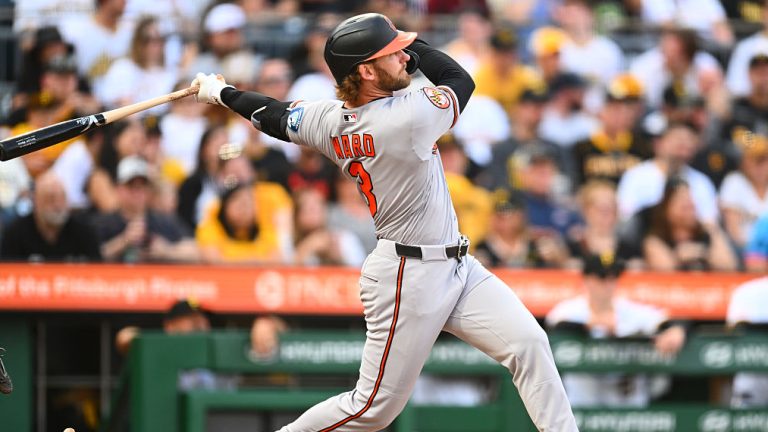
The Baltimore Orioles have not gotten off to the start they envisioned. They sit at 20-24 and nine games behind the Tampa Bay Rays in the American League East.
A big reason for that has been the lack of production from the lineup. Baltimore ranks 25th in batting average and 21st in on-base percentage. Pair that with a starting rotation that ranks 28th in ERA, and it explains why the Orioles are in this spot.
However, one player who’s not responsible for their lack of production is Taylor Ward.
The Orioles acquired Ward in a shocking trade with the Los Angeles Angels that sent Grayson Rodriguez out west. Over the past two seasons, Ward built a reputation as a power hitter who tried to lift everything in the air.
But since arriving in Baltimore, Ward has become a completely different hitter. The biggest sign of that is his power drop-off. After hitting 36 home runs last season, Ward has just one through the first quarter of this year.
Still, it is not because Ward has fallen off. He has simply changed his approach and become a hitter focused on getting on base.
Stats were taken prior to play on May 14.
How Taylor Ward Has Changed as a Hitter
Comparing the Taylor Ward of 2025 to 2026 reveals a stark difference. Ward went from an average launch angle of 18 degrees to just 11.7 this season.
He has transformed his swing and approach into one that is far more pesky for opposing pitchers. Last season, Ward had more holes in his swing, and pitchers took advantage. He posted an out-of-zone swing rate of 20.6%.
This season, though, Ward has shown much better discipline at the plate. His out-of-zone swing rate has dropped nearly 10 percentage points to 10.9%. In fact, that’s the lowest chase rate in all of baseball, and by a wide margin. Overall, Ward is seeing more pitches per at-bat.
Last season with the Angels, Ward averaged 4.19 pitches per plate appearance. This year, Ward not only leads the Orioles with 4.55 pitches per plate appearance, but he also leads all players in Major League Baseball.
The Orioles as a team see the second-most pitches per plate appearance in baseball at 4.00. Only the Cleveland Guardians rank ahead of them at 4.08. Because of that, it is fair to believe Baltimore played a major role in Ward’s new approach.
To add even more perspective, Ward ranks in the 100th percentile in walk rate at 21.5%. The pace the 32-year-old is on has been remarkable. Ward has already drawn 42 walks this season, which, to no surprise, leads MLB.
In Orioles history, only two players have drawn more walks through the team’s first 43 games: Albert Belle had 43 in 1999, while Randy Milligan had 44 in 1990.
Ward has led off the majority of games this season for the Orioles. Although Baltimore has struggled to create offense at times, it has not been because Ward failed to get on base.
A valuable part of any leadoff hitter is working counts early in games. It helps the hitters behind him get a better look at the opposing pitcher. Ward has taken that to another level.
Of all the strikes Ward has seen this season, 47% have come looking. The next closest hitter is Steven Kwan at 41.8%.
This is to show just how selective Ward has become at the plate. He is laying off pitches in the strike zone that are outside of his hot zones. That also explains why his swing percentage has dropped almost nine percentage points to 28.9%.
As a result, when Ward does strike out, he often goes down looking. His called strikeout rate sits at 61.8%, the highest mark in baseball.
Comparing this version of Ward to last season reveals a dramatic shift. Last year, he chased more often and swung early with power in mind. Now, Ward looks more focused on wearing pitchers down, getting on base, and starting rallies rather than driving runners in himself.
The Orioles also have plenty of offensive talent behind him in the lineup, even with several key injuries. A group featuring Gunnar Henderson, Pete Alonso, Adley Rutschman, and Samuel Basallo is difficult for any pitcher to navigate.
Having Ward constantly on base only makes that challenge tougher.
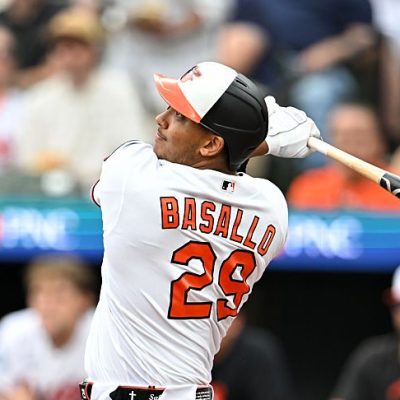
Still, the Orioles probably expected more when they traded Grayson Rodriguez for him. Ward is not a strong defender, so Baltimore likely envisioned more power production alongside the elite on-base skills.
That does not mean Ward needs to abandon his new approach and start swinging for the fences again. Instead, he may need to learn when to attack pitchers more aggressively in certain spots.
After all, Baltimore’s offense ranks near the bottom in several key categories, as mentioned earlier. Yet, when using WAR as the primary metric to measure a player’s value, Ward has still produced at a high level. He has already posted a 1.2 bWAR this season, nearly halfway to his 2.7 total from last year.
Baseball is always a game of adjustments. Even at 32 years old, Ward may still be evolving into the best version of himself.
Become a Member of Just Baseball
Subscribe and upgrade to go ad-free!
* Save 25% by subscribing annually.

Written by
Thomas Kelson is an intern at Just Baseball and a graduating senior at Rutgers University, where he studied Journalism and Media Studies with a specialization in…