
What Happened To the Jakob Marsee We Know and Love?
After bursting onto the scene in 2025, Jakob Marsee has failed to replicate the same success so far this season. What's changed?
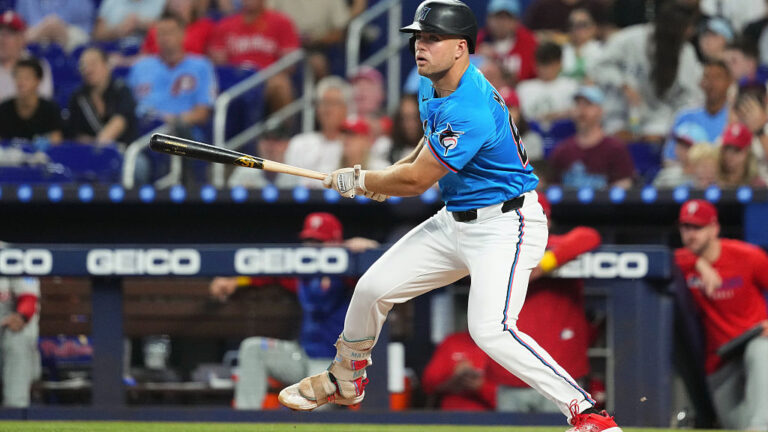
It was just one year ago that the Miami Marlins thought they had found their center fielder of the future. Well, unfortunately for the Marlins right now, Jakob Marsee just has not been able to replicate the success he had last season.
For someone who was identified as not just the future at the position, but the prototypical leadoff hitter for a team, this one hurts just a bit more than usual.
It was not even a year ago when I wrote an article on how I believed that Marsee was the real deal. Flash forward to May of 2026, and here we are wondering where that player has gone.
As we sit here today, Marsee is currently hitting .175 with only one home run, a .254 slugging percentage, an OPS+ of 59, and just 0.1 fWAR.
Yikes.
Especially when you consider how much of a discrepancy there is between that and the .292/.363/.478 slash line from last season to go along with his 2.1 fWAR, five home runs, 21 extra-base hits, and 133 wRC+.
Oh, and it was done in just 55 games.
The 24-year-old has seemed to revert a bit to the version of himself that prompted the struggles at the plate as he was coming up through the minor leagues.
All stats were taken prior to play on May 3.
What’s Changed?
Marsee was called up last season on August 1 after going on a torrid stretch in Triple-A Jacksonville. In the 46 games played before his promotion, he had hit .289 with 11 home runs, 14 stolen bases, and a .977 OPS in just 46 games played.
The one thing I had always found impressive with Marsee’s approach at the plate was the fact that he had always managed to maintain contact rates above 80% in each full season down in the minors.
What makes the struggles now even more head-scratching is that he is still north of that mark today. As it stands, Marsee is maintaining an 81.9% contact rate.
Then, once you dig a little deeper, you may identify what the root of the problem could actually be.
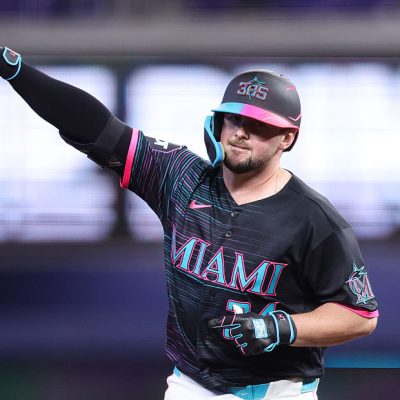
For one, the percentage of the time he swings has gone from 42.8% last year, above league average, to 38.1% this year. Then you take a look at the even more advanced metrics, and it all begins to make more sense.
Nothing stands out more to me than the 6.1% waste swings that he is making. If that sounds like a lot, it is because it is. Especially when you see the league average, according to Fangraphs, sitting at 3.2%.
I then look at where he is hitting the ball and I notice something else.
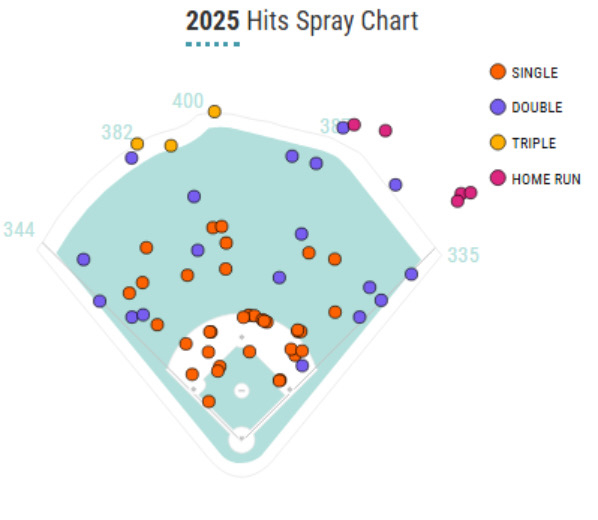
This chart shows his spray chart from last season, where, as you can see, he was doing damage to all fields.
This year, not so much.
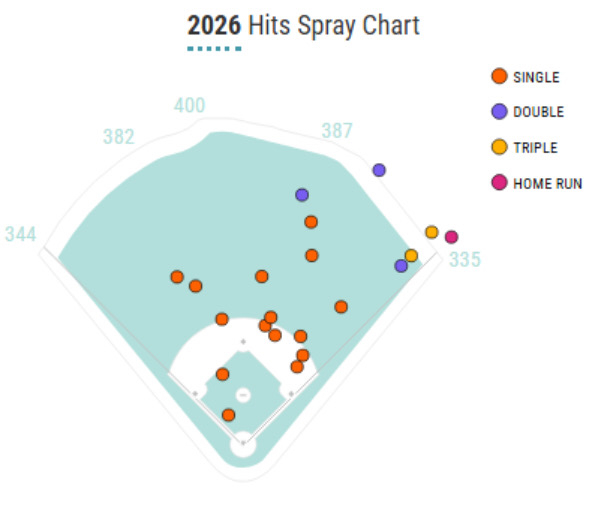
His whole approach has seemingly changed. That becomes even more evident when you look into his positioning in the batter’s box.
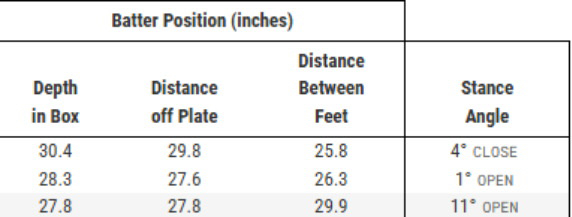
Why is he having trouble identifying pitches? Well, he has cut off two inches of reaction time by moving up in the box the way he has.
Why can’t he make solid contact on pitches on the outer part of the zone? He has also moved 2.2 inches further away from the plate. Surely this means he has adjusted the angle of his body at the plate by closing the front foot to be able to still cover the outside part, right? Wrong.
According to the Statcast data captured by Baseball Savant, Marsee is now pulling the ball by an average of four degrees more than he was last year, which explains the spray chart that much more.
I then wanted to look at a breakdown of his stats per pitch type, and it just became that much more of a headache.
Per Fangraphs Pitch Values breakdown through Statcast data, we are able to see each hitter’s average run value per pitch type. Marsee has a negative run value on every pitch but a curveball (2.5) and a changeup (1.5). The –3.4 on the fastball just seems outrageous, considering this was someone who was well above average against them last season.
I would like to just boil it down to him needing to make better contact, but the issue is clearly bigger than that.
At the end of the day, Marsee just isn’t swinging at strikes, as evidenced by his 5.6% swinging strike percentage.
Can He Break Out of It?
It’s the million dollar question.
In an interview that Marsee did with Just Baseball last year, he was quoted saying:
“I hit the ball hard and was just unlucky at times. I let that spiral, which doesn’t help. This year, if I hit the ball hard and get out, I take it as a win.”
This is the same hitter who, at that time, was seeing a 4.5 mph jump in exit velocity during his hot stretch that got him to the major leaguews last season. In fact, in this article written by Aram Leighton highlighting Marsee’s 2025 breakout, he even identified the exact swing change that allowed him to adjust the plate, leading to the increased hard-hit rate.
When I do deep dives on players’ struggles, as well as those succeeding, I want to look for trends or markers that stand out as a reason as to why they are doing what they are doing.
In the case of Marsee, here are the positives:
- The cut in his swing percentage has allowed him to draw more walks this year, holding his season mark at 13.9%.
- With the increase in walks, he is still getting on base at a good enough clip to utilize his speed at the top of the order, as evidenced by the 10 stolen bases he’s already accumulated.
- The average exit velocity has been relatively similar to his big-league stint last season.
Other than that, it is hard to find a silver lining.
Pulling the ball in the air at a 25.3% clip is not going to do him any favors. He isn’t chasing much out of the zone, holding firm in the 86th percentile, but a ninth-percentile barrel rate, paired with a 31st-percentile hard hit percentage, is going to make for a prolonged slump to continue.
If Marsee is going to return to the same hitter that had Marlins fans holding him at some of the highest regards for a center fielder since Juan Pierre, then he is going to have to start digging back into some of the 2025 film and finding what was working for him.
I know Pedro Guerrero is no longer the hitting coach for the Miami Marlins, but Marsee ultimately found his success in the minor leagues. The infrastructure is still the same. Mike Marjama is still the hitting coach down in Jacksonville. Maybe a call down to him is in order.
Either way, I believe the talent is still in there, and I want to believe that it will make its way back out onto the field.
Become a Member of Just Baseball
Subscribe and upgrade to go ad-free!
* Save 25% by subscribing annually.

Written by
Cristian has been at Just Baseball since 2021, when he first started writing about prospects. He spent eight years working in Major League Baseball with the…