
Is Brice Turang MLB’s New Best Second Baseman?
Building on his 2025 breakout, Brice Turang could soon be considered Major League Baseball's new best second baseman.
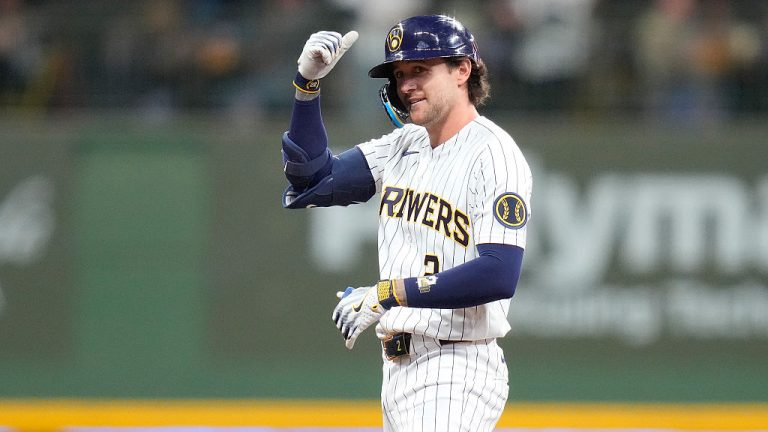
Heading into 2026, the unanimous top second baseman in MLB was Ketel Marte. He has held claim to that title for a couple of years now, as he’s not just one of the game’s best second basemen but one of the best overall players in the sport.
I am not here to strip that title away from him, because at the end of the day his track record at the position is second to none, and it’s going to take a substantial step back for somebody to dethrone Marte at the top of the second base rankings.
When that time comes, however, I do believe that Brice Turang could be the player to supplant him at the top. As Marte works into his mid-30s and Turang enters his prime, the passing of the torch could come sooner rather than later — especially with Turang’s current level of play.
It’s not as if Turang is flying under the radar by any means. He was the starting second baseman for a loaded Team USA in the 2026 World Baseball Classic, and he came into 2026 as a consensus top-five player at the position.
But I’m not sure how many people are aware of just how good Turang has been over the past couple of months dating back to the end of 2025. He ended last season as one of the top players in all of MLB, and he’s carried that momentum right into 2026.
If he can put together another strong campaign this coming year, it could make fans think twice about who to put atop the second base rankings come season’s end.
Steady Development as a Hitter
When Turang broke into MLB for the Milwaukee Brewers, he left a lot to be desired offensively. And that’s putting it lightly.
His 61 wRC+ as a rookie in 2023 was tied for the second-lowest mark in MLB among hitters with at least 400 plate appearances. He followed that up with a more respectable 88 wRC+ in 2024, but he was still hardly making an impact with the bat.
But even with a .665 OPS that year, Turang still managed to post 2.6 fWAR with his ability to impact the game outside of his bat, including stealing 50 bases while winning a Platinum Glove at second base. He had the makings of being a slap-hitting, glove-first speedster, and the Brewers were perfectly content with that type of profile.
What transpired last season is something not many saw coming, and the growth he showed at the plate completely changed the trajectory of his career. Emerging as a focal point in the Brewers’ lineup, Turang’s power surge has taken his game to a whole new level.
Power, Power, and More Power
Turang’s quality of contact has steadily improved with each season. What’s more, he’s managed to increase his impact with the bat without sacrificing the tools that got him to the show in the first place.
It takes a special type of hitter to develop the way Turang has in the power department without straying from the approach that made him a top prospect in the system.
| Barrel % | Hard-Hit % | Average Exit Velocity | wOBA / xwOBA | K% | BB% | |
| 2023 | 2.9% | 27% | 85.5 mph | .262 / .275 | 21% | 8.5% |
| 2024 | 2.4% | 29.7% | 87.0 mph | .294 / .302 | 17% | 8.1% |
| 2025 | 7.9% | 47.4% | 91.1 mph | .346 / .335 | 22.8% | 10% |
| 2026 | 9.7% | 53.2% | 93.2 mph | .406 / .409 | 21.4% | 18.4% |
Across the board, it’s been steady improvements in nearly every aspect of Turang’s batted-ball profile.
Since his rookie season, Turang has added nearly eight ticks to his average exit velocity, going from a measly 85.5 mph (second percentile) in 2023 to 93.2 mph this season (91st percentile). The quality of contact improvements have been noticeable across the board.
After posting a barrel rate below three percent across his first two seasons, Turang posted a barrel rate near eight percent last season and has been above league average in that department in 2026 at 9.7%. The strides in hard-hit rate are staggering, going from one of the worst marks in MLB in 2023 and 2024 to 47.4% last season (76th percentile) and a whopping 53.2% in 2026 (90th percentile).
Over half of the batted balls that Turang has put into play thus far have been over 95 mph; what an incredible achievement given where he was as a hitter this time last year.
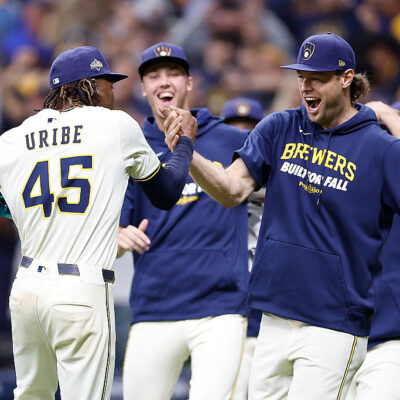
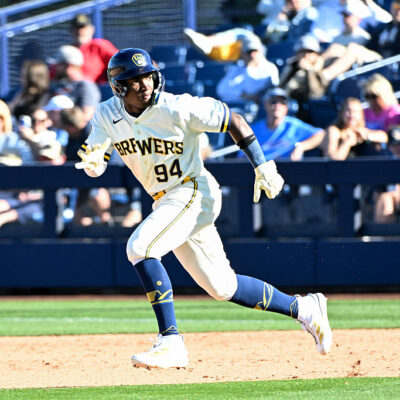
As mentioned, Turang has experienced a power surge without compromising his approach, a feat that is far from easy to achieve.
On top of impacting the ball at a much greater clip, he’s managed to actually drop his punchout rate from last season. He’s also walking at an unbelievable 18.4% clip thus far, a mark that is in the top three percent of MLB. In turn, his .412 on-base percentage is top 10 in all of MLB and fourth in the National League.
His ability to get on base stems from his incredible feel for the strike zone. Turang is currently in the 97th percentile in chase rate, a mark that has gone from 28.4% in 2024 to 23.8% last season all the way to 17.6% in 2026.
Not only is he expanding the strike zone less, but he’s making contact 83.7% of the time. For reference, league average sits at 75%. His wOBA on that contact (wOBACON) sits at .463, the same number as Mike Trout, who has torched baseballs to open his 2026 season.
Turang’s ability to put bat on ball was never in question, but the contact skills blended with this newfound power make him a complete different caliber of hitter. That combination working in tandem with his defense and baserunning is putting him on the fast track to becoming the next best second baseman in the game.
How He Stacks Up Against the Rest
Now for the fun part: where does Turang stack up against other second basemen across MLB, and does he actually have a claim to be at the top of the list? I’ll let you be the judge, but the numbers speak for themselves.
It wasn’t really until the latter half of the 2025 season where Turang put himself on the radar in this discussion. But once the calendar turned to August, no second baseman was better than Turang, and few players across MLB posted better numbers than the Brewers second baseman.
| Brice Turang | 2B Rank / MLB Rank | |
| fWAR | 3.9 | 1st / 4th |
| wRC+ | 168 | 1st / 6th |
| AVG | .309 | 1st / 5th |
| OBP | .403 | 1st / 7th |
| SLG | .560 | 1st / 9th |
| OPS | .963 | 1st / 6th |
| wOBA | .414 | 1st / 6th |
Overall, Turang had a very solid season in 2025. However, I’m not sure how many are aware of just how elite he was after the All-Star break.
Dating back to August 1, 2025, Turang has been the top second baseman in the game, statistically speaking. Not only that, but he has been a top-10 player in the entire sport over that stretch as well.
Since that date, Turang has a higher slugging percentage than players like Matt Olson, Kyle Schwarber, Pete Alonso, Nick Kurtz, among many others. Not to mention he also ranks fifth in batting average over that stretch and top 10 in on-base percentage. It’s that aforementioned blend of contact and power that has unlocked the next level for Turang.
Now, Turang will need to prove that he can sustain that level of play over the course of a full season in order to earn the title of best second baseman in the game. After all, that’s what Ketel Marte has done year in and year out for the past handful of seasons, and that’s what’s made him the consensus top dog at the position.
But the improvements that Turang showed at the tail end of last season have continued into 2026, and if he can maintain that momentum as the season progresses, the sky is the limit for his ceiling.
Expanding the sample size back to the beginning of last season, Turang still grades out as one of the top second basemen in baseball even after his quieter start to 2025, where he posted a 102 wRC+ in the first half.
There was a clear-cut top four heading into 2026 when it comes to the second base position, and the table below stacks all the numbers up against one another dating back to Opening Day of 2025.
| Brice Turang | Ketel Marte | Nico Hoerner | Jazz Chisholm Jr. | |
| FWAR | 5.5 | 4.8 | 6.1 | 4.6 |
| WRC+ | 128 | 137 | 115 | 116 |
| AVG | .287 | .276 | .298 | .234 |
| OBP | .366 | .364 | .351 | .323 |
| SLG | .444 | .497 | .408 | .450 |
| OPS | .811 | .860 | .759 | .773 |
| WOBA | .354 | .370 | .334 | .335 |
It’s important to note that the fWAR totals from above can be slightly misleading given that Turang and Nico Hoerner have roughly 30 more games played than both Marte and Jazz Chisholm Jr. dating back to 2025.
Likewise, on a per-game basis, Marte still outclasses all the names mentioned when it comes to offensive performance. But that gap isn’t as large as some may believe, and Turang even has the advantage in certain categories.
Another element to this conversation is the value that each player brings outside of the bat. When taking into account baserunning and defensive value, that’s where the discussion becomes really interesting.
| Brice Turang | Ketel Marte | Nico Hoerner | Jazz Chisholm | |
| SB | 31 | 4 | 36 | 39 |
| OAA | -1 | 3 | 17 | 11 |
| DRS | 8 | 3 | 21 | 2 |
Statistically speaking, Hoerner blows every other player out of the water. But I do want to make one thing clear: Turang is a far better defender than his -1 OAA suggests.
Tune into any given Brewers game, and Turang is likely making his presence felt at second base, whether it’s turning two or making a game-altering play with the glove. While he might not grade out metrically as elite across the past two seasons, few are as smooth at the position as Turang.
Now, at the end of the day, metrics are king, and Hoerner has been one of the game’s elite defenders since coming into the league. But I would argue that the defensive gap between Hoerner and Turang is not nearly as wide as the advance metrics suggest.
All in all, when taking into account the total package, few can rival what Turang brings to the table on a daily basis.
Final Thoughts
Ever since we here at Just Baseball ranked our top second basemen for 2026 back in the offseason, this is a topic that has stuck with me. While Marte still deserves to be considered the unanimous top second baseman in baseball, there’s a world in which he gets challenged for that title come season’s end.
What’s fascinating is that each player mentioned above brings a unique skillset to the table, making it such a challenging, yet exciting discussion.
For example, Nico Hoerner is one of the game’s elite defenders, is a gifted baserunner, and hardly strikes out, posting a career punchout rate of just 10.9% across eight big-league seasons.
If his early power surge sustains, as was the case with Turang in 2025, it could propel Hoerner into MVP consideration, as this is really the last missing piece to his game.
But for the time being, it feels safe to say that there is no better hitter at second base than Ketel Marte. At the end of the day, this is a player who is coming off back-to-back All-Star appearances at second base and finished third in NL MVP voting in 2024.
Dating back to the beginning of the 2023 season, he’s slashing .281/.365/.512 with an .876 OPS. That type of production at second base is rare, and there’s a reason why he was Just Baseball’s No. 17 overall player heading into 2026. Until proven otherwise, it’s Marte’s position and all other names are vying for second.
With that being said, Turang’s profile is a fascinating blend of the two players just mentioned.
While, statistically speaking, he’s not quite the defender that Hoerner is, he’s still one of the better defenders at the position and can create just as much havoc on the bases. Both Turang and Hoerner have that advantage over Marte.
And when compared to Hoerner offensively, what Turang lacks in the bat-to-ball department he makes up for with pop and slugging ability. The latter sports a punchout rate around 20% but possesses the ability to launch 20-plus homers, while the former is one of the game’s premier contact hitters but doesn’t have nearly the same slugging upside.
At the end of the day, it will be fascinating to see how the contracts of these players all stack up against one another. Marte, 32, signed a six-year, $116.5 million extension back in April of 2025. With incentives, the contract could push close to $150 million, and it replaced the five-year, $76 million deal he signed back in 2022.
Hoerner, 28, inked a deal just as the 2026 season began, agreeing to a six-year extension with Chicago worth $141 million. It was the fourth-largest contact ever handed out to a second baseman, and it could be what Turang uses as a benchmark for when he signs his first multi-year contract.
Turang will remain in arbitration through 2029 and will hit free agency as a 29-year-old pushing 30. An extension before he hits free agency is not off the table, although for a cash-strapped Milwaukee team, that ship has likely sailed.
Nonetheless, Turang is set up for a massive payday when the time comes. And in the meantime, he continues to put together a strong argument for being MLB’s next best second baseman.
Become a Member of Just Baseball
Subscribe and upgrade to go ad-free!
* Save 25% by subscribing annually.

Written by
Joey Peterson is a graduate of the University of Wisconsin-Madison and an editor for Just Baseball. Joey covers the Milwaukee Brewers, along with general MLB topics…