
Parker Messick’s Ace Turn Is Driving the Guardians’ Success
Why is the Guardians lefty off to such a strong start in 2026, and can he keep it up?

The Cleveland Guardians entered the season projected to finish third in the AL Central, yet here they are in first place. They have a knack for finding ways to win even if their roster is not up to par on paper. I guess that’s just the Cleveland way.
While rookie Chase DeLauter has made headlines for his start to the season, it’s a different rookie that I want to highlight today: Parker Messick.
The 2022 second-round selection debuted late last season and caught some eyes with his 2.72 ERA and 2.98 FIP across seven starts. It was a promising start, but not quite a large enough sample to capture the national eye. Well, I think he’s captured everyone’s attention now, especially after nearly completing a no-hitter last week.
Messick has made four starts, pitching to the tune of a 1.05 ERA and 2.50 FIP while striking out 8.77 per nine. A start so good that he leads Cleveland’s pitching staff in fWAR and has been a driver in this team’s success.
So, what has led to this magnificent start to Messick’s career, and is it something the Guardians can count on continuing? Let’s dive in.
How Messick Attacks Hitters
In this era of baseball, the 101 mph fastball is what makes most highlight reels. Velocity has been a focus for some time, and while it is an effective way to attack hitters, it is not the only way. Messick is proving that with each start.
Messick’s fastball sits at 93 mph and won’t confuse anyone with Aroldis Chapman’s. Instead of overpowering hitters, his blend of six pitches darting and dropping keeps hitters guessing and off their barrels, leading to his success.
Through four starts, Messick has used five different pitches at least 10% of the time: a four-seam (35%), changeup (22%), slider (13%), curveball (12%), and slider (10%), with his cutter (7%) being the only pitch used under 10%.
Mixing these pitches and using each in sequence to set up the next has been the strategy. The execution is carried out with stellar command.
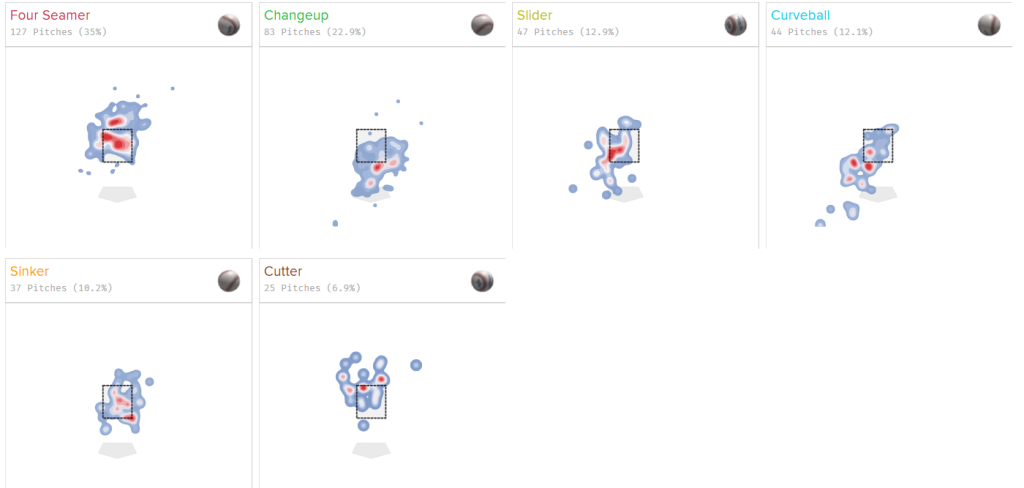
The graphic above shows the heat map of each pitch Messick throws and where they typically land relative to the strike zone. Let’s start with his four-seamer, which he uses just above the zone, not only to produce swing and miss, but more importantly, to change the eye level of the hitter and set up his secondary pitches.
Although the pitch has seen its fair share of contact, it is still producing a 14% whiff rate and only a .133 batting average and .267 slugging percentage. While the movement profile does not stand out, it does come with 16 inches of induced vertical break, which is enough for it to be effective and avoid being a “flat” fastball.
What really propels Messick is how his secondaries play off the fastball. Look at the heat maps again. Small areas of contact, mostly right on the edge of the zone, lead to soft contact. Pitches that come with a tight cluster and an obvious plan of attack. The only way this approach works is with great control, and Messick has it.
When a righty is up to bat, you are going to see the four-seamer high and tight, a changeup low and away, and a curveball as the big breaker. This is also when he breaks out his cutter, which offers similar speed to his four-seamer but more movement.
Against lefties, he leans more on his sinker to set up the slider moving away from the batter and breaking outside of the zone. But, it’s not that cut and dry. Messick sprinkles in his other offerings to keep batters on their toes and off his scent, giving hitters more to think about, leading to guessing.
Because of how well he locates his pitches, they become even more effective. Not only is he getting batter to chase outside of the zone, but the ability to miss the barrel of the bat has led to weak contact and a 50% groundball rate.
If you watch a Messick start, you can tell by the batters’ body language that they are not having comfortable at-bats. With so many pitches and an unpredictable sequence, you truly do not know what is coming next.
While Messick is the one driving the ball, we also need to give some recognition to his caddy, Guardians catcher Austin Hedges.
Hedges has put together a 12-year career despite his .558 OPS over 2,566 plate appearances, and it’s not by happenstance. His value behind the plate is so immense that Cleveland is willing to put an automatic out in the lineup.
Hedges has been used as the primary catcher for Messick and is the brainchild behind his pitch usage and plan to attack hitters. A veteran with amazing baseball knowledge, Hedges not only knows each batter’s tendencies and weaknesses, he also uses cues during each at-bat to adjust his plan and attack accordingly.


What’s Next for Messick?
Anytime a pitcher who is not well established starts hot, the question is always about if he can sustain the pace. Well, I don’t think Messick will have a sub-2.00 ERA for the entire season, but I do think what we are seeing is real.
Messick’s profile is pretty safe: a lefty with good enough stuff to still produce swing and miss with a fallback of soft contact and groundballs. His command has improved, which leads me to believe he’ll continue to be effective and still get batters to chase pitches outside of the zone.
Last season’s seven starts did come with a .762 OPS against righties. Part of that was some unlucky BABIP, but adding a cutter in the offseason should help him neutralize righties a bit more. He has not used the pitch enough to have concrete takeaways, but I’m sure we will see it more over time.
His numbers against righties, although in only 62 plate appearances, have improved to .138/.194/.241 slash. Not only will the cutter help, but his changeup has picked up an extra inch of drop, and he’s getting a 47% whiff rate on the pitch compared to 31% last season.
We aren’t talking about a small sample that comes with a bunch of outlier results, shaky command, and no repeatable ways to win. We are talking about a tough lefty that often executes his team’s strategy and avoids areas of the game that could present a red flag, such as hard contact or long fly balls.
As is the case with most young pitchers, I’m sure your next question will be about innings. Well, good news.
In 2024, Messick threw a total of 133.1 innings between High-A and Double-A, followed by 138.1 innings last season between Triple-A and MLB. Considering the type of arm he is, I expect him to push past 150 this season. If all goes well, there’s no real concern about him being on any type of harsh limit.
Final Thoughts
Cleveland has found a way to churn out great pitchers, and Messick could be the next in that long line of success. Although he is not a household name, per se, he is one of the more enjoyable pitchers to watch. A crafty lefty is an aesthetic that will never go sour.
The Guardians are once again a team that people are not taking seriously enough. I get it, their lineup is not fear-inducing, yet they keep finding wins. A tale as old as time. If they are going to win the AL Central, Messick will be a big reason why.
Become a Member of Just Baseball
Subscribe and upgrade to go ad-free!
* Save 25% by subscribing annually.

Written by