
The Top 15 Relief Pitchers in Major League Baseball for 2026
Some of baseball's most underappreciated stars, and most interesting characters, toe the rubber in late-game, high-leverage situations. These are the top 15 heading into the 2026 campaign.
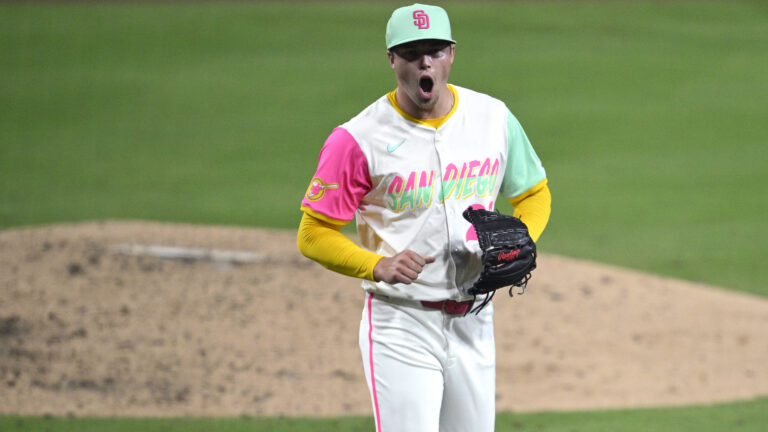
As we continue rolling out our positional rankings for 2026 here at Just Baseball, we now turn to perhaps the most volatile, and fascinating, group in the sport: relief pitchers.
Bullpens are built on razor-thin margins. One bad month can tank a season line, while one dominant stretch can vault a reliever into superstardom. This list is packed with failed starters turned high-leverage monsters, longtime closers chasing Hall of Fame cases, and flamethrowing late bloomers who are just scratching the surface.
Ranking relievers is an annual exercise in embracing chaos. No position group has more year-to-year fluctuation. But based on track record and trajectory, here are Just Baseball’s top 15 relief pitchers in MLB entering 2026.
The voting panel for Just Baseball’s 2026 position rankings comprised of editors Ryan Finkelstein, Leo Morgenstern, Eric Treuden, and Joey Peterson, as well as Just Baseball’s Aram Leighton, Peter Appel, and Jack McMullen.
Each panelist ranked players 1-25 and gave those outside of their top 25 a numerical score of 30. The list below reflects the average of those rankings – the lower the mean score, the better.
15. David Bednar, New York Yankees
- Average Ranking: 15.571
- 2025 Stats: 64 G, 62.2 IP, 2.30 ERA, 2.18 FIP, 1.04 WHIP, 12.35 K/9, 2.73 BB/9
David Bednar’s surface numbers were strong, but the fact his FIP undercut his ERA and BB/9 was sub-3.0 tell a more impressive story than what first meets the eye.
He was solid but not elite to start the year in his final run in Pittsburgh, and after a rough first couple outings in New York, which led to a demotion, Bednar regained command consistency and was awesome down the stretch.
He is four-seamer dominant and that pitch averaged 97 mph with high ride, generating whiffs at the top of the zone, while his curveball (.172 opponent average) works beautifully off that fastball and yet again proved to be his best out pitch.
The splitter was critical against lefties (.175 opponent average), giving him neutral splits and making him matchup-proof late in games. In late August and through September, he claimed the ninth inning and stabilized the Yankees’ bullpen. The combination of swing-and-miss and improved strike efficiency makes this version of Bednar sustainable rather than streak-driven.
14. Matt Brash, Seattle Mariners
- Average Ranking: 14.571
- 2025 Stats: 53 G, 47.1 IP, 2.47 ERA, 3.05 FIP, 1.25 WHIP, 11.03 K/9, 3.42 BB/9
Matt Brash’s value lies in swing-and-miss volatility, but when he’s healthy and on, he is one of the most uncomfortable at-bats in the sport.
His slider is one of the highest-spin breaking balls in baseball, and he allowed just four home runs in 2025, even though it was an injury-shortened campaign in 2025. The 3.05 FIP indicates his ERA was mostly earned, though the 1.25 WHIP and occasional command lapses still create traffic.
What makes Brash dangerous is bat-missing depth. He isn’t pitch-to-contact; he hunts strikeouts. In October environments, that certainly plays. If he trims the walk rate slightly, he solidifies himself as the premier setup man to a guy who will appear later on this list.
13. Griffin Jax, Tampa Bay Rays
- Average Ranking: 13.571
- 2025 Stats: 73 G, 66 IP, 4.23 ERA, 2.51 FIP, 1.29 WHIP, 13.50 K/9, 2.86 BB/9
Griffin Jax is the classic ERA/FIP divergence candidate. His 2025 ERA masks elite bat-missing ability and a strong BB/9. The FIP suggests sequencing and batted-ball variance drove the inflated ERA.
His sweeper (.230 opponent average) and changeup (.182) remain legitimate putaway weapons. Tampa Bay’s usage flexibility adds value, as he can close or bridge. If even modest regression hits, his run prevention should normalize closer to 2024 levels (2.03 ERA). The strikeout foundation is unquestioned.
It’s hard to tell what kind of year the Rays are in for, and the first half of the season could provide a friendly, low-pressure backdrop for Jax as he builds trade value for the deadline. At 31 years old, Jax is as reliable and consistent a veteran as they come in the backend of a bullpen heading into 2026.
12. Trevor Megill, Milwaukee Brewers
- Average Ranking: 12
- 2025 Stats: 50 G, 47 IP, 2.49 ERA, 2.50 FIP, 1.13 WHIP, 11.49 K/9, 3.26 BB/9
Trevor Megill’s profile is power-overwhelm. At 6-foot-8, he releases the ball from a steep plane, pairing 100-101 mph velocity with extension that shortens reaction time. The near-identical ERA and FIP indicate sustainability.
30 saves in limited innings underscore perfect deployment and immense trust in him. He doesn’t generate the same other-wordly strikeout rates relative to peers on this list, but he limits damage and suppresses quality contact. The combination of role security and stable peripherals solidifies his top-12 placement.
11. Jeremiah Estrada, San Diego Padres
- Average Ranking: 11.857
- 2025 Stats: 77 G, 73 IP, 3.45 ERA, 3.55 FIP, 1.16 WHIP, 13.32 K/9, 3.33 BB/9
Jeremiah Estrada’s “chitter” (split-change hybrid) is one of the most unique pitches in baseball, and hitters went 9-for-71 against it with a 48% whiff rate and zero home runs in 2025. That single offering drove his strikeout rate north of 13 per nine.
His 98-100 mph fastball tunnels effectively off the splitter. The ERA sat didn’t pop, but the swing-and-miss and durability indicate reliability in leverage. Few relievers combine volume and bat-missing like Estrada.
10. Abner Uribe, Milwaukee Brewers
- Average Ranking: 11
- 2025 Stats: 75 G, 75.1 IP, 1.67 ERA, 2.75 FIP, 1.04 WHIP, 10.75 K/9, 3.23 BB/9
Abner Uribe’s incredible bounce back was rooted in command and elite homer suppression. His 99-mph sinker produced elite ground-ball numbers, and his slider (.134 opponent average) missed barrels entirely. Only four home runs allowed in 75+ innings was ridiculous.
The 2.75 FIP suggests mild regression potential, largely tied to walk rate volatility. But a 50% ground-ball rate plus strikeouts is a stable formula. At 25, his stuff-driven ceiling rivals just about anyone.
9. Bryan Abreu, Houston Astros
- Average Ranking: 9.429
- 2025 Stats: 70 G, 71.0 IP, 2.28 ERA, 2.39 FIP, 1.15 WHIP, 13.31 K/9, 3.93 BB/9
Three consecutive 100-strikeout seasons out of the bullpen define Bryan Abreu’s underappreciated dominance and reliability as a strikeout artist. The FIP mirrors his ERA, and his durability separates him from many current high-octane arms.
He thrives in multi-inning leverage spots, setting up another name to be featured later on this list. His fastball-slider combination remains elite against both handedness splits. If he ever inherits full-time closing duties, his counting stats would skyrocket.
As a 28-year-old who could be on the trade block as a rental at this year’s deadline, he could potentially be the most sought-after arm, even among starting pitchers.
8. Devin Williams, New York Mets
- Average Ranking: 7.857
- 2025 Stats: 67 G, 62.0 IP, 4.79 ERA, 2.68 FIP, 1.13 WHIP, 13.06 K/9, 3.63 BB/9
Devin Williams’ 2025 ERA spike was driven by sequencing and a few high-leverage blowups. The 2.68 FIP and still-elite strikeout rate show that his stuff, especially the changeup (“The Airbender”) remains devastating. His underlying contact metrics didn’t crater like his run prevention variance did.
His final 19 outings (two earned runs allowed) hint at a complete bounce back in a different New York borough in 2026. With role clarity and health, statistical correction is likely. This is still a guy who has 465 career strikeouts in 297 innings – 14.1 K/9. He was the NL Rookie of the Year in 2020: 27 innings, 8 hits allowed, 1 earned run allowed, 53 Ks and 9 walks.
Reteaming with David Stearns, who ran baseball operations in Milwaukee when he developed, could offer an ideal change of scenery.
7. Josh Hader, Houston Astros
- Average Ranking: 6.714
- 2025 Stats: 48 G, 52.2 IP, 2,05 ERA, 3.25 FIP, 0.85 WHIP, 12.99 K/9, 2.73 BB/9
Even off an injury-shortened campaign, Josh Hader’s dominance remains unmatched. He limits hard contact and consistently suppresses batting average against. His strikeout rate still hovers near elite territory.
Durability questions linger, but when active, he compresses games into eight innings. His track record sustains his placement. Yes, he’s in his 30s, but this is still the guy who pitched to a 1.28 ERA in 2023 with 85 punchouts in 56 innings. And when he “struggled” in 2024, his first year with Houston, he pitched to a 3.50 FIP, WHIP under 1.00 and allowed just 43 hits in 71 innings.
He has 227 career saves, and if he can stay on the mound for another contract or two, the Hall of Fame case will be an intriguing one.
6. Aroldis Chapman, Boston Red Sox
- Average Ranking: 6
- 2025 Stats: 67 G, 61.1 IP, 1.17 ERA, 1.73 FIP, 0.70 WHIP, 12.47 K/9, 2.20 BB/9
Aroldis Chapman’s renaissance was built on improved strike throwing (career-best walk rate of 6.6%) and contact suppression — just 28 hits allowed in 61.1 innings. The velocity remains premium, but command refinement sent him to the moon in 2025, boasting an OPS+ of 351.
Sustaining sub-1.20 ERA numbers in his 38 -year-old season is unlikely, but his peripherals suggest legitimate high-leverage viability remains.
5. Andrés Muñoz, Seattle Mariners
- Average Ranking: 5
- 2025 Stats: 64 G, 62.1 IP, 1.73 ERA, 2.43 FIP, 1.03 WHIP, 11.98 K/9, 4.04 BB/9
Andres Muñoz is a premier fireballer, and his fastball no doubt steals headlines, but it’s his slider (.109 opponent average, 50+% whiff rate) that is among baseball’s most devastating and unhittable offerings. Only two home runs allowed all year against 254 hitters is a testament to his elite barrel suppression.
He has now had four straight years with an ERA+ of 135 or better, and he held opposing hitters to a .493 OPS in 2025.
And, oh yeah, he tossed 8 ⅓ postseason innings, allowing 0 earned runs on two hits. His ability to miss bats without issuing excessive walks pushes him into top-five certainty. This is a guy who could be ranked as the top reliever or at least top three by season’s end.
4. Jhoan Duran, Philadelphia Phillies
- Average Ranking: 4.714
- 2025 Stats: 72 G, 70.0 IP, 2.06 ERA, 2.35 FIP, 1.10 WHIP, 10.29 K/9, 2.44 BB/9
After arriving on the mound after the most electric and most intimidating closing pitcher entrance routine, Jhoan Duran pairs a 100.6 mph average fastball with a 65% ground-ball rate, which is just an uber-rare blend of power and contact control.
After being traded to Philadelphia at the deadline, he struck out 27 and walked just one hitter in 20 innings. This man doesn’t beat himself, and he hardly ever gets beat by a hitter. On September 11, 2025 against the Mets, Duran made a statement against fellow contenders and NL East rivals, the New York Mets. He sat down Juan Soto, Pete Alonso on 11 pitches, striking out the side on some ugly swings.
3. Cade Smith, Cleveland Guardians
- Average Ranking: 3.571
- 2025 Stats: 76 G, 73.2 IP, 2.93 ERA, 1.95 FIP, 1.00 WHIP, 12.71 K/9, 2.32 BB/9
Cade Smith has struck out 207 hitters in 149 career innings while allowing just five total home runs. For a guy who heavily relies on a four-seam fastball, that’s just insane. In 2024, opponents hit .174 against his fastball. In 2025, they hit just .170 against it.
That rare pairing of elite K-rate and extreme long-ball prevention stabilizes his floor, and the FIP under 2.00 compared to an ERA close to 3.00 tells us he should experience some positive regression this year.
He attacks with fearlessness and sequencing maturity beyond his experience. With Emmanuel Clase’s career in severe jeopardy, likely on a path of no return, Smith will be given full-time closing duties in Cleveland, and the numbers, along with the value, could explode.
Barring injury, Smith is on track to join Abreu with three straight 100+ strikeout seasons out of the bullpen.
2. Edwin Diaz, Los Angeles Dodgers
- Average Ranking: 2.143
- 2025 Stats: 62 G, 66.1 IP, 1.63 ERA, 2.28 FIP, 0.87 WHIP, 13.30 K/9, 2.85 BB/9
A three-time All-Star, two-time Trevor Hoffman NL Reliever of the Year, and one-time Mariano Rivera AL Reliever of the Year, Edwin Díaz’s second best season in a Met uniform saw him allow just 37 hits and a .502 OPS in 66 2025 innings.
His fastball regained life, and the slider generated consistent chase. With Los Angeles’ roster depth, his leverage situations should remain high-impact but controlled. It will be interesting to see how Diaz lives up to his gaudy, record-breaking contract in year one with the back-to-back defending champions, as well as dealing with the stress that can come with change of scenery.
Diaz faces a mountain of pressure, but if he can be the guy the Dodgers paid for, he could be the piece to sure up LA’s Death Star and put them over the top as they hunt rarified air with a three-peat.
1. Mason Miller, San Diego Padres
- Average Ranking: 1
- 2025 Stats: 60 G, 61.2 IP, 2.63 ERA, 2.23 FIP, 0.91 WHIP, 15.18 K/9, 4.09 BB/9
Overpowering is an understatement. Mason Miller, AKA “The Reaper” comes at you with a 103-104 mph fastball that never seems to let up at all.
Post-trade to San Diego, he allowed two runs in 23⅓ innings. What’s even more insane is that he held hitters to 4-for-65 with 42 strikeouts and zero extra-base hits after allowing a two-run home run to Lourdes Gurriel Jr. in one of his first appearances with the team.
The top 25 MLB hitters by OPS since 2024 are just 2-for-42 against him with 24 strikeouts. The strikeout rate places him in historic territory, and his home-run suppression during his San Diego stretch suggests maturation beyond pure velocity.
When healthy, no reliever combines strikeout volume, intimidation and damage prevention at Miller’s level. He enters 2026 as the clear No. 1 on this list.
Become a Member of Just Baseball
Subscribe and upgrade to go ad-free!
* Save 25% by subscribing annually.

Written by