
Evaluating the Red Sox’s Acquisition of Caleb Durbin and Where It Leaves Their Offense
Here's a deeper look at how Caleb Durbin fits into a fascinating Red Sox offensive puzzle.
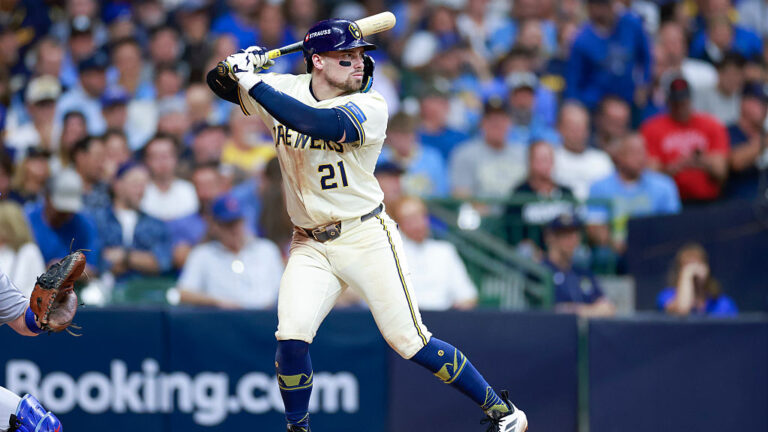
Just hours before Alex Cora was set for his beginning of spring training press conference, the Boston Red Sox solidified their roster with the long-rumored second bat.
To much surprise, the acquisition of choice wasn’t Isaac Paredes, Nico Hoerner or Matt Shaw, three players who had been connected to the Red Sox since former third baseman Alex Bregman departed to Chicago.
Instead, the Red Sox swung a deal for Milwaukee Brewers infielder Caleb Durbin, acquiring him alongside fellow infielders Anthony Seigler and Andruw Monasterio and a compensatory pick for left-handed pitchers Kyle Harrison and Shane Drohan and infielder David Hamilton.
There is a lot to unpack with this trade, but whether this deal is ultimately judged as a success or a failure will rest almost entirely on the shoulders of Durbin and how much he can contribute to the 2026 Red Sox.
Welcome to the Boston Red Sox, Caleb Durbin
A 14th-round pick by the Atlanta Braves, Durbin was dealt twice as a prospect, first to the New York Yankees for Lucas Luetge and then to the Milwaukee Brewers last winter as part of the Devin Williams return.
After beginning the season in the minor leagues, Durbin got the call to the show in the middle of April and quickly entrenched himself as the starting third baseman for MLB’s best regular-season team.
In 136 games, Durbin slashed a solid .256/.334/.387 while playing above-average defense at the hot corner, accounting for a 2.8 bWAR that ranked seventh among rookies.
Like Hoerner, the five-foot-seven Durbin has well-below-average batted-ball metrics but has become an above-average offensive player due to his top-end bat-to-ball skills.
He ranked in the 98th percentile with a 9.9% strikeout rate and the 96th percentile with a 13.0% whiff rate while also posting an above-average 24.6% chase rate.
Because Durbin is elite at putting the ball in play and has the speed to leg out infield singles, he should have a floor of at least an average offensive contributor. What will determine if he can become something more is whether he can maximize his batted-ball profile.
Durbin’s 2026 Outlook
Given that Durbin ranked in the fourth percentile with an 85.2 mph average exit velocity, it may seem surprising that he finished with 11 home runs. The biggest factor for Durbin’s pop was a solid 23.4% pull-air percentage, which ranked in the 67th percentile among all hitters with at least 200 batted balls.
That is a formula that should work well at Fenway Park, and there is reason to believe there is still more power in the tank. His pull-air percentage during his brief stop at Triple-A in 2025 was a whopping 32%, which would have been the third-highest mark in the majors last year behind Paredes and Cal Raleigh.
If Durbin is able to creep his MLB pull-air percentage up near 30%, there’s no reason he can’t hit around 10-15 home runs at Fenway Park despite middling exit velocity numbers.
As a result of his mature approach at the plate, it’s easy to forget that Durbin was a rookie in 2025 and went through the inevitable growing pains.
After slashing .165/.265/.236 with a single home run through his first 30 games, Durbin proceeded to slash .278/.352/.424 from May 21 onward, good for a .776 OPS that topped the marks of both Jarren Duran (.774) and Trevor Story (.740).
This is not to say that Durbin should be depended on to be a top-of-the-order bat, but it does provide hope that he can be an above-average offensive contributor, which, along with plus defender and 20-steal potential, will make him a very valuable player.
Valuable Depth Additions
Though neither of the other two position players the Red Sox acquired are Opening Day roster locks like Durbin, they will each have a chance to contribute to the 2026 club.
Andruw Monasterio
With Rob Refsnyder departing for Seattle, the Red Sox have been in need of another lefty-masher alongside Romy Gonzalez, and Monasterio’s .273/.360/.477 line against southpaws last year indicates that he could help fill the gap.
The 28-year-old Monasterio has unwhelming batted-ball metrics but has a solid idea of what he is doing at the plate, posting an above-average 26.4% chase rate and a tolerable 23.7% strikeout rate.
And while his middling exit velocity numbers prevented him from doing damage, it is worth noting that Monasterio’s 43.6% sweet-spot percentage ranked fourth among players with at least 75 batted-ball events.
Perhaps most important to Monasterio’s chances of big-league playing time is his defensive skills and versatility. He filled in adequately at second base, shortstop, and third base for the Brewers last season and accumulated +6 defensive runs saved (DRS) at second base over parts of three MLB seasons.
The combination of defense and lefty-mashing should push Monasterio ahead of the likes of other potential depth options Brendan Rodgers, Mickey Gasper and Nick Sogard and put him first in line for a call-up if an infielder goes down.
Anthony Seigler
The third and final piece of the Red Sox’s return is Seigler, who actually made the Brewers’ NLDS roster despite slashing just .194/.292/.210 in 34 second-half contests.
This is a testament to his baserunning and defensive versatility, as Seigler has experience at second base, third base, first base and even catcher and swiped 52 stolen bases in his last two minor-league seasons while being caught stealing just seven times.
In terms of his production at the plate, the switch-hitting Seigler used a sharp eye to post a .414 on-base percentage in Triple-A last season, but he will likely need to make more hard contact to earn consistent at-bats at the major-league level.
A Look at Who the Red Sox Sent Out
As far as the package the Red Sox sent to the Brewers, the obvious headliner is Harrison, the former top prospect who was the key return who was in the Rafael Devers trade.
Putting aside the nuanced and convoluted fallout from the Devers trade and Breslow’s comments that he saw Harrison as someone who “can pitch at the top half of a rotation,” it had become pretty evident that the organization didn’t feel as strongly about Harrison as they did about Payton Tolle and Connelly Early.
While both pitchers dominated Triple-A competition and flashed elite upside during their brief MLB stints, Harrison’s performance at Worcester was a mixed bag at best.
Some of his inconsistencies can be attributed to reworking his arsenal in a new system, but many of his issues at Triple-A have also plagued him in the major leagues. He walked 27 batters in 50.1 innings, struggled to work deep into games, and displayed inconsistent command of his fastball.
Though he pitched six crucial innings in a win against the Rays in his Red Sox debut, a rocky performance in his next time out against the Tigers (3 IP, 7 H, 3 R, 3 BB) was a key factor in Early getting the start in Game 3 of the Wild Card Series against the Yankees in place of the injured Lucas Giolito.
Still just 24 years old, Harrison has time to reach his mid-rotation ceiling, but there are enough questions about his command, ability to neutralize right-handed hitters, and the development of his secondary pitches that the Red Sox were comfortable letting the Brewers figure him out instead.
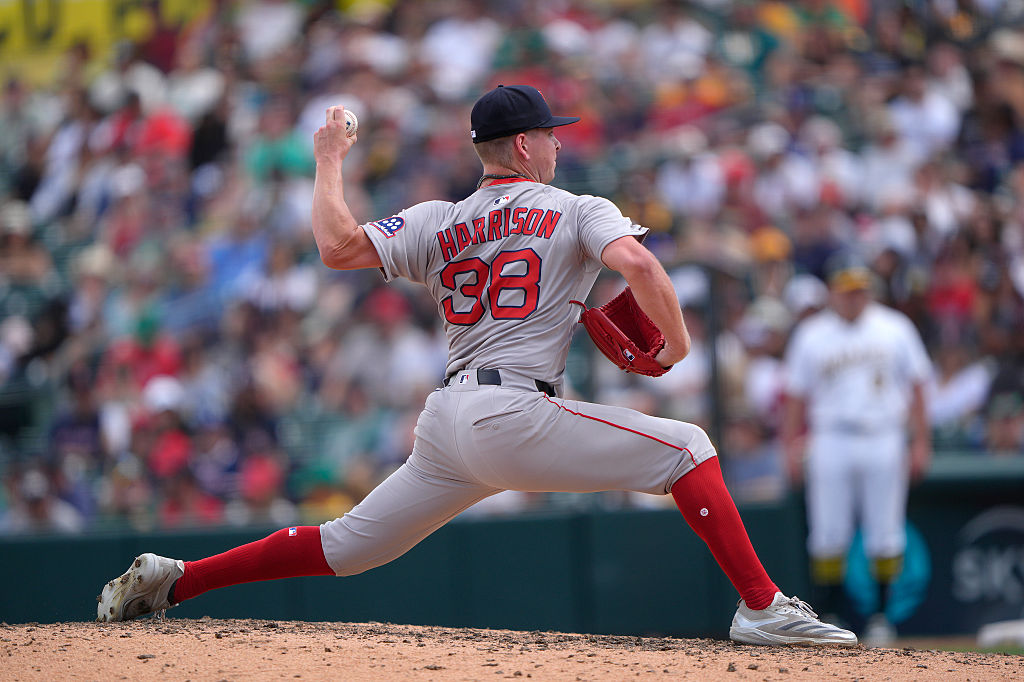
While the future around Harrison is still uncertain, the book on David Hamilton is pretty much written. A dynamic base stealer with true 80-grade speed, Hamilton has struggled to take advantage of clear avenues to playing time due to his struggles at the plate and the field.
His 87.6 mph average exit velocity and 27.8 hard-hit percentage are comfortably below average while his 24.2% strikeout rate and 14.2 degree average launch angle are both much higher than you would like from a speedster.
And though Hamilton rated as an above-average defensive second baseman by outs above average, he committed seven errors in just 157.1 innings and is limited to the keystone thanks to below-average arm strength.
In the era of four-man benches, using a spot on a de facto designated pinch runner is poor roster management, and with an overly left-handed lineup already, it makes sense why the Red Sox would choose to send Hamilton to Milwaukee over the right-handed Nate Eaton and the switch-hitting Nick Sogard.
The final piece of this deal is Drohan, who oddly may have had the clearest path to big-league playing time as a left-handed reliever. The 27-year-old was selected by the White Sox in the 2023 Rule 5 draft but was returned in the following summer after missing the first two months with a shoulder injury.
Fully healthy in 2025, Drohan turned in a dominant performance at Triple-A, posting a 2.27 ERA and striking out 67 batters in 47.2 innings. Drohan throws five pitches that all grade out at least average, headlined by a mid-90s fastball with good shape and a potentially above-average changeup.
When the Red Sox added Drohan to the 40-man roster this winter and traded away Brennan Bernardino and Chris Murphy, it appeared they were positioning him for a possible left-handed reliever role.
In that sense, it was a little surprising to see Drohan traded away, but it is understandable why the Red Sox didn’t want to commit a 40-man spot to a 27-year-old with a lengthy injury history who has never pitched in the big leagues.
Like so many guys the Red Sox traded away this winter, none of these three guys had a realistic pathway to having a consistent and important role on the MLB roster, barring significant injury.
Drohan and Harrison were buried on the starting pitcher depth chart, while Hamilton’s chances of making the Opening Day roster were slammed shut with the acquisition of Isiah Kiner-Falefa.
Each of the three players the Red Sox acquired has a better chance of making an impact at the big-league level in 2026, which makes this trade, in a vacuum, a win for the Red Sox.
Where Does This Trade Leave the Red Sox?
With the presumed last major offensive addition in the books, it’s now fair to take a look at the Red Sox’s lineup as a whole, which means going back to Craig Breslow’s comments from the beginning of the offseason.
”I think that the true middle-of-the-order bat that can hit the ball out of the park, has probably an outsized impact on the rest of the lineup because of the way you have to attack someone — the on-base implications it can have,” Breslow said at the Winter Meetings. “And so, again, we’re going to consider all ways of improving the team, but finding someone in the middle of the order and who hits the ball out of the park is a really good place to start.”
Even the most optimistic of fans would say that the Red Sox came up short on that. The swap of Willson Contreras for Bregman is essentially a wash in the power department, while the only other offensive additions were Kiner-Falefa (84.6 average exit velocity) and Durbin (85.2 average exit velocity)
In response to this, Breslow reasoned that the sequence of events at the beginning of the offseason caused him to go further in the pitching-and-defense direction.
“We work backwards from, ‘We need to put a better team on the field and win more games than we did last year. How do we do that?’ Offense was a fairly obvious one, but preventing runs is another way,” Breslow told reporters after the Isiah Kiner-Falefa signing. “I joked with (hitting coach) Pete (Fatse) that hopefully we’re making his job easier, too, by not putting such demands on the offense.”
While it may be true that leaning into run prevention was the most reasonable pivot after missing out on Bregman, the Red Sox’s failure to land a second big bat in addition to Bregman puts a lot of pressure on the returning players to increase their power production.
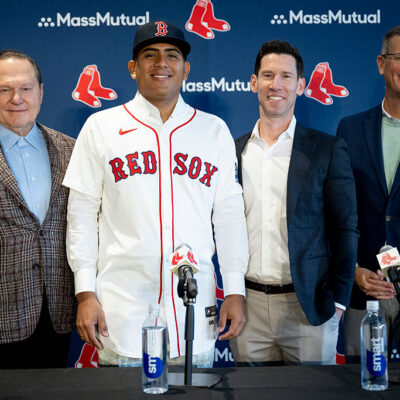
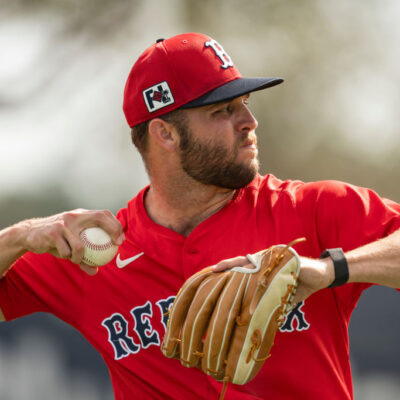
For the Red Sox to improve from what was the 27th-ranked home run offense in the second half of the season, they will depend heavily on the quartet of Roman Anthony, Trevor Story, Wilyer Abreu and Willson Contereas, each of whom comes with their separate concerns.
Though Anthony has all the makings of a future superstar, it’s unreasonable to ask a 22-year-old in his first full MLB season to carry an offense, particularly given his occasional struggles to lift the ball and tap into his pull-side power.
Story was the Red Sox’s leader in home runs last season but averaged just 54 games played over his first three seasons in Boston and ranked in just the 50th percentile in xSLG in 2025.
Abreu has been the player manager Alex Cora has been most prone to identify as a breakout candidate, but he will need to prove he can overcome struggles against lefties (.205/.271/.318) and nagging injuries (77 games missed over the last two seasons) before he can be penciled in as a true middle-of-the-order bat.
And while Contreras’ pull percentage and smooth transition to first base provide hope that he can level up in his first season in Boston, he is still a player who has never played more than 138 games or hit more than 24 home runs in a season.
Part of the reason so many fans were clamoring to sign Pete Alonso was that, for all his faults on defense and the bases, he is arguably the most consistent and dependable power bat in the game.
The Polar Bear has never failed to hit 34 home runs in a non-COVID shortened season and has averaged 37 home runs and a .516 slugging percentage during his seven-year MLB career.
The current Red Sox lineup, meanwhile, has combined for just two 30-homer seasons, both by Story in his Colorado Rockies days. Having to string multiple hits together to score runs leaves them susceptible to scoring droughts when the batted-ball luck isn’t going their way, which will put even more pressure on an overhauled pitching staff to carry the day.
The Red Sox’s revamped defense and incredible pitching depth have them well-positioned to handle the 162-game grind, but it’s hard to see them having enough juice in the lineup to compete with the stacked American League lineups.
Closing Thoughts
Part of the benefit of the Alonso or Vladimir Guerrero Jr. or Aaron Judge or Cal Raleigh is that they take the pressure off the rest of the lineup. The Red Sox don’t have that guy, and their only realistic pathway to having one is a 22-year-old with 71 career games and eight home runs under his belt.
That’s not to say there isn’t a scenario where the aforementioned Big 4, along with a return to form from Triston Casas and steps forward from Carlos Narvaez, Ceddanne Rafaela and Marcelo Mayer, help the Red Sox become a middle-of-the-pack home run team.
The far more likely scenario, however, is that the Red Sox are spending the trade deadline scouring for more offensive firepower, which is a difficult pill to swallow after Breslow’s comments at the beginning of the winter.
Become a Member of Just Baseball
Subscribe and upgrade to go ad-free!
* Save 25% by subscribing annually.

Written by
Daniel Fox is a contributing writer for Just Baseball. He has previously written for Pitcher List, BoSoxInjection, and in the Cape Cod Baseball League. He is…