
How the Threat of 2027’s Labor War Could Haunt the 2026 MLB Season
The 2026 campaign will unfold under a dark cloud, with a labor war looming that could impact decisions made by teams, players and fans.
The 2026 Major League Baseball season hasn’t started yet, but it’s already operating in the shadow of what comes after it ends.
Fans expecting a typical campaign of summer baseball and October drama should prepare for something different — an MLB season where many decisions, contract negotiations, and front office moves will be filtered through the lens of an impending labor catastrophe that could shut down the sport entirely in 2027.
The current collective bargaining agreement governing baseball expires on December 1, 2026. What happens when the clock strikes midnight could determine what America’s pastime will look like on the field and behind the scenes when 2027 arrives. That uneasiness could well poison everything that happens in the months leading up to it.
The Salary Cap Showdown
Baseball owners want a salary cap. The players’ union has already declared that won’t happen. These aren’t negotiating positions. They’re drawn battle lines that both sides insist are non-negotiable.
Consider the financial landscape owners will point to: In 2025, the Los Angeles Dodgers won the World Series with an active roster costing more than $296 million, while the Chicago White Sox finished the year with a roster totaling just over $17 million.
That’s not competitive imbalance. That’s different economic universes operating under the same league banner. The gap between baseball’s biggest and smallest spenders exceeds 10-to-1, dwarfing the disparity in other sports.
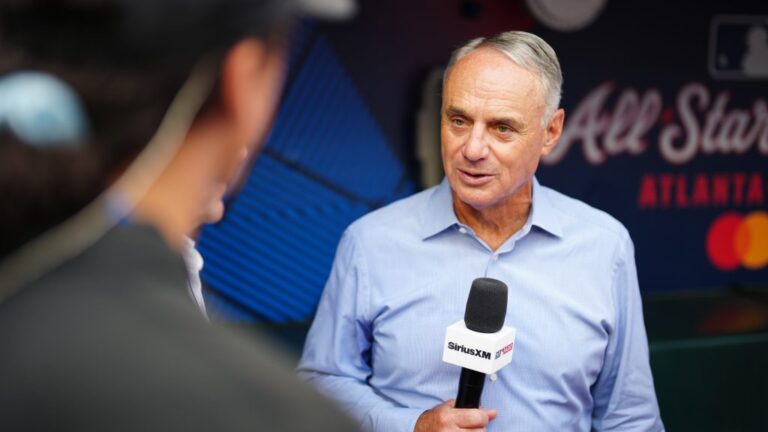
Commissioner Rob Manfred has begun public preparation for conflict, bizarrely praising lockouts over any kind of in-season stoppage — “a .22 caliber firearm as opposed to a shotgun or nuclear weapon,” in his words. That’s not the language of compromise or hope. That’s the language of someone preparing for war.
The players’ association, meanwhile, views salary caps as nothing less than organized theft. Executive director Tony Clark has labeled the push “institutionalized collusion,” and the union’s position is simple: They have watched every other major sport implement caps, and in every case, the players’ share of revenue has steadily eroded afterward. They’re not interested in repeating that mistake inside MLB.
Neither side is bluffing. Both sides believe they cannot afford to lose, and 2026 will unfold in the shadow of that certainty.
The Ripple Effects Start Immediately
Labor uncertainty doesn’t wait politely until negotiations begin. It warps decision-making long before anyone sits down at a bargaining table. Here’s how 2026 will suffer:
MLB Free Agency Continues as a Guessing Game
This offseason, we’re seeing a free agent market that has been slow-moving at best. The front office of the Chicago Cubs reportedly acknowledged structuring contracts deliberately to expire after 2026, positioning themselves to enter whatever new economic reality emerges with maximum flexibility.
Smart teams everywhere could well follow that blueprint, creating bizarre market dynamics. Some elite players will demand long-term security before the storm hits. Others will gamble on one-year deals, betting they’ll command premium prices under whatever system replaces the current one. Front offices will struggle to balance immediate competitive needs against the unknown financial landscape waiting on the other side of December.
Nobody knows what contracts will look like in 2027. That uncertainty will drive every significant financial decision in 2026.
Championship Windows Close in Darkness
Teams with legitimate title aspirations face an impossible calculation. How aggressively should they pursue championships when the entire economic foundation of the sport might fundamentally change in 12 months?
Should MLB contenders mortgage their futures by trading prospects for rental players when they don’t know if those prospects will be worth more or less under a potential salary cap system? Should rebuilding teams accelerate their timelines or wait to see what competitive landscape emerges from the labor battle?
Industry insiders already expect to see unusually aggressive win-now moves precisely because teams want to capture championships before the rules change. That desperation breeds bad decisions — mortgaging sustainable success for immediate gratification that might not even pay off.
The Federal Investigation Wild Card
As if the salary cap battle weren’t complicated enough, the players’ union is currently under federal investigation for alleged financial improprieties that began surfacing in mid-2025. The timing couldn’t be worse.
Players preparing for what their leadership calls an existential fight over salary caps will simultaneously watch their union navigate potential criminal prosecution. That dual crisis creates unprecedented uncertainty about whether the MLBPA can even effectively negotiate, let alone hold firm on core principles.
A federal investigation could explode into public view during the 2026 season, potentially undermining player solidarity at the worst possible moment.
MLB Fans Will Feel the Chill
The psychological impact on baseball’s audience can’t be overstated. Fans investing emotionally and financially in 2026 will do so knowing that everything afterward remains uncertain.
Season ticket renewals become harder sells when buyers know they might not see baseball for an unknown period of time. Corporate sponsors could hesitate to commit long-term dollars when the sport’s immediate future is cloudy. Casual fans who recently rediscovered baseball through exciting postseasons will question whether they want to reinvest only to watch another labor battle shut everything down.
Baseball barely survived canceling the 1994 World Series. The sport spent years recovering lost audience and cultural relevance. In today’s entertainment landscape — where streaming services, video games, and countless other options compete for attention — another prolonged work stoppage might prove fatal to baseball’s mainstream relevance.
The Precedent Offers No Comfort
Baseball’s most recent labor disruption occurred after 2021, when owners locked players out for 99 days before salvaging the 2022 season at the last possible moment. But those negotiations didn’t involve the fundamental question of salary caps, a fight both sides view as worth sacrificing an entire season to win.
It’s completely possible that the entire 2027 season could be lost. That’s not speculation or worst-case scenario thinking. That’s the realistic assessment from people in the industry who understand how deeply entrenched both positions have become.
Even Success Leaves Scars
The optimistic scenario — where both sides miraculously compromise without missing games — still damages 2026. Negotiations intensify during spring training, meaning players will report to camps in February already distracted by December’s looming battle.
Every trade deadline decision will carry the weight of unknown future constraints. Every playoff race will unfold knowing the rules might completely change in weeks. Even the 2026 World Series champion will celebrate with the knowledge that everything could stop immediately afterward.
What 2026 Will Really Mean for MLB
Games will be played. Statistics will be compiled. A champion will be crowned. However, 2026 will fundamentally be a season lived in fear of what comes next, fear of decisions made without complete information, and fear that this might be the last normal season for years.
MLB teams will prioritize short-term wins over sustainable planning. Players will sign contracts without understanding the economic system they’ll operate under next year. Fans will invest in a sport that might vanish for 12 to 18 months the moment the season ends.
Baseball has weathered labor wars before, but each one changed the sport permanently. The 1994 strike cost baseball an entire generation of fans. Another work stoppage in 2027 — following an anxiety-filled 2026 season played under constant threat — could prove even more devastating.
The tragedy is that 2026 should be celebrated. The game is thriving on the field. Young stars are emerging, and veterans such as Mike Trout, Aaron Judge and Nolan Arenado are padding their Hall of Fame resumes. Shohei Ohtani will dazzle once again on the mound and at the plate. None of that will matter, however, if the season plays out as a prelude to disaster rather than a chapter in an ongoing story.
Baseball in 2026 will likely feel like waiting for a storm everyone can see coming, but nobody can stop. Players will grip their bats a little tighter. Owners will count their money a little more carefully. Fans will wonder if they’re watching the last summer before everything changes — or the last summer before everything ends.
That’s not the legacy anyone wants for the 2026 MLB season … but it’s the reality that everyone in baseball must now face.

Written by
A member of the Baseball Writers Association of America (BBWAA), Kevin Henry has been covering MLB and MiLB for nearly two decades. Those assignments have included…